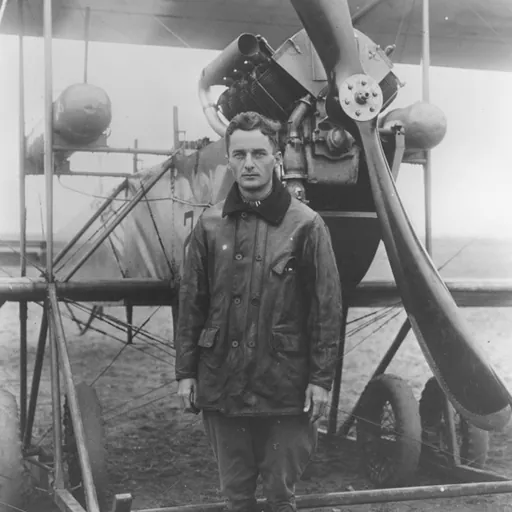
About Townsend F. Dodd
Lived 1886 – 1919 (aged 33). Townsend F. Dodd was an American aircraft pilot.
Townsend Foster Dodd (6 March 1886 – 5 October 1919) was the first commissioned US Army aviator. As a University of Illinois graduate with a Bachelor of Science in electrical engineering, he joined the Coast Artillery Corps and shortly thereafter became an aviator in the US Army Air Service. Dodd sat on many boards of review during the service's infancy and was one of the members who condemned pusher planes in favor of tractors. He served with General John Pershing on the Mexican Border where he set records for endurance flying. During World War I he was first assigned as the aviation officer of the American Expeditionary Force in 1917. He was later replaced by Colonel Billy Mitchell and was reassigned to the Bolling Mission.
He was the first US pilot to receive the Distinguished Service Medal during World War I. Dodd was promoted to colonel on 14 August 1918 and at the end of the war he was appointed the Chief of Staff, Material under Mitchell. Dodd was then posted to Fort Sam Houston at San Antonio. With the completion of the war he reverted to his pre-war rank of captain and became the commander of Langley Field, Hampton, Virginia. After returning home from the war he competed in endurance flight competitions and during one such contest he crashed and died. Nine years after his death Dodd Army Airfield was named in his honor.
Biography Dodd was born on 6 March 1886 to Zachary Taylor Dodd and Ruth Anna Dodd (née McLean) in Illinois. Dodd attended the University of Illinois, from where he graduated in 1907 with a Bachelor of Science in Electrical Engineering degree. Ruth Dodd was one of the Charter Members of the Order of the Eastern Star of Illinois. He was married to St Clair Dodd with whom he had no children.
Military career
Pre-World War I On 25 September 1909, Dodd was commissioned as a second lieutenant in the Coast Artillery Corps. He was transferred to the Aviation Section, Signal Corps in 1912. While there he became a fully qualified military aviator. In the War Department General Order #39, dated 27 May 1913, Dodd was listed as one of the "original military aviators". Promoted to the rank of first lieutenant, Dodd was ordered to join the 1st Aero Squadron at Texas City, Texas, on 9 March 1913. In June Dodd, along with his squadron, transferred to the San Diego Signal Corps Aviation School (now known as Rockwell Field). There he participated in various flight experiments and sat on boards to establish training requirements and aircraft specifications. Dodd qualified as a military aviator on 30 December 1913. The following month, the board drew up specifications for a tractor-configured training airplane. Dodd was involved in the aftermath of a major incident in 1914, which became known as the Goodier Court Martial. The commanding officer of the 1st Aero Squadron's 2nd Company at San Diego, Capt. Lewis E. Goodier, was seriously injured in a demonstration accident on 5 November 1914. Goodier was flying with Glenn L. Martin in a new aircraft when they stalled during a required competitive slow speed test and, when Martin over corrected with too much throttle, went into what was described as the first tailspin. Goodier suffered a nearly severed nose, two broken legs, a re-opened skull fracture, and a severe puncture of his knee from the drive shaft. After a cursory review of the crashes, school commandant Capt. Arthur S. Cowan, dismissed the pilots as "nothing but amateurs". While recuperating, Goodier assisted Dodd and 1st Lt. Walter Taliaferro in an attempt to prefer charges against Cowan for fraudulently collecting flight pay when he was neither certified to fly nor on flying duty. These charges were dismissed as being laid out of malice.
Dodd went with the 1st Aero to Galveston during the Vera Cruz incident in 1914, then to Fort Sill. Following a promotion to captain, Dodd and his observer, Lieutenant S. W. Fitzgerald, won the third annual contest for the Mackay aviation trophy when he descended at North Island after a trip of three hours and three minutes.
On 12 March 1916, Dodd was appointed as a pilot to the 1st Aero Squadron, under General John Pershing's 8th Brigade, which was positioned on the Mexican border. As the pilot of Airplane #44, he and his observer, Captain Benjamin Foulois, made the first reconnaissance flight into Mexico on 15 March 1916. Upon the completion of his work in Mexico he remained with the 1st Aero Squadron and was promoted to major in May 1917. Upon his arrival in Europe in late 1917, Dodd was appointed lieutenant colonel in the Signal Corps. Dodd, however, had been superseded as Aviation Officer by Colonel William Mitchell, who outranked him.
The Bolling Commission (also known as the Bolling Mission and named after Colonel Raynal Bolling, the head of the mission) was an aeronautical commission sent to Europe on behalf of the Aircraft Production Board of the Council of National Defense. Dodd was assigned to the mission, after being replaced as Aviation Officer. His assignment was to evaluate aircraft for use by the AEF, specifically for reconnaissance purposes. Dodd evaluated French aircraft and favored adopting the Salmson two-seater for reconnaissance work. Eventually 705 Salmsons were purchased for the Air Service; of these 557 saw front-line service.
Post-war service Having been promoted to the rank of colonel on 14 August 1918, by the end of the war Dodd was appointed Chief of Staff, Material under Brigadier General Billy Mitchell. Dodd was then posted to Fort Sam Houston at San Antonio where he served as Chief of Materiel and Assistant Chief of Supply, Air Service, and then as G-2, Air Service, First Army. With the completion of the war he reverted to his pre-war rank of captain and became the commander of Langley Field, Hampton, Virginia.
Death and legacy While Dodd was the commander of Langley Field he was killed in an air crash. The crash occurred on 5 October 1919 at Bustleton Field, Philadelphia, during the New York to San Francisco transcontinental air race. Active flight operations were terminated in October 1931, although the official date of closure of Dodd Field as an aviation facility has not been determined.
Don’t just read it —
keep it.
Full-length biographies made to live with: read them, listen on the way to work, watch them tonight.
- E-book
- Audio
- Video
Instant download · yours to keep · every purchase keeps this site free
Important facts
People in Townsend F. Dodd's life
Named in this biography and alive at the same time




Related people
Same field, nearest in time


Contemporaries
People whose lives overlapped Townsend F. Dodd's



Frequently asked questions
Who was Townsend F. Dodd?
First US Pilot of World War I to receive the DSM (1886–1919)
When was Townsend F. Dodd born?
Townsend F. Dodd was born on 6 March 1886 in Anna.
When did Townsend F. Dodd die?
Townsend F. Dodd died on 5 October 1919 in Bustleton.
What was Townsend F. Dodd's occupation?
Townsend F. Dodd was an aircraft pilot.
What nationality was Townsend F. Dodd?
Townsend F. Dodd was American.
Sources & further reading
Cite this page
APA: Biography.guide. (2026). Townsend F. Dodd. https://biography.guide/townsend-f-dodd/
MLA: "Townsend F. Dodd." Biography.guide, https://biography.guide/townsend-f-dodd/.
Chicago: "Townsend F. Dodd." Biography.guide. https://biography.guide/townsend-f-dodd/.
Data last updated: 2026-09-22 · Spot an error? Report a correction.
Portrait: Wikimedia Commons · author & licence
Page generated 2026-09-27 05:03 UTC