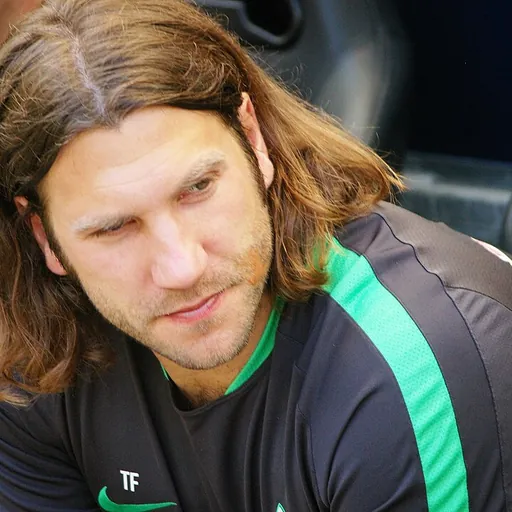
Torsten Frings
German association football player and manager
About Torsten Frings
Born 1976. Torsten Frings is a German association football player and association football coach.
Torsten Klaus Frings (born 22 November 1976) is a German former footballer and manager, who last managed SV Meppen.
A former midfielder, throughout his career he played for several German clubs, namely Alemannia Aachen, Werder Bremen, Borussia Dortmund, and Bayern Munich, before ending his career with Canadian MLS side Toronto FC. At international level, he played 79 matches for the Germany national team since his debut in 2001, and represented his nation at two European Championships and two FIFA World Cups.
Club career Early career His professional career began at third division Alemannia Aachen before a move to Werder Bremen in 1996–97, helping the Weserstadion outfit to a German Cup final defeat of Bayern Munich in 1999 and tallying more than 160 Bundesliga appearances and 15 goals over five and a half seasons. He also helped them win the 1998 UEFA Intertoto Cup, scoring the decisive goal in the final against FK Vojvodina.
Borussia Dortmund In 2002, a number of Europe's leading clubs were on Frings's trail prior to the World Cup but he opted for a four-year deal with Borussia Dortmund for a reported fee of €10 million, penning the contract two games into the competition. A regular in his first term at the Westfalenstadion, Frings also played 12 times in the UEFA Champions League, scoring home and away against Lokomotiv Moscow.
Frings's 2003–04 season only began on 30 January when he played against Schalke 04, his first game since damaging his knee against VfL Bochum in July. He took over from Tomáš Rosický in the playmaking role and scored four times in 16 games before signing a three-year contract with Dortmund's rivals, Bayern Munich.
Bayern Munich Despite winning the domestic double with Bayern and making 29 Bundesliga and ten Champions League appearances, Frings never really enjoyed his football in Munich, and was played out of position by coach Felix Magath.
Werder Bremen
In June 2005, he rejoined Bremen for an undisclosed fee on a three-year deal, helping them past FC Basel into the Champions League group stage.
Toronto FC and retirement
On 29 June 2011, it was announced that Frings had reached an agreement to join Major League Soccer team Toronto FC as a designated player. During the press conference in which Frings was presented to the Toronto media, the club also announced the signing of Danny Koevermans. Frings made his debut for Toronto on 20 July 2011 in a 1–0 home defeat to FC Dallas. On 29 July 2011, Frings made his CONCACAF Champions League debut against Real Estelí in which he was given the honour of wearing the captain's armband for Toronto. Frings became the permanent captain of the club following Maicon Santos's transfer to Dallas. On 27 June 2012, Frings scored his first MLS goal in a 3–0 away victory over Montreal Impact, blasting a free kick in the 52nd minute from 22 yards out. Frings missed the latter portion of the 2012 season after sustaining a hip injury which required arthroscopic surgery. Frings’ subsequent recovery progressed slower than expected, ultimately leading to his decision to retire from football in February 2013. Club president, Kevin Payne indicated that the team wanted to maintain a relationship with Frings "not just for next season, but for seasons to come." Frings himself said he wanted to return to the game as a coach.
International career Frings represented Germany at the 2002 FIFA World Cup in Japan and South Korea, where the German team reached the final, only to be defeated 2–0 by Brazil. During the tournament, he was part of a controversial call when he prevented a goal with his hand on the goal line in the quarter-final match against the United States; the referee deemed the handball involuntary, however.
Following Germany's penalty shootout victory over Argentina on 30 June 2006, Frings was fined and suspended by FIFA for two games (one of which is subject to a six-month probationary period) for his role in the brawl that broke out between the Argentine and German teams after the match. After reviewing video footage of the brawl, FIFA's Disciplinary Committee determined that Frings had punched Argentine forward Julio Cruz and levelled punishment accordingly, even though Cruz himself had denied that Frings punched him; the second game of the suspension was made probationary due to the Committee's determination that Frings had been provoked into fighting. This suspension decision, announced by FIFA only the day before Germany's semi-final versus Italy on 4 July 2006, rendered Frings unavailable for the important match – which Germany subsequently lost; Germany finished the tournament in third place after defeating Portugal in the bronze medal match. He played his last international match on 11 February 2009 in a 0–1 home defeat against Norway. In total, he earned 79 caps for Germany.
Style of play Frings was a versatile midfielder. He played in several midfield positions, although he was most comfortable in the centre, running deep from his own team's box to the opposition's box, due to his work-rate, vision, solid first touch and passing with either foot, despite his lack of notable pace. He was usually deployed as defensive midfielder, however, where he was known for his tackling playing style. In addition to his defensive attributes, Frings was also known for his leadership on the pitch, as well as his explosive, powerful shot from distance. Werder Bremen Ex-CEO Klaus Allofs stated that "he can learn the coaching profession for us from the bottom up." in March 2015.
Darmstadt 98 On 27 December 2016, Frings was appointed as the head coach of Darmstadt 98. Frings took over a team in last place and five points below the relegation playoff spot. Darmstadt 98 finished the 2016–17 season on the last place and was relegated to the 2. Bundesliga. On 9 December 2017, Frings was relieved of his duties as Darmstadt's head coach. His final match was a 1–0 loss to Erzgebirge Aue on 8 December 2017. He finished with a record of nine wins, eight draws, and 19 losses. He was sacked on 14 April 2021.
Personal life Frings is married to Petra and they have two children, Lisa-Katharina and Lena Alina. His hobbies include spending time with his family and riding his motorcycle.
Career statistics Club
International
Scores and results list Germany's goal tally first, score column indicates score after each Frings goal.
Managerial statistics
!!!!!!!!!!!!!!!!
Germany FIFA World Cup runner-up: 2002; third place: 2006 FIFA Confederations Cup third place: 2005 UEFA European Championship runner-up: 2008
Individual kicker Bundesliga Team of the Season: 2001–02, 2003–04, 2005–06, 2006–07
Orders
Don’t just read it —
keep it.
Full-length biographies made to live with: read them, listen on the way to work, watch them tonight.
- E-book
- Audio
- Video
Instant download · yours to keep · every purchase keeps this site free
Important facts
People in Torsten Frings's life
Named in this biography and alive at the same time




Related people
Same field, nearest in time



Contemporaries
People whose lives overlapped Torsten Frings's



Frequently asked questions
Who is Torsten Frings?
German association football player and manager
When was Torsten Frings born?
Torsten Frings was born on 22 November 1976 in Würselen.
What is Torsten Frings's occupation?
Torsten Frings is an association football player and association football coach.
What nationality is Torsten Frings?
Torsten Frings is German.
Sources & further reading
Cite this page
APA: Biography.guide. (2026). Torsten Frings. https://biography.guide/torsten-frings/
MLA: "Torsten Frings." Biography.guide, https://biography.guide/torsten-frings/.
Chicago: "Torsten Frings." Biography.guide. https://biography.guide/torsten-frings/.
Data last updated: 2026-09-20 · Spot an error? Report a correction.
Portrait: Wikimedia Commons · author & licence
Page generated 2026-09-27 04:57 UTC