
About Toramana
Lived 500 – 515. Toramana was a monarch.
Gwalior inscription of Mihirakula Gwalior inscription of Mihirakula in which Toramana is eulogized.
In the Gwalior inscription of Mihirakula, from Gwalior in northern Madhya Pradesh, India, and written in Sanskrit, Toramana is described as:
Eran Boar inscription
The Eran boar (left) on which an inscription relating to Toramana can be found.
The Eran Boar inscription (in Eran, Malwa, 540 km south of New Delhi, state of Madhya Pradesh) of his first regnal year indicates that eastern Malwa was included in his dominion. The Eran Boar inscription was erected in honor of the deity Vishnu as his avatar, Varaha.
The statue is of the deity in form of a boar, with engravings display it protecting rishis and upholding Dharma. Additionally, the statue contains Sanskrit inscriptions inscribed on the neck of the boar, in 8 lines of in Brahmi script. It also records the building of the temple in which the current Varaha image stands, by Dhanyaviṣṇu, the younger brother of the deceased Maharaja Mātṛviṣṇu. The first line of the inscription, made after 484/85 CE mentions the "Maharajadhiraja Toramana" ("The great king of king Toramana") and reads:
Sack of Kausambi The presence of seals in the name of "Toramana" and "Hunaraja" in Kausambi, suggests that the city was probably sacked by the Alkhons under Toramana in 497–500.
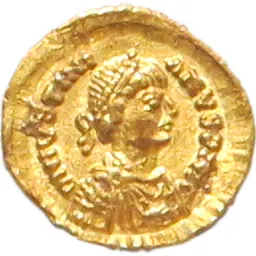
Defeats Coin of Toramana. The initials 12px14px "Tora" in Brahmi script appear in large letters on the reverse, under the solar wheel design. A rare gold coin of Toramana with Lakshmi on the reverse (–515), inspired from contemporary Gupta coins, such as those of Narasimhagupta Baladitya. The obverse legend reads "avanipati torama(no) vijitya vasudham divam jayati": "The lord of the earth, Toramana, having conquered the earth, wins Heaven".
𑀫𑀳𑀸𑀭𑀸𑀚𑀥𑀺𑀭𑀸𑀚 𑀰𑁆𑀭𑀻 𑀢𑁄𑀭𑀫𑀸𑀡 Mahārājadhirāja Shrī Toramāṇa ("Great King of Kings, Lord Toramana"), in the Gupta script, in the Eran boar inscription. On the obverse the date "52" is also inscribed. A modern image: .
According to the Rishtal stone-slab inscription, discovered in 1983, the Aulikara king Prakashadharma of Malwa defeated him in 515 CE.
Toramana may also have been defeated by the Indian Emperor Bhanugupta of the Gupta Empire in 510 A.D. according to the Eran inscription, although the "great battle" to which Bhanagupta participated is not explicited.
A few silver coins of Toramana closely followed the Gupta silver coins. The only difference in the obverse is that the king's head is turned to the left. The reverse retains the fantailed peacock and the legend is almost similar, except the change of name to Toramana Deva.
A Jaina work of the 8th century, the Kuvalayamala states that he lived in Pavvaiya on the bank of the Chandrabhaga and enjoyed the sovereignty of the world.
Successor Toramana was succeeded by his son Mihirakula.
Don’t just read it —
keep it.
Full-length biographies made to live with: read them, listen on the way to work, watch them tonight.
- E-book
- Audio
- Video
Instant download · yours to keep · every purchase keeps this site free
Important facts
Related people
Same field, nearest in time

Frequently asked questions
Who was Toramana?
ruler of the Alchon Huns
When was Toramana born?
Toramana was born in 500.
When did Toramana die?
Toramana died in 515.
What was Toramana's occupation?
Toramana was a monarch.
Sources & further reading
Cite this page
APA: Biography.guide. (2026). Toramana. https://biography.guide/toramana/
MLA: "Toramana." Biography.guide, https://biography.guide/toramana/.
Chicago: "Toramana." Biography.guide. https://biography.guide/toramana/.
Data last updated: 2026-09-20 · Spot an error? Report a correction.
Page generated 2026-09-27 05:27 UTC