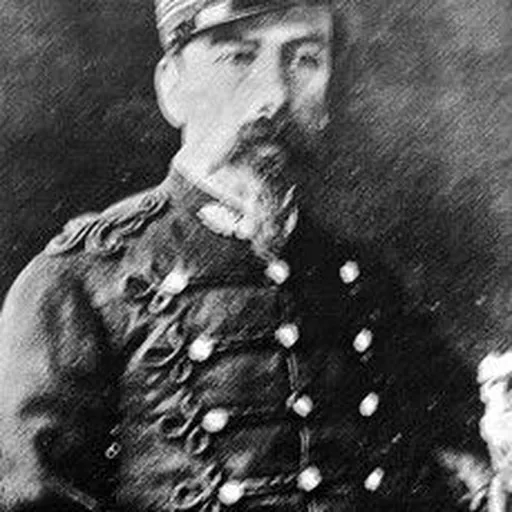
About Tomás Yávar
Lived 1834 – 1881 (aged 46). Tomás Yávar was a Chilean military personnel.
Tomás Segundo Yávar Ruiz de Cabrera (Santiago, December 23, 1834 – Department of Lima, January 13, 1881) was a Chilean cavalry colonel of the Chilean Army who was a war hero of the War of the Pacific before being killed at the Battle of San Juan and Chorrillos.
Early life Tomás was the son of Ramón Yávar Vivanco and María de Dolores Ruiz de Cabrera Morán, he also had two brothers: José Tomás and Germán. His brother, José, followed a military career.
He entered the Military School of the Chilean Army in 1847 at the age of 14, graduating as an ensign in 1851, he was assigned to the cavalry arm of horse grenadiers. In the year of graduation he participated in the Chilean Revolution of 1851 supporting the forces of Manuel Montt, being present in the combats of this period. He was promoted to lieutenant in 1852 and assigned to the Arauco region in the Occupation of Araucanía, he remained in the area until 1868 where with the rank of sergeant major he was commander of Fort Toltén .
He was reassigned to Santiago, in 1874 he was an aide to General and was promoted to lieutenant colonel in 1878, when he took over as effective commander of the corps of Horse Grenadiers .
He married the former nun of the San Vicente de Paul Convent, Hortensia Claudina Urrutia Anguita, with whom he had two children: Hortensia and Rafael.
War of the Pacific The body of Granaderos was transferred in the Matías Cosuiño steamer in 1880, disembarking in the port of Pisagua. He was assigned exploration as an outpost in the towns of Tiliviche, Tana and Sica holding brief skirmishes with remnants of the Bolivian Army. He was assigned to Jazpampa where he was assigned reconnaissance tasks. The Army of Granaderos was then transferred to the Peruvian district of Pacocha, placing itself under the command of General Manuel Baquedano, who was preparing the Tacna and Arica campaign.
Yávar and his troops were sent overland to Ite and from there to Conde under harsh conditions where thirst, lack of water and the harshness of the desert caused deaths and mutinies in the army due to the lack of foresight of the commanders. After the difficult trek, the corps of Granaderos was quartered in Moquehua and later in Locumba.
He participated in the cavalry charges of the Battle of Los Ángeles in March 1880 and the Battle of Tacna in May of that year, which culminated in the taking of the city of Tacna. In that battle, Yávar and his men helped and saved the forces of General Santiago Amengual from certain death who had been left ahead and without ammunition and who were being decimated by Bolivian forces. In November, the Yávar Grenadiers became part of the 2nd Brigade of the Army's First Division, being transferred to Arica in December of that year.
On January 14, he was placed under the command of Patricio Lynch in Paracas and the Lima campaign began, holding skirmishes in Herbay and in the Ate ravine. The Yávar Grenadiers were assigned to Lurín in preparation for the Lima campaign. On January 13, 1881, Colonel Yávar's squads formed an attack front at the foot of Cerro Papa together with Carabineros de Yungay and Cazadores del Desierto under the command of Lieutenant Colonel Emeterio Letelier.
Death Watercolor by Rudolph de Lisle depicting the final moment of Colonel Yávar.
He participated in the cavalry charge during the Battle of San Juan and Chorrillos on January 13, 1881, disbanding the retreat of the Peruvian army in San Juan. He then led the main cavalry charge against Merino's Peruvian forces; Being at the head of his three squads, he headed towards the hills of Chorrillos.
After passing the line of Morro San Juan, he crossed the enemy lines and when crossing some walls he received a shot from close range that was fatal, piercing his left wrist and stomach, whose trajectory ended in his left lung. His horse bolted as he fell from his mount, caught in one of the stirrups, and was dragged and eroded toward the enemy lines.
He was able to be rescued on the run, still alive by his assistants, but due to the seriousness of his injuries and despite the medical care he died at 2:30 p.m. that day. His body was embalmed and transferred to Valparaíso to be buried in Santiago with honors.
Don’t just read it —
keep it.
Full-length biographies made to live with: read them, listen on the way to work, watch them tonight.
- E-book
- Audio
- Video
Instant download · yours to keep · every purchase keeps this site free
Important facts
People in Tomás Yávar's life
Named in this biography and alive at the same time

Related people
Same field, nearest in time


Contemporaries
People whose lives overlapped Tomás Yávar's





Frequently asked questions
Who was Tomás Yávar?
Chilean military personnel (1834-1881)
When was Tomás Yávar born?
Tomás Yávar was born on 23 December 1834 in Santiago.
When did Tomás Yávar die?
Tomás Yávar died on 13 January 1881 in Battle of San Juan and Chorrillos.
What was Tomás Yávar's occupation?
Tomás Yávar was a military personnel.
What nationality was Tomás Yávar?
Tomás Yávar was Chilean.
Sources & further reading
Cite this page
APA: Biography.guide. (2026). Tomás Yávar. https://biography.guide/tomas-yavar/
MLA: "Tomás Yávar." Biography.guide, https://biography.guide/tomas-yavar/.
Chicago: "Tomás Yávar." Biography.guide. https://biography.guide/tomas-yavar/.
Data last updated: 2026-09-21 · Spot an error? Report a correction.
Portrait: Wikimedia Commons · author & licence
Page generated 2026-09-27 05:01 UTC