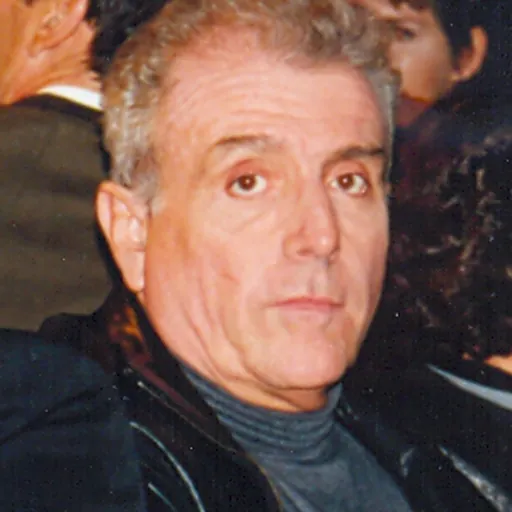
About Tomás Vidiella
Lived 1937 – 2021 (aged 83). Tomás Vidiella was a Chilean actor, film actor, television actor, theatre director and cultural manager.
Tomás Humberto Eduardo Vidiella Baigorrotegui (26 October 1937 – 10 March 2021) was a Chilean actor, theatre director, and cultural manager.
He is notable for his long and broad artistic career. He was the founder of the theater companies El Túnel (1970), Hollywood (1976), Anfiteatro Lo Castillo (1980) and El Conventillo (1983), along with his sister Eliana Vidiella. He is considered the father of café-concert in Chile, which he helped forge and develop with remarkable success in the 1970s and 1980s.
In theater he acted and collaborated in various and successful plays, with national and international tours, such as Cabaret Bijoux and Viejos de mierda. While on television he is recognized for his roles of character and interpretive strength, in titles such as La torre 10, La villa, Amor a domicilio, Fuera de control, Sabor a ti and his magisterial antagonistic role in Montecristo. In cinema he stand out in films such as El nominado (2003), Cachimba (2004) and La memoria de mi padre (2017)
Biography Vidiella alongside fellow actors Patricio Achurra, Rodolfo Bravo, Willy Semler, Aldo Parodi, Cristián Campos, Romeo Singer, among others, at the 2000 Viña del Mar International Film Festival.
He was the son of Tomás Vidiella Sánchez and Lina Elvira Baigorrotegui de la Barra. He had a sister named Eliana Vidiella, also an actress. In his childhood he lived in a wealthy family in the Lastarria neighborhood of Santiago. He studied at the San José Patrocinio and later at the Barros Arana National Boarding School. Later, he performed at the School of Theater at the University of Chile. Of his generation, 36 students entered the theater and only four graduated, among them Víctor Jara, Alejandro Sieveking, Luis Barahona and him. Later, with Víctor Jara and Alejandro Sieveking they made a tour of Latin America and when they were in Mexico, after six months, they fought before leaving for Spain. So Vidiella returned to Chile, sold her clothes and his record player, and left for New York with $200.
Upon his return he soon stood out, especially as a creative, manager and entrepreneur of the show. He brought to Chile the concept of the café concert, which he developed with total success. And he opened nine theaters, while still performing. His sister, Eliana, supported him in the administration of his premises, reaching great success in the 70s and 80s. The first show of this genre in Chile was orchestrated by Vidiella together with the actors Alejandro Cohen and Pina Brandt, thus premiering Hagamos el amor in 1971 at the El Túnel Theater.
Already in 1961 the interpreter had his first appearance in the Chilean fotonovela, in the magazine Cine Amor in El que volvió, directed by Eduardo Naveda. Vidiella first appeared on a cover in 1962 with El Milagro.
His El Túnel Theater company was the first to premiere a work by Isabel Allende in 1973, with Balada de medio pelo and with the performance of Valentín Trujillo. In 1975, Vidiella made her debut at the Chilean-French Institute of Culture with the play Los siete espejos, written by Allende and Francisco Flores del Campo.
In 1976, he played the second transforming character in the Chilean theater, after Travesti por mi abuela (1971) by Eduardo Soto, playing "Lulú" in the play Cabaret Bijoux, which became a success and over time came to be presented in Valparaíso, Osorno, Concepción, Arica, Puerto Montt and Valdivia. Famous actresses such as Sonia Viveros and Silvia Piñeiro took part in it.
On television, he was one of the first gallants of the Dramatic Area of National Television of Chile hired by the Executive Director, Sonia Fuchs, thus standing out in telenovelas such as La torre 10, along with Sonia Viveros and young Javiera Parada, and in La Villa. He also contributed his experience as a mature actor in several Channel 13 productions in the 1990s, with titles such as Amor a domicilio, Fuera de control, Sabor a tí, among others. In 2006 he masterfully antagonized the telenovela Montecristo, by Megavisión.
As a cultural manager and producer, he stands out as founder of the theaters El Túnel (1970), Hollywood (1976), Anfiteatro Lo Castillo (1980) and El Conventillo (1983). He has acted and directed in Mrs. Warren's Profession (2002) and Los Chinos (2002).
With the work Parecido a la felicidad, he toured La Havana, Caracas, Bogotá, Guatemala, San José and Mexico City. He has also toured in Buenos Aires with Las Sirvientas, Fausto Shock and Los Chinos.
In 2001, Vidiella was awarded the Award of the Association of Journalists of Shows, Art and Culture of Chile (APES) for Best Theater Actor in 2001 for Largo viaje del día hacia la noche.
Regarding cinema, his performances in El nominado (2003), Cachimba (2004) and La memoria de mi padre (2017) stand out. In the latter, along with Jaime McManus, directed by Rodrigo Bacigalupe. His performance was the winner of the Best Actor Award at the Santiago International Film Festival.
In the theater field, he stood out in his last years mainly with the play Viejos de Mierda (2015–2021), a delirious comedy written and directed by Rodrigo Bastidas, where Vidiella shared roles with comedian Coco Legrand and Jaime Vadell.
In 2018, he received a tribute from the Actors Union of Chile to his career. On 26 February 2021, two weeks before his death, ChileActores awarded him with a Caleuche Lifetime Achievement Award for his exceptional work in the performing arts. The actor said that: “I have made a career out of love, because theater is very important for the life of human beings”.
Death On 5 March 2021, Vidiella was hospitalized at the UC Christus Clinic after contracting COVID-19, just days after it was confirmed that Cristián Campos, his co-star in the play Orquesta de Señoritas, also tested positive. In turn, all the rest of team members also underwent a preventive quarantine including stars such as Luis Gnecco, Willy Semler and Mauricio Pesutic.
On 9 March, his friend and actor, Jaime Vadell, indicated that Vidiella was in good health, and they even communicated by phone on 6 March. Despite this, the actor remained connected to a mechanical ventilator since 7 March, finally dying three days later of complications related to COVID-19 during the COVID-19 pandemic in Chile.
Filmography Films Year Produccion Character Director 1973 Antonio Claudio Guzmán 1998 El entusiasmo Canoso Ricardo Larraín 2003 The Chosen One Mañungo Eyzaguirre Ignacio Argiró & Gabriel López 2004 Cachimba Marcel Silvio Caiozzi 2009 Teresa Antonio Balmaceda Tatiana Gaviola 2011 Dios me libre Óscar Cifuentes Martín Duplaquet 2012 Educación Física Padre de Exequiel Pablo Cerda 2013 Oranch Pablo Lagos 2015 Sendero Gustavo Lucio A. Rojas 2017 La memoria de mi padre Jesús Rodrigo Bacigalupe 2021 Un loco matrimonio en cuarentena Hugo Espíndola Rodrigo Bastidas
Telenovelas
TV Series Year Produccion Role Channel 1978 El show de Tomás Vidiella Él mismo Canal 9 U 1980 Tres veces amor Dr. Ismael Flores TVN 1996 Amor a domicilio, la comedia Gaspar Encina Canal 13 2003 La vida es una lotería Gregorio TVN 2004 Tiempo final: en tiempo real Héctor TVN 2010 Cartas de mujer Luis Alberto Chilevisión 2015 Fabulosas Flores Leopoldo Ramos La Red 2017 Lo que callamos las mujeres Chilevisión
Don’t just read it —
keep it.
Full-length biographies made to live with: read them, listen on the way to work, watch them tonight.
- E-book
- Audio
- Video
Instant download · yours to keep · every purchase keeps this site free
Important facts
People in Tomás Vidiella's life
Named in this biography and alive at the same time





Related people
Same field, nearest in time




Contemporaries
People whose lives overlapped Tomás Vidiella's


Frequently asked questions
Who was Tomás Vidiella?
Chilean actor (1937–2021)
When was Tomás Vidiella born?
Tomás Vidiella was born on 26 October 1937 in Santiago.
When did Tomás Vidiella die?
Tomás Vidiella died on 10 March 2021 in Santiago.
What was Tomás Vidiella's occupation?
Tomás Vidiella was an actor, film actor, television actor, theatre director and cultural manager.
What nationality was Tomás Vidiella?
Tomás Vidiella was Chilean.
Sources & further reading
Cite this page
APA: Biography.guide. (2026). Tomás Vidiella. https://biography.guide/tomas-vidiella/
MLA: "Tomás Vidiella." Biography.guide, https://biography.guide/tomas-vidiella/.
Chicago: "Tomás Vidiella." Biography.guide. https://biography.guide/tomas-vidiella/.
Data last updated: 2026-09-22 · Spot an error? Report a correction.
Page generated 2026-09-27 05:10 UTC