
About Tomáš Kubík
Born 1977. Tomáš Kubík is a Czech painter.
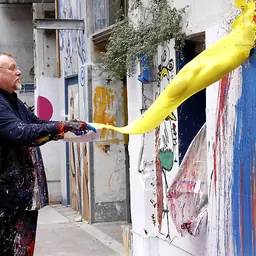
Tomáš Kubík (born 15 October 1977) is a Czech painter. He is graduate of the Studio of Classical Painting Techniques of Prof. Zdeněk Beran at the Academy of Fine Arts in Prague. Formerly, he was also active in dance and movement theatre, played the flute and worked as a teacher at a private painting school he co-founded.
Life Tomáš Kubík comes from a family of an artist, advertising graphic designer and director of the local cultural centre in Pelhřimov, who led both his sons to visual arts and music. After finishing primary school he attended the Václav Hollar Art School in Prague in 1992–1996, where he mastered graphic techniques, modelling and photography in addition to drawing and painting. He went to copy masterpieces at the National Gallery and painted landscapes in the open air with his classmate Zdeněk Daňek.
During his studies, Tomáš Kubík was already recognised as an exceptional talent when in his second year he received the Atelier Prize and the academyRector's Prize (1998) and in 2000 the Minister of Education's prize for exceptional achievements in painting. In the same year, he succeeded in the competition for a representative portrait of Karel Malý for the portrait gallery of the rectors of Charles University in Karolinum. His painting Scenes from Married Life was purchased by the National Gallery in Prague in 2004. Paintings from his first foreign exhibition in the USA (2002), which received excellent reviews in the local press, were sold off to private collections.
After graduating from the academy, he became active in Dance and movement theatre but never abandoned painting and painted smaller formats, portrait commissions, illustrations and storyboards/comics for advertising and film agencies. He later used his experience with digital painting and its combination with photomontage (matte painting) to prepare compositions in the Michelangelo project.
In 2017 he got married and in 2019 his son Nicholas was born. Tomáš Kubík also works as a teacher of painting. In 2010, he began taking students for individual painting lessons in his studio and in 2012 he co-founded an art school in Prague 1, which he ran until 2018. At that time, he left his shares to his partner so that he could devote himself entirely to painting.
Tomáš Kubík's first participation in a competition organised by the Royal Society of Portrait Painters in London brought him a special Award for Classically Inspired Portraiture (Highly Commended) from Burke's Peerage Foundation in 2021 for his portrait of David in the Renaissance style. The jury also selected another portrait by Kubík, Valeria, for the competition. In 2021, Kubík's painting Inner Rage was selected for the European Museum of Modern Art'''s (MEAM) annual show in Barcelona, Figurativas 2021.
Awards 1998 Atelier Prize and the AVU Rector's Prize 2000 Minister of Education's prize 2021 Burke's Peerage Foundation Award for Classically Inspired Portraiture
Work During his studies at secondary school, Tomáš Kubík painted en plein air and gravitated towards impressionist painting. In his first year at the academy, he devoted himself mostly to still life painting, and in his first series of paintings, which began originally in a post-impressionist style after Cézanne, he switched to realistic Trompe-l'œil painting as the arranged apples gradually deteriorated. Eventually, a series of five still lifes with apples and compotes on a checkered wool blanket, entitled "Study of Decomposition" (1997), was created on this theme. His veristic still lifes depict mostly quite ordinary objects, such as a dry aloe in a pot (Still Life with Cactus, 1997) or bunches of onions (Onions I and II, 1997, 1998), entirely in keeping with the aesthetic advocated by Prof. Beran.
Foreign travels and immediate impressions of paintings by Rembrandt, Caravaggio or Michelangelo, as well as the Belvedere Torso, were a significant inspiration for his own work. The marble Greek torso from the first century BC influenced generations of artists, starting with the Italian Renaissance, with its perfection (Tomáš Kubík, Belvedere Torso I, from the series "Michelangelo Project", 2020).
Kubík moved on to portrait painting with an extensive series of portrait studies of his expressions in the mirror, which he eventually translated into the "group self-portrait" Clone (1998-1999), in which he repeats the self-portrait several times in a kind of deaf-mute flurry, studying his own face in a complex lighting regime. Here he applied Rembrandt's psychologization of figures, Caravaggio's chiaroscuro and the attention to detail and imitation of folk types characteristic of Dutch paintings. Kubík's figurative painting is characterised by the contrast between neo-Baroque theatricality and the psychological uncertainty or ironic self-examination of figures reacting to the outside world. Kubík enjoys multi-figural compositions, where he can use his technical skills and individual characterization of figures previously studied in preparatory sketches in the studio (Dinner in the Jordaens Style, 1998–1999, The Four Wise Men, 1999).
In Portrait Document in the Renaissance Style, a series of paintings from 2020 to 2021, inspired by the early Renaissance portrait paintings of Albrecht Dürer and Hans Holbein, he creates sets of portraits of his contemporaries that would ultimately serve as a kind of time-lapse document. Two portraits from this series (David in Renaissance Style, 2020, Valeria, 2021 ) were selected for a competition held by The Royal Society of Portrait Painters in London, and the first of these won the Burke's Peerage Foundation award.
In the series Death and the Girl (2018), he used a white plaster cast of a face as a model which allows him to study the subtle nuances of relief under different lighting. This is a traditional academic discipline that introduced students to the ancient heritage and grisaille drawing technique. Yet the model itself evokes the tension between the impersonal plaster and the emotionally charged, romantic subject matter.
Tomáš Kubík often inserts some extraneous details into paintings, that are inspired by classical paintings and created with the same technique, to make it clear that they are contemporary works. Michelangelo's idealised male nudes from the ceiling of the Sistine Chapel, called Ignudi, served as compositional models for his hyperrealistic male nudes. To portray them, he somewhat provocatively chose contemporary human types from the fitness centre, with pronounced musculature, tattoos and uniformly tanned skin from the solarium. In doing so, the painter had to transpose the original mannerist composition, intended for the ceiling, into a real, believable and unobtrusive position.
Collective (selection) 1997 Panorama of Mannerism, Galerie U prstenu, Prague 1997/1998 The Last Picture, Rudolfinum Gallery, Prague 2000/2001 Současná minulost. Czech Postmodern Modernism 1960-2000, Alšova jihočeská galerie v Hluboká nad Vltavou, Regional Gallery of Highlands, Jihlava 2003 Academy of Fine Arts: Intermedia School of Professor Milan Knížák, Wortner House of the Alš South Bohemian Gallery, České Budějovice 2003 Nejmladší / The youngest: Přehlídka výmladného umění nejmladší generace z let 1995 - 2003 (Exhibition of the youngest Generation Art from 1995 - 2003), Veletržní palác, Praha 2004 Diplomanti AVU 2004, AVU Modern Gallery, Prague 2005 Easter, U prstenu Gallery, Prague 2005 Prague Studios, New Town Hall Gallery, Prague 2006 IV. Zlín Salon of the Young 2017 Fascinace skutečností: Hyperrealismus v české malbě / Fascination with Reality: Hyperrealism in Czech Painting, Museum of Art Olomouc - Museum of Modern Art, Olomouc 2019 Artista Art Spoon, Villa Baruchello, Porto Sant'Elpidio, Italy 2019-2020 Figurativas, MEAM Museum, Barcelona 2019-2020 It's Already the Worst, Galerie 90°, Černošice 2020 LA Art Show, Los Angeles, USA 2021 Royal Society of Portrait Painters Annual Exhibition, London, UK 2021 Figurativas 2021'', MEAM Museum, Barcelona
Don’t just read it —
keep it.
Full-length biographies made to live with: read them, listen on the way to work, watch them tonight.
- E-book
- Audio
- Video
Instant download · yours to keep · every purchase keeps this site free
Important facts
People in Tomáš Kubík's life
Named in this biography and alive at the same time
Related people
Same field, nearest in time



Contemporaries
People whose lives overlapped Tomáš Kubík's





Frequently asked questions
Who is Tomáš Kubík?
Czech painter
When was Tomáš Kubík born?
Tomáš Kubík was born on 15 October 1977 in Pelhřimov.
What is Tomáš Kubík's occupation?
Tomáš Kubík is a painter.
What nationality is Tomáš Kubík?
Tomáš Kubík is Czech.
Sources & further reading
· DBpedia: Tomáš Kubík (painter)
Cite this page
APA: Biography.guide. (2026). Tomáš Kubík. https://biography.guide/tomas-kubik/
MLA: "Tomáš Kubík." Biography.guide, https://biography.guide/tomas-kubik/.
Chicago: "Tomáš Kubík." Biography.guide. https://biography.guide/tomas-kubik/.
Data last updated: 2026-09-20 · Spot an error? Report a correction.
Page generated 2026-09-27 05:30 UTC