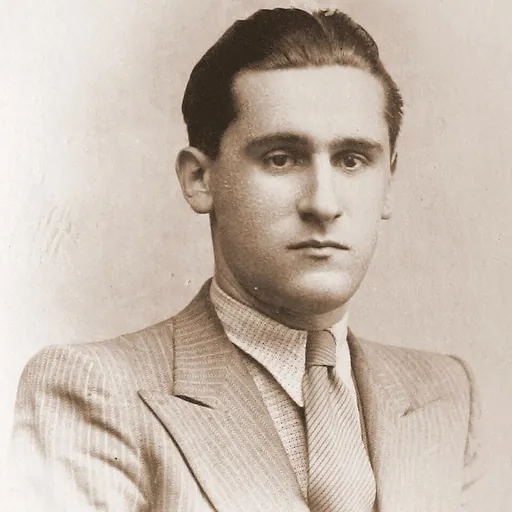
About Toma Barbu Socolescu
Lived 1909 – 1977 (aged 68). Toma Barbu Socolescu was a Romanian architect and professor.
(born July 10, 1909, in Ploiești, Romania, and died July 21, 1977, in Bucharest, Romania) was a Romanian architect, son of Toma T. Socolescu and grandson of Toma N. Socolescu. A functionalist against his will, he was compelled to conform to the directives of communist Romania.
Biography alt=Drawing of (fontains) – 1st mention at Delaon Prize in 1938. Drawing of (fontains) – 1st mention at Delaon Prize in 1938.
He was awarded two third-place medals, in construction and ornamental drawing, and later, in the first class from November 4, 1936, he received a second-place medal for a rendered project.
Graduated in architecture from the École nationale supérieure des beaux-arts of Paris in 1939, he was admitted to the 2nd class on July 10, 1934, winning two 3rd medals in construction and ornamental design, then to the 1st class on November 4, 1936, winning a 2nd medal for a submitted design. in Roger-Henri Expert's studio.
His first steps were taken alongside his father , in the 1940s, with whom he worked on several projects in the : plans for a locomotive depot in as well as the urban development plans for Câmpina and Mizil. His first position was as a university assistant at the Ion Mincu Institute of Architecture (Bucharest) in 1939, a post he held until 1951. From 1942 to 1945, he was Design Architect at the C.A.M , a position he would still assume from 1949 to 1951 at the IPC (Institute of Design and Construction). From 1952 to 1958, he was chief design architect at the Institute of Design for Industrial Constructions (IPCI), while also working externally for the Ministry of Local Economy, alt=Drawing of (gardens) - 1st mention at Delaon Prize in 1938.
Architectural contests
1937: First prize for the sketch competition on a casino project decided by the Astra Română rafinery, in Ploiești, co-designed with his father . April 1938: 1st mention at concours Paul Delaon, Paris. 1964: Award of the Architecture and Building State Commission for the canned vegetables factory of Ovidiu, Constanța County. since 1939. sister of Prince Antonie-Vodă. was recognized by as his illegitimate daughter, following an extra-marital liaison with . is buried in the church of Răzvadu de Sus, where, on a richly carved stone slab, her name can be read.
Nicolae Iorga, the great Romanian historian and friend of Barbu's father Toma T. Socolescu, found ancestors among the founders of the City of in the 12th century. In 1655, the Prince of Transylvania George II Rákóczi ennobled an ancestor of Nicolae G. Socol: ", and through him his wife , his son , and their heirs and descendants of whatever sex, to be treated and regarded as true and undeniable NOBLEMEN.", in gratitude for his services as the Prince's courier in the Carpathians, a function "which he fulfilled faithfully and steadfastly for many years, and especially in these stormy times [...]". Around 1846, five come to Muntenia, from , in the territory of . One of the brothers was architect Nicolae Gh. Socol (??-1872). He settled in around 1840-1845, and named himself . He married , from the suburb. He had a daughter (died in infancy) and four sons, two of whom became major architects: Toma N. Socolescu and . The lineage of architects continues with Toma T. Socolescu, and his son Barbu Socolescu.
The historian, cartographer and geographer evokes, in 1891, the presence of Romanian boyars of the first rank , in Bucharest, descendants of from . Finally, Constantin Stan also refers, in 1928, to the precise origin of Nicolae Gheorghe Socol :
Architectural achievements
Interior decoration of the liner Normandie in 1936, under the direction of professor of architecture Roger-Henri Expert. Several other industrial buildings until 1966, including the large Ovidiu vegetable canning factory (later Munca Ovidiu) at Ovidiu near Constanța in 1962. The entire factory has been emptied of its machine tools, and only the building and its metal structures remain clearly recognizable (in April 2024), despite extensions and modifications. It is located in a square bounded by the and the .
Conceived but unimplemented architectural projects Sketch of a casino project for the Astra Româna refinery, Ploiești, Romania, 1937. Astra Refinery Casino, Ploiești, carried out with his father, Toma T. Socolescu, in 1937.
Don’t just read it —
keep it.
Full-length biographies made to live with: read them, listen on the way to work, watch them tonight.
- E-book
- Audio
- Video
Instant download · yours to keep · every purchase keeps this site free
Important facts
People in Toma Barbu Socolescu's life
Named in this biography and alive at the same time





Related people
Same field, nearest in time
Contemporaries
People whose lives overlapped Toma Barbu Socolescu's


Frequently asked questions
Who was Toma Barbu Socolescu?
Romanian architect (1909-1977)
When was Toma Barbu Socolescu born?
Toma Barbu Socolescu was born on 10 July 1909 in Ploiești.
When did Toma Barbu Socolescu die?
Toma Barbu Socolescu died on 21 July 1977 in Bucharest.
What was Toma Barbu Socolescu's occupation?
Toma Barbu Socolescu was an architect and professor.
What nationality was Toma Barbu Socolescu?
Toma Barbu Socolescu was Romanian.
Sources & further reading
· Wikipedia: Toma Barbu Socolescu
· DBpedia: Toma Barbu Socolescu
Cite this page
APA: Biography.guide. (2026). Toma Barbu Socolescu. https://biography.guide/toma-barbu-socolescu/
MLA: "Toma Barbu Socolescu." Biography.guide, https://biography.guide/toma-barbu-socolescu/.
Chicago: "Toma Barbu Socolescu." Biography.guide. https://biography.guide/toma-barbu-socolescu/.
Data last updated: 2026-09-23 · Spot an error? Report a correction.
Portrait: Wikimedia Commons · author & licence
Page generated 2026-09-27 05:05 UTC