
Tom Hafey
Australian rules footballer and coach
About Tom Hafey
Lived 1931 – 2014 (aged 82). Tom Hafey was an Australian australian rules football coach and australian rules football player.
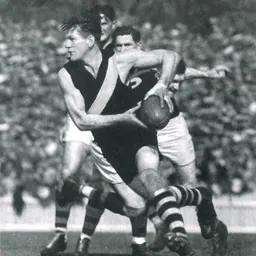
Thomas Stanley Raymond Hafey (5 August 1931 – 12 May 2014) was an Australian rules footballer who played for the Richmond Football Club in the Victorian Football League (VFL). He then became one of the VFL's longest-serving and most successful coaches, guiding Richmond to four VFL premierships before also having stints at , and finally .Hafey was an inaugural inductee into the Australian Football Hall of Fame in 1996, named coach of Richmond's team of the century in 1998, and given the AFL Coaches Association "Coaching Legend Award" in 2011. He was renowned for his fitness and toughness even in his elderly years when he would still run rings around his juniors. He would do over 700 push-ups and crunches a day every day since he started playing in the VFL.
He was appointed Member of the Order of the British Empire (MBE) in the 1982 New Year Honours.
Playing career Tom Hafey was born and raised in Richmond. He began his football career with the East Malvern under-19 team before graduating to the senior side in 1950. He spent three years with the club, winning the best and fairest in 1952.
Richmond Football Club Hafey was then invited to train at Richmond. At the time, the Tigers were in turmoil after legendary coach Jack Dyer quit. In an effort to reinvigorate the team, Richmond recruited a number of highly considered young players, including Ron Branton, Frank Dunin and Brian Davie. However, it was Hafey, an unheralded local, who played twelve of the eighteen matches his first year, scoring eight goals, including scoring a goal with his first kick in the VFL.
The following season was less productive for Hafey as he played just four games
After the appointment of Alan McDonald as coach, Hafey was often relegated to the bench as Ken Ward played in the back pocket. The Tigers fell to the bottom part of the ladder. Playing a backup role for a poor team, Hafey decided to retire from the VFL at the end of 1958. Over six seasons, he had played in 67 games, starting 52 of them. In 1959, Hafey played for the local Richmond Amateurs who won the premiership that year.
Coaching career After the 1959 season, Hafey left the city of Richmond, taking a job as playing coach of Shepparton in the Goulburn Valley area of northern Victoria. His tenacious attitude and devotion to fitness turned the club into a winner. Shepparton lost the Grand Final to Tongala in 1961, then won three straight from 1963 to 1965.
Hafey was an instant success, taking the club from last to first in one year – the first time this had been achieved in the VFL.
Collingwood lost to North Melbourne in the 1978 Preliminary Final, leading to a number of personnel changes during the offseason. In 1979, the team returned to the 1979 Grand Final. After taking a second quarter led, Collingwood fell behind at the half. They ultimately lost by five points against Carlton. In the 1980 Grand Final, Hafey took on his old team of Richmond. Kevin Bartlett won the Norm Smith medal as the Tigers won by a record margin. The Magpies under Hafey again made the Grand Final in 1981 against Carlton. After holding a 21-point lead in the third, Collingwood gave up two late goals before the three-quarter-time break. The resulting disharmony in the Magpie huddle allowed the Blues to dominate the fourth quarter and win the game.
After years of disappointment, players and fans began to criticise Hafey's methods. Several leading players said Hafey over-trained the team, particularly in the lead-up to finals matches. Others said Hafey was too slow to respond when the team was going under. During the 1982 season, a record losing streak of nine games sealed Hafey's fate, and he was sacked mid-season.
Geelong Hafey was given a three-year contract to coach Geelong in 1983. However, he was unable to engender the type of team spirit he created at Collingwood and Richmond, and the team did not make the finals during his tenure. During 1985, it became clear that Hafey's contract would not be renewed.
Sydney Swans During the 1985 season, the VFL had sold the Sydney Swans to controversial medical entrepreneur Geoffrey Edelsten to create the first privately owned club. Franchising, club licensing, player drafts and salary caps were all concepts that the VFL was attempting to import into Australian football at a time of financial crisis. Edelsten quickly signed numerous star players away from Melbourne clubs by offering large contracts. He wanted to hire Kevin Sheedy, who had just coached Essendon to successive premierships. Sheedy turned Edelsten down, but urged the Swans' owner to sign his old mentor, Tom Hafey. Edelsten took the advice and signed Hafey for three years. The Sydney Swans under Hafey made the finals campaigns in 1986 and 1987, both of which ended at the First Semi Final.
Coaching methods Hafey's teams usually tackled hard, shepherded, persisted, smothered and backed each other up, aspects of the game now called "one-percenters". Supreme fitness was required to play this way, so Hafey put a strong emphasis on training. However, his training methods were sometimes labelled monotonous and he was described as tactically unsophisticated.
Hafey strongly believed in leaving players in their designated position, even if they were losing to their opponent, which attracted criticism when the team lost. By contrast, virtually all players are rotated in modern play as the coach seeks match-ups favourable to the team.
Hafey was prepared to back his players and build their confidence, contributing to a strong team spirit. His approach differed from most successful coaches who remained aloof from their players. He focussed on the team's camaraderie, in many cases becoming intimately involved with the lives of his charges and he sought to mix with them in social situations even though he was a teetotaller and non-smoker. All four teams that he coached improved immediately after Hafey's appointment. However, he also "lost" his players several times during his career as they rebelled against his training requirements.
Comparative coaching statistics Gamescoached Won Lost Drawn Win% Finals Win%(Finals) Premierships 1. Mick Malthouse (31 seasons) 718 406 305 7 57% 42 54% 3 2. Jock McHale (38 seasons) 713 466 237 10 66% 58 47% 8 3. Kevin Sheedy (27 seasons) 678 386 242 7 61% 41 56% 4 4. Allan Jeans (26 seasons) 575 357 216 2 62% 41 54% 4 5. Tom Hafey (23 seasons) 522 336 182 4 65% 42 59% 4 6. David Parkin (22 seasons) 518 306 210 2 59% 3853% 4 7. Ron Barassi (23 seasons) 515 275 236 4 54% 33 53% 4 8. Norm Smith (23 seasons) 452 253 192 7 57% 24 71% 6 9. Leigh Matthews (20 seasons) 461 267 186 8 59% 2765% 4 10. Dick Reynolds (22 seasons) 415 275 134 6 67% 37 57% 4 Statistics up to the end of the 2023 AFL season.
Later career Returning to Melbourne in 1989, Hafey was employed by ABC radio as a football commentator. He was a popular figure at St. Kilda beach, often greeting fellow joggers and cyclists.
Death and legacy An inaugural inductee to the Australian Football Hall of Fame 1996, Hafey was named coach of Richmond's team of the century in 1998. In 2003, the Tigers set up the "Tom Hafey club", a corporate networking group, in his honour.
In 2011, a book titled The Hafey Years – Reliving a golden era at Tigerland was published. It documents Hafey's involvement with Richmond as a player, and his run of success as a coach in the 1960s and 1970s. Hafey had previously resisted having a biography written about him; author Elliot Cartledge said he changed his stance "because The Hafey Years is not a biography but a chronicle of an era."
During AFL Grand Final week in 2011, Hafey was awarded the "Coaching Legend Award" by the AFL Coaches Association.
After a brief illness due to a secondary cancer, Hafey died at the age of 82 on 12 May 2014.
Coaching tree At least 20 men that played under Hafey at Richmond later went on to success as coaches themselves. At VFL/AFL level, these include premiership coaches Tony Jewell (at Richmond), Kevin Sheedy (at Essendon) and Mick Malthouse (at Footscray, West Coast, Collingwood and Carlton), as well as Kevin Bartlett, Royce Hart, Francis Bourke, Paul Sproule, Mike Patterson, Mick Erwin (who replaced Hafey when he was sacked by Collingwood), Neil Balme, John Northey, Ian Stewart, and Barry Richardson. In addition, a number of his former players had important careers coaching at lower levels of the game, such as Merv Keane and Kevin Morris.
Don’t just read it —
keep it.
Full-length biographies made to live with: read them, listen on the way to work, watch them tonight.
- E-book
- Audio
- Video
Instant download · yours to keep · every purchase keeps this site free
Important facts
People in Tom Hafey's life
Named in this biography and alive at the same time

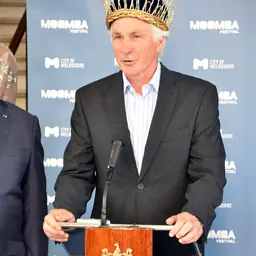
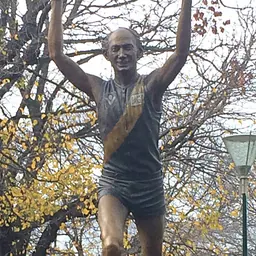


Related people
Same field, nearest in time




Contemporaries
People whose lives overlapped Tom Hafey's
Frequently asked questions
Who was Tom Hafey?
Australian rules footballer and coach
When was Tom Hafey born?
Tom Hafey was born on 5 August 1931 in Richmond.
When did Tom Hafey die?
Tom Hafey died on 12 May 2014 in Malvern.
What was Tom Hafey's occupation?
Tom Hafey was an australian rules football coach and australian rules football player.
What nationality was Tom Hafey?
Tom Hafey was Australian.
Sources & further reading
Cite this page
APA: Biography.guide. (2026). Tom Hafey. https://biography.guide/tom-hafey-australian-rules-football-coach/
MLA: "Tom Hafey." Biography.guide, https://biography.guide/tom-hafey-australian-rules-football-coach/.
Chicago: "Tom Hafey." Biography.guide. https://biography.guide/tom-hafey-australian-rules-football-coach/.
Data last updated: 2026-09-20 · Spot an error? Report a correction.
Page generated 2026-09-27 05:29 UTC