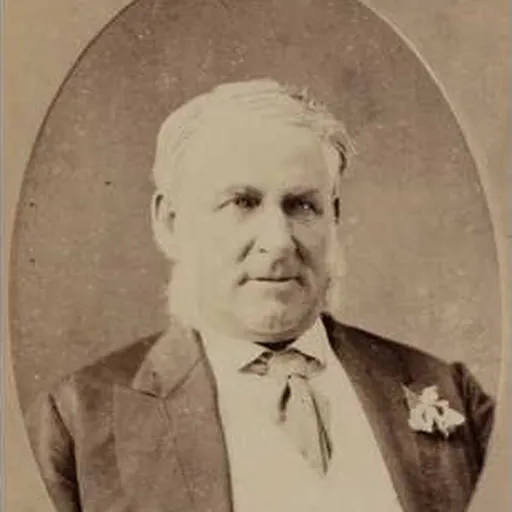
About Tom Durkin
Lived 1853 – 1902 (aged 48–49). Tom Durkin was an Australian cartoonist.
Thomas Coleman Durkin (1853 – 29 April 1902) was an Australian cartoonist and caricaturist based in Melbourne, active in the decades before Federation. He contributed to a variety of newspapers and illustrated journals during the 1870s and 1880s, including a series of caricatures of prominent Victorians published in the Melbourne newspaper, The Weekly Times. Fourteen lithographic prints from this series are now held by the National Portrait Gallery in Canberra. In the early 1890s Durkin was a part-owner with Edward Dyson of the illustrated Bull-Ant newspaper. From 1893 Durkin was employed as the Melbourne cartoonist for the Sydney-based Bulletin magazine, the first Australian-born artist to join its staff. He contributed a regular full-page of Melbourne-themed cartoons and caricatures, as well as smaller format illustrations. Durkin left The Bulletin in 1898, intending to travel to England, but his plans were abandoned through illness. Tom Durkin died of a liver disease in April 1902.
Early life Thomas Coleman Durkin was the eldest son of Michael Durkin and Jane (née Coleman), born at sea in 1853 aboard the S.S. West Wind in the South Atlantic Ocean south-east of the island of Saint Helena. His parents had departed from New York aboard the West Wind in early September 1852. Michael Durkin was a native of county Sligo in Ireland and Jane was born in the United States; the couple had married in March 1852 at Cincinnati, Ohio. Thomas' parents settled in the Williamstown area near Melbourne, on the west side of Hobsons Bay on Port Phillip, where Michael Durkin established a dairy business at Newport.
As a boy Durkin had a passion for sketching. He was "wholly self-taught as an artist".
Durkin trained at the Williamstown School of Design, learning the trade of engraving and die-sinking, after which he was apprenticed to an engraver. When the term of apprenticeship expired he found a job earning adult wages as a journeyman to a leading Melbourne jeweller.
Career Newspaper work
Durkin's first published cartoons appeared in The Trumpeter, a local Williamstown newspaper which he co-owned. The 'Masks and Faces' series commenced on 27 September 1873 with the publication of Durkin's caricature of John Thomas Smith. The illustration was entitled 'An Old Colonist' and came as a coloured supplement in the newspaper. The final caricature in the series was of William McCulloch, published on 3 April 1875.
In 1876, Tom Durkin and Bridget Agnes Murphy were married in Victoria. He also contributed to Queensland Punch in about 1880. Durkin contributed seven other large-format cartoons to the 1883 almanac, together with a number of "smaller etchings".
Durkin's wood engraving portrait of Miss Nellie Stewart was used for the cover of the 23 February 1884 edition of the Australian Graphic newspaper.
John Haynes, one of the founders of The Bulletin, left that magazine in 1885 to start Haynes' Weekly, described as "a very spicy production". Durkin contributed illustrations to Haynes' Weekly. Durkin and Dyson were part-owners of the newspaper, together with James Hamilton Smith. The journal, first printed in 1890, was described as "an illustrated comic weekly" and had its offices at 367a Little Bourke Street in Melbourne. The publication featured full-page cartoons and cover illustrations drawn by Durkin. The Bull-Ant was considered to be an "unofficial Labor paper".
In late April 1891, Constable Cornelius Crowe, a policeman stationed at Fitzroy, initiated an action in the County Court against the proprietors of the Bull-Ant newspaper, Dyson, Durkin and Smith, seeking to recover £250 damages for libel. The alleged libel had been published on 29 January 1891, referring to the arrest and subsequent death of Alfred Gange, a cab-owner. Gange had been drunk on the streets of Fitzroy on the afternoon of January 22 and was arrested by Constable Crowe and put in the Fitzroy lock-up. Early the next morning when Gange was roused, "he appeared to be in a fit" and was taken to Melbourne Hospital in a cab where he later died. A coronial inquest that concluded on January 29 found that Gange had died "of an effusion of blood on the brain, caused by direct violence to the top of his head", but there was "no direct evidence to show how he received the injury". The jury expressed the opinion that Gange had received the fatal injury prior to being arrested. The references to the case published in the Bull-Ant was made up of "caustic remarks about the want of intelligence in the ordinary constable, and stated that Gange was only one of a number of unfortunate wretches who had been arrested in a dying state". An accompanying double-page cartoon by Durkin, as alleged by Constable Crowe, depicted him as incompetent, lacking intellect and engaging in "inhuman conduct", holding him up to "contempt, hatred and ridicule". The argument of the Bull-Ant proprietors was that the published comments and pictorial representation "were not meant to apply to the plaintiff individually, but to the lesser intellectual portion of the police force". The Ant, as the Bull-Ant was renamed, ceased publication in mid-1892.
In February 1893, Durkin replaced George Rossi Ashton (brother of Julian Ashton) as The Bulletin'''s Melbourne cartoonist. Ashton had been contributing a regular full-page of cartoons and caricatures on a weekly basis, as commentary on political and social issues and current news-stories, most often as they related to Melbourne. When Durkin replaced Ashton he also produced a weekly Melbourne-themed page of cartoons and caricatures, similar to the pages previously done by Ashton, in addition to smaller-format cartoons.
Tom Durkin was considered to be the first Australian-born artist to join the staff of The Bulletin (though in a technical sense, he was born on board an incoming vessel).
Durkin left The Bulletin at the end of April 1898, intending to depart for London soon afterwards to join the staff of Black and White'', a leading English illustrated journal. Durkin left Melbourne for Sydney, but did not proceed to London "through illness".
Death
In December 1901, it was reported that Durkin was "lying seriously ill, of jaundice, in Melbourne Hospital". He was suffering from "a malignant growth on the liver" (also described as "an abscess on the liver"). By early February 1902 Durkin had been discharged from hospital after undergoing "a serious operation". It was initially thought that the operation had been successful, but "the disease developed again almost immediately". He was buried in the Melbourne General Cemetery at North Carlton.
Gallery
Don’t just read it —
keep it.
Full-length biographies made to live with: read them, listen on the way to work, watch them tonight.
- E-book
- Audio
- Video
Instant download · yours to keep · every purchase keeps this site free
Important facts
People in Tom Durkin's life
Named in this biography and alive at the same time





Related people
Same field, nearest in time



Contemporaries
People whose lives overlapped Tom Durkin's
Frequently asked questions
Who was Tom Durkin?
Australian caricaturist and cartoonist
When was Tom Durkin born?
Tom Durkin was born in 1853 in at sea.
When did Tom Durkin die?
Tom Durkin died on 10 May 1902.
What was Tom Durkin's occupation?
Tom Durkin was a cartoonist.
What nationality was Tom Durkin?
Tom Durkin was Australian.
Sources & further reading
· DBpedia: Tom Durkin (artist)
Cite this page
APA: Biography.guide. (2026). Tom Durkin. https://biography.guide/tom-durkin-cartoonist/
MLA: "Tom Durkin." Biography.guide, https://biography.guide/tom-durkin-cartoonist/.
Chicago: "Tom Durkin." Biography.guide. https://biography.guide/tom-durkin-cartoonist/.
Data last updated: 2026-09-23 · Spot an error? Report a correction.
Portrait: Wikimedia Commons · author & licence
Page generated 2026-09-27 05:07 UTC