
About Timur Apakidze
Lived 1954 – 2001 (aged 47). Timur Apakidze was a Russian aircraft pilot, test pilot and military personnel.
Temur Avtandilis Dze Apakidze (, , Timur Avtandilovich Apakidze; 4 March 1954 – 17 July 2001) was a Russian major general of Georgian ethnicity, fighter pilot, flight specialist and founder of the modern Russian Naval Aviation and Hero of the Russian Federation.
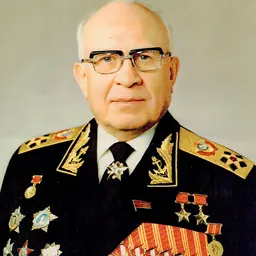
Early life and education Temur Apakidze was born in Tbilisi, Georgian SSR to a Russian mother and a Georgian father from the noble Georgian house of Apakidze. His mother moved with him to Leningrad when he was one year old. There he grew up and attended school. After graduating from 8th grade Apakidze enrolled in the Leningrad Nakhimov Naval School. In 1971, on the eve of graduation, the chief commander of the academy telegraphed Admiral Sergey Gorshkov about Apakidze's exceptional skills and requested his return to the fleet as soon as he had finished flight school. The Admiral agreed and from 1971 Apakidze began serving in the Soviet military as a naval aviator. The same year he became a cadet of the Yeysk Higher Military Aviation School.
Military service In 1975, after his EVVAU graduation in Yeysk, Temur Apakidze was assigned, with the rank of lieutenant, to the 846th Separate Guards Naval Attack Aviation Regiment "VP Chkalov" of the Baltic Fleet. By 1983, having already been promoted to major, he acted as deputy commander for the same regiment's flight training. During that appointment he introduced hand-to-hand combat training for pilots, being convinced that warriors without a weapon should know how to defend themselves if the situation demanded it. In 1986 after graduating from the Grechkov Naval Academy he was sent to the city of Nikolayev and appointed commander of the 100th Fighter Regiment. He studied shipborne aviation techniques at the "Center of Naval Aviation". From the late 1980s to the early 1990s he was considered the best Soviet, then Russian fighter pilot, being the first one who would land a Su-27K (Su-33) on deck of the aircraft carrier Admiral Kuznetsov on September 26, 1991. On the same day he performed another three landings and afterwards successfully tested the same maneuver at night and under difficult weather conditions, practically becoming the founder of modern Russian naval aviation. Prior to that Apakidze had lost one of the first aircraft of the series, code-named "T-10K-8", due to control malfunctions. He survived the incident by ejecting but repeatedly stated that he could not forgive himself for not having saved the fighter. Russia taking the regimental colors with him. In 1992 he was appointed commander of Russia's only naval fighter regiment, the 279th (Severomorsk-3). Serving from March 1993 as deputy commander and from November 1994 as commander of the 57th Mixed Air Division of the Northern Fleet, Timur Avtandilovich Apakidze was awarded the title Hero of the Russian Federation and distinction Gold Star by the President of the Russian Federation on 17 August 1995, for the development of efficient carrier based education and training programs and his daring and numerous experimental flight tests with the Su-33. Later that year division commander Apakidze departed with the aircraft carrier Kuznetsov for the Mediterranean Sea for combat duty. During the campaign, which ended in March 1996, his pilots performed 2,500 landings. Apakidze performed take-offs up to seven times a day, giving an example to others. It was around that time that two Israeli F-16s engaged a Russian Su-33 trespassing Israel's airspace but were outmaneuvered. The Russian pilot managed to place himself behind the F-16s that were chasing him but then withdrew.
Despite these impressive efforts and results, flight activity and intensity dropped from then on. At that point, the only Russian aircraft carrier moved out at sea for only two or three weeks' worth of maneuver training a year, until such activities were ceased completely. Shipborne fighter jets numbered no more than 15 at a time. However it was due to Apakidze's commitment that the Admiral Kuznetsov wasn't scrapped like other Soviet vessels as the result of drastic financial cuts in the military, especially the navy. In 1997 Major General Apakidze started teaching the so-called "Pugachev's Cobra" and "Bell" to his subordinates, who then would teach their students. However, they didn't catch on in the long run, since those techniques are considered unconventional and are not covered by any regulations and therefore aren't implemented as a standard drill for Russian fighter pilots. Apakidze was one of only five pilots in the world to master Pugachev's Cobra. In 1998, General Apakidze attended the Military Academy of the General Staff of the Armed Forces of Russia and in 2001 was made deputy commander of the Naval Aviation training program. Despite being a senior officer and already tasked with important business, he never stopped flying. At the time of his death, he had flown for 3850 hours on 13 different aircraft and performed 283 deck landings on an aircraft carrier. Not a single pilot died under his command or during his service. The name of the military-patriotic club "Cadets Aviation" in the city of Syzran.
Honours and awards "Gold Star" Hero of the Russian Federation (17 August 1995) Order for Service to the Homeland in the Armed Forces of the USSR, 3rd class Order for Personal Courage Medal for Combat Service Jubilee Medal "300 Years of the Russian Navy" Jubilee Medal "60 Years of the Armed Forces of the USSR" Jubilee Medal "70 Years of the Armed Forces of the USSR" Medal "For Impeccable Service" 1st, 2nd and 3rd classes Honoured Military Pilot of the Russian Federation
Don’t just read it —
keep it.
Full-length biographies made to live with: read them, listen on the way to work, watch them tonight.
- E-book
- Audio
- Video
Instant download · yours to keep · every purchase keeps this site free
Important facts
People in Timur Apakidze's life
Named in this biography and alive at the same time

Related people
Same field, nearest in time


Contemporaries
People whose lives overlapped Timur Apakidze's



Frequently asked questions
Who was Timur Apakidze?
Russian general (1954–2001)
When was Timur Apakidze born?
Timur Apakidze was born on 4 March 1954 in Tbilisi.
When did Timur Apakidze die?
Timur Apakidze died on 17 July 2001 in Ostrov.
What was Timur Apakidze's occupation?
Timur Apakidze was an aircraft pilot, test pilot and military personnel.
What nationality was Timur Apakidze?
Timur Apakidze was Russian.
Sources & further reading
Cite this page
APA: Biography.guide. (2026). Timur Apakidze. https://biography.guide/timur-apakidze/
MLA: "Timur Apakidze." Biography.guide, https://biography.guide/timur-apakidze/.
Chicago: "Timur Apakidze." Biography.guide. https://biography.guide/timur-apakidze/.
Data last updated: 2026-09-20 · Spot an error? Report a correction.
Page generated 2026-09-27 05:15 UTC