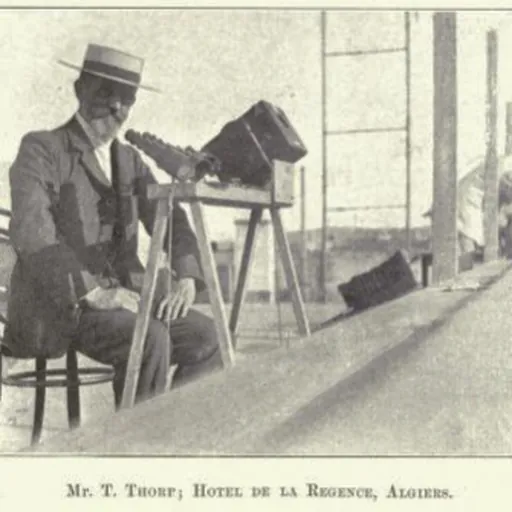
About Thomas Thorp
Lived 1850 – 1914 (aged 63–64). Thomas Thorp was an astronomer.
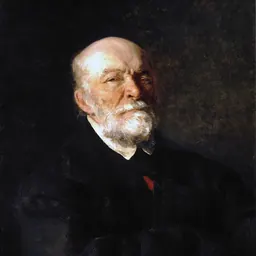
Thomas Thorp (1850–1914) was an English manufacturer of scientific instruments credited with inventing the first practical coin-in-the-slot gas meter, with innovations in the field of photography, including that involving colour, and for producing an early example of what has since been developed into the modern spectrohelioscope. He began his working life as an apprentice to a firm of architects and ended it as a Fellow of the Royal Astronomical Society, having had a keen interest in astronomy since childhood.
Early life Thomas Thorp was born on 26 October 1850, the son of a farmer who worked land around Narrow Lane (now known as Victoria Avenue), Besses o' th' Barn, Whitefield, Lancashire. He was educated first at the local Park Lane School and subsequently at Manchester Grammar School, following which he was apprenticed to Maycock and Bell, a firm of architects and surveyors in Manchester. During his apprenticeship, he had a role in the town-planning of New Brighton, which was then rising as a Victorian resort town. He had an interest in the practical application of scientific knowledge, as did his inventive father, and a consequence of this trait was an inclination towards civil and mechanical engineering.
Engineering As early as 1872, while still working for Maycock and Bell, he was sole patentee of a mechanism for tap valves. In 1875, he was jointly named with A. P. Bell, architect, on a patent application regarding improvements to the automation of gas lighting, and continued to design items for the gas industry thereafter. In 1880 he established a business for the manufacture of his designs, originally known as Thomas Thorp & Co., with premises at Narrow Lane, Whitefield.
Despite its practicality, the meter design of Thorp and Marsh was rapidly superseded and by 1894 J. Nasmith was reporting that it was "practically out of the running". The Edinburgh-based William Cowan and the Manchester business of Sawyer and Purves were among those who had been granted patents for improvements to the mechanism by that time.
Around the same time, Thorp and Marsh were among the many people experimenting with the possibilities of using acetylene gas as an alternate to coal gas. Acetylene – produced by mixing calcium carbide and water – was thought to produce a better quality of light but there were practical difficulties to overcome. They discovered that adding the carbide to the water was less dangerous than adding the water to the carbide, and they surmounted problems related to gradual "choking" of the burners when in use by mixing air with the product. They also invented a safety valve that they claimed cut off the burner outlet in the not unusual event that the supply to it was interrupted, thus preventing unlit gas from being emitted when the supply was restored. This valve was capable of use in both acetylene and coal gas installations.
Scientific instruments Thorp was a "scientific and mechanical genius". In pursuit of his childhood interest in astronomy, he developed considerable skills in the manufacture of optical glass and both reflector and refractor telescopes. He also created celluloid diffraction grating replicas, polarising solar eyepieces and prominence spectroscopes that were widely used, as well as objective prisms. diffracting grating replicas were significant advances of the ideas developed by Henry Rowland, whilst his multi-slit spectroscope was the first to enable the showing of both celestial and terrestrial objects and has formed the basis for the present day spectrohelioscope. Father Aloysius Cortie, of Stonyhurst College, Lancashire, was one whom achieved good results from an example of the objective prisms. Eventually owning houses in Whitefield#tag:ref|Thorp's Whitefield house was called Moss Bank, on Knowsley Street; and that in Prestatyn was The Uplands. He was also recognised by awards from other bodies, including international exhibitions. Similarly, although he used partial vacuums in his development of his diffraction gratings, he also investigated their use elsewhere as, for example, in his paper of 1903 entitled On the Production of Polished Metallic Surfaces having the Properties of Japanese "Magic" Mirrors. and the use of optics for gunsights – were reported to the Manchester Literary and Philosophical Society, of which he had been elected a member on 21 January 1896. He served as member of the Society's Council for all but one year between 1902 and 1912, was a vice-president for three years and was offered, but refused, a nomination to be president. He was also a vice-president of the Manchester Astronomical Society, He was buried at All Saints' Church, Stand, a few days later. He also left a partially developed scheme for the manufacture of a ruling machine that obviated the need for a screw drive, being controlled instead by a mercury clepsydra and micrometre valve,
The business that he founded, Thomas Thorp & Co. Ltd, was finally liquidated in 1976.
Don’t just read it —
keep it.
Full-length biographies made to live with: read them, listen on the way to work, watch them tonight.
- E-book
- Audio
- Video
Instant download · yours to keep · every purchase keeps this site free
Important facts
People in Thomas Thorp's life
Named in this biography and alive at the same time




Related people
Same field, nearest in time

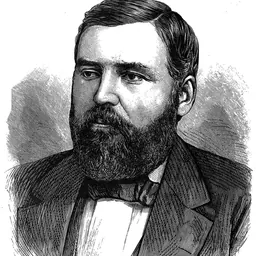
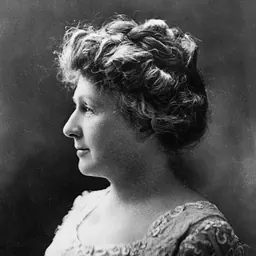

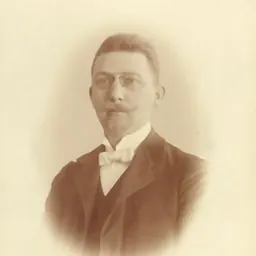

Contemporaries
People whose lives overlapped Thomas Thorp's





Frequently asked questions
Who was Thomas Thorp?
English manufacturer of scientific instruments (1850–1914)
When was Thomas Thorp born?
Thomas Thorp was born in 1850.
When did Thomas Thorp die?
Thomas Thorp died in 1914.
What was Thomas Thorp's occupation?
Thomas Thorp was an astronomer.
Sources & further reading
· DBpedia: Thomas Thorp (scientific instrument manufacturer)
Cite this page
APA: Biography.guide. (2026). Thomas Thorp. https://biography.guide/thomas-thorp/
MLA: "Thomas Thorp." Biography.guide, https://biography.guide/thomas-thorp/.
Chicago: "Thomas Thorp." Biography.guide. https://biography.guide/thomas-thorp/.
Data last updated: 2026-09-22 · Spot an error? Report a correction.
Portrait: Wikimedia Commons · author & licence
Page generated 2026-09-27 05:02 UTC