
About Thomas Stukley
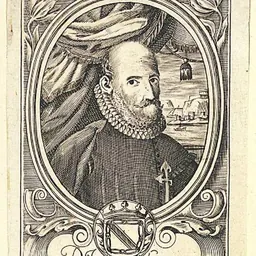
Lived 1525 – 1578 (aged 52–53). Thomas Stukley was an English military personnel and mercenary.
Arms of Stucley of Affeton: Azure, three pears or. Motto: Bellement et Hardiment ("beautifully and bravely") Thomas Stucley ( 4 August 1578) was an English mercenary who fought in France, Ireland and at the Battle of Lepanto before being killed at the Battle of Alcácer Quibir in 1578. He was a Catholic recusant and a rebel against the Protestant Elizabeth I. He was also rumoured to be an illegitimate son of Elizabeth's father, Henry VIII.
Family He was a younger son of Sir Hugh Stucley (1496–1559) lord of the manor of Affeton, in the parish of West Worlington in Devon, head of an ancient gentry family, a Knight of the Body to King Henry VIII and Sheriff of Devon in 1545. His mother was Jane Pollard, daughter of Sir Lewis Pollard (1465–1526), lord of the manor of King's Nympton, Devon, Justice of the Common Pleas, and his wife Anne Hext.
It has been alleged that he was instead an illegitimate son of King Henry VIII. Details of any wives or children he may have had are imprecise.
Career Stucley's early mentors were Charles Brandon, 1st Duke of Suffolk, and then the Bishop of Exeter, in whose household he held a post. He was present at Boulogne during the siege of 1544–45, and again in 1550 on the surrender of the city to the English. From 1547 to 1550, he was a standard-bearer at Boulogne, and then entered the service of Edward Seymour, 1st Duke of Somerset. After his master's arrest in 1551 a warrant was issued against him, but he succeeded in escaping to France, where he served in the French army.
His military talents brought him to the attention of Henri III de Montmorency, and he was sent to England with a letter of recommendation from Henry II of France to his supposed half-brother King Edward VI. On his arrival he proceeded on 16 September 1552 to reveal the French plans for the capture of Calais and for a descent upon England, the furtherance of which had, according to his account, been the object of his mission to England. John Dudley, 1st Duke of Northumberland evaded the payment of any reward to Stucley, and sought to gain the friendship of the French king by pretending to disbelieve Stucley's statements.
Stucley, who may well have been the originator of the plans adopted by the French, was imprisoned in the Tower of London for some months.
Stucley then devised a plan for a colony in Florida, at the time hotly contested by rival Spanish and French settlers (see Spanish Florida). To this end, he persuaded the queen to supply a ship of 100 tons (including 100 men, plus sailors), to supplement his fleet of five vessels. Having staged a naval pageant for the queen on the Thames, he promptly sailed his fleet to the coast of Munster in Ireland in June 1563 to go privateering against French, Spanish and Portuguese ships.
Legacy Stucley's career made a considerable impression on his contemporaries, and in death he attracted as much speculation and gossip as he had in life. A play generally assigned to George Peele, The Battell of Alcazar with the Death of Captain Stukely, printed in 1594, was probably acted in 1592 . It deals with Stucley's arrival in Lisbon and his Moorish expedition; in a long speech before his death he recapitulates the events of his life.
A later piece, The Famous History of the Life and Death of Captain Thomas Stukeley, printed for Thomas Pavier (1605), which is possibly the Stewtle, played, according to Henslowe, on 11 December 1596, is a biographical piece dealing with successive episodes, and seems to be a patchwork of older plays on Dom António and on Stucley. His adventures also form the subject of various ballads.
There is a detailed biography of Stucley, based chiefly on the English, Venetian and Spanish state papers, in R Simpson's edition of the 1605 play (School of Shakespeare, 1878, vol. i.), where the Stucley ballads are also printed. References in contemporary poetry are quoted by Dyce in his introduction to The Battle of Alcazar in Peele's Works.
Don’t just read it —
keep it.
Full-length biographies made to live with: read them, listen on the way to work, watch them tonight.
- E-book
- Audio
- Video
Instant download · yours to keep · every purchase keeps this site free
Important facts
People in Thomas Stukley's life
Named in this biography and alive at the same time





Related people
Same field, nearest in time


Contemporaries
People whose lives overlapped Thomas Stukley's
Frequently asked questions
Who was Thomas Stukley?
English mercenary
When was Thomas Stukley born?
Thomas Stukley was born in 1525 in Ilfracombe.
When did Thomas Stukley die?
Thomas Stukley died on 4 August 1578 in Ksar el-Kebir.
What was Thomas Stukley's occupation?
Thomas Stukley was a military personnel and mercenary.
What nationality was Thomas Stukley?
Thomas Stukley was English.
Sources & further reading
Cite this page
APA: Biography.guide. (2026). Thomas Stukley. https://biography.guide/thomas-stukley/
MLA: "Thomas Stukley." Biography.guide, https://biography.guide/thomas-stukley/.
Chicago: "Thomas Stukley." Biography.guide. https://biography.guide/thomas-stukley/.
Data last updated: 2026-09-20 · Spot an error? Report a correction.
Page generated 2026-09-27 05:03 UTC