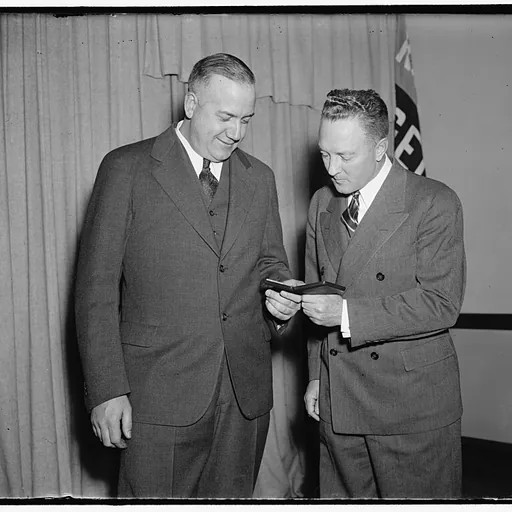
Thomas Poulter
American physicist and Antarctic explorer
About Thomas Poulter
Lived 1897 – 1978 (aged 81). Thomas Poulter was an American physicist, explorer and university teacher, known for Antarctic exploration.
Thomas Charles Poulter (March 3, 1897 – June 4, 1978) was an American scientist and antarctic explorer who worked at the Armour Institute of Technology and SRI International, where he was an associate director.
Early career Poulter taught physics while attending high school (1914-1918), joined the U.S. Navy in 1918 and returned to school in 1921. Poulter received his B.S. from Iowa Wesleyan College (IWC) in 1923; took a position as head of the chemistry division at IWC (1925); and served as head of the math, physics and astronomy divisions with "great creativity and much success" while attending graduate school at the University of Chicago (Ph. D., 1933).
While he was a physics professor at IWS he recognized James Van Allen as a student and put him to work, at 35 cents an hour, preparing seismic and magnetic equipment for the Antarctic Expedition.
He was second in command on the Second Byrd Antarctic Mission to the South Pole with Richard E. Byrd. The Poulter Glacier was named after him by Admiral Byrd. Byrd credited him with saving his life as the expedition leader approached death from carbon monoxide poisoning.
After his first expedition he became the scientific director of the Armour Research Foundation at the Armour Institute of Technology (later Illinois Institute of Technology) where he developed the Antarctic Snow Cruiser (a.k.a. "Penguin 1"). This device was built for and taken along on his second expedition with Admiral Byrd in 1939. Poulter devised seismic pattern shooting in the 1950s, and according to W. Harry Mayne, Poulter's "method called for a pattern of explosive charges to be mounted on poles (usually 5-6 ft above the surface of the ground, which prevented any significant environmental damage)." He became interested in seals after visiting the elephant seal colony at Año Nuevo Island off the coast of California in 1961. The seal colony there included elephant seals, sea lions harbor seals and many others. He began studying the seal colonies in 1962 and was active in having the island protected as a biological preserve in 1967. There he did research on a number of marine mammals. He was fond of them as he described in a "Note" for the Arctic.
He died on June 4, 1978, in Menlo Park, California, while working in his laboratory.
Publications Poulter, Thomas C., (1943) HYDRAULIC PUMP, Patent No. 2,333,885. United States Patent Office. Poulter, Thomas C., (1945) METHOD AND APPARATUS FOR CASTING METAL, Patent No. 2,379,401. United States Patent Office. Poulter, T. C., (1947) Seismic measurements on the Ross Shelf Ice—Part I, Transactions, American Geophysical Union, Volume 28, Issue 2, p. 162-170. Poulter, T. C., Allen, C. F., and Miller, S. W., (1950) Seismic measurements on the Taku Glacier, in Geophysical studies in the Antarctic; Contract N8onr 526, ProjectNo. NR-081-020, published by the Stanford Research Institute. Poulter, T. C. (1950) The Poulter seismic method of geophysical exploration, Geophysics, Vol. 1 5, pp. 1 81 -207. Poulter, T. C., (1950) The Poulter Seismic Method, The Canadian Mining and Metalluraical Bulletin, May, pp. 258–267. Poulter, Thomas C., (1954) METHOD AND APPARATUS FOR SEISMIC EXPLORATION, Patent No. 2,672,204. United States Patent Office. Poulter, T. C., (1955) Meteor observations in the Antarctic; Byrd Antarctic Expedition II, 1933–1935. Stanford Research Institute Poulter, T. C. 1963. Sonar signals of the sea lion. Science, 139 753-755 Poulter, T. C. 1963. The sonar of the sea lion. Inst. Elec. Electron. Eng. Trans., 10, 109-111 Pressure regulation in the middle ear cavity of sea lions: a possible mechanism S Odend'hal, T C Poulter Science. 1966 Aug 12;153 (737):768-9 5940898 Orr, R. T. and T. C. Poulter (1967) Some observations on reproduction, growth, and social behavior in the Steller sea lion Proceedings of the California Academy of Sciences 35:193–226 Sea lion echo ranging H N Shaver, T C Poulter The Journal of the Acoustical Society of America. 1967 Aug R C Hubbard, T C Poulter 1968 Seals and sea lions as models for studies in comparative biology Lab Anim Care. 1968 Apr;18 (2):Suppl:288-97 4233361 Watkins, W.; Singleton, R.; Poulter, T. Comments on spectral analysis of the calls of the Male Killer Whale Audio and Electroacoustics, IEEE Transactions on Volume 16, Issue 4, Dec 1968 Page(s): 523 - 523 R J Stephens, I J Beebe, T C Poulter Innervation of the vibrissae of the California sea lion, Zalophus californianus Anat Rec. 1973 Aug;176 (4):421-41 4723405 W B Neff, M T Sullivan, T C Poulter A magnetic-drive circulator designed for completely closed carbon dioxide absorption systems Anesthesiology. 1979 Aug;51 (2):169-70 453621
Don’t just read it —
keep it.
Full-length biographies made to live with: read them, listen on the way to work, watch them tonight.
- E-book
- Audio
- Video
Instant download · yours to keep · every purchase keeps this site free
Important facts
Related people
Same field, nearest in time

Contemporaries
People whose lives overlapped Thomas Poulter's



Frequently asked questions
Who was Thomas Poulter?
American physicist and Antarctic explorer (1897-1978)
When was Thomas Poulter born?
Thomas Poulter was born on 3 March 1897 in Salem.
When did Thomas Poulter die?
Thomas Poulter died on 4 June 1978 in Menlo Park.
What was Thomas Poulter's occupation?
Thomas Poulter was a physicist, explorer and university teacher.
What was Thomas Poulter known for?
Thomas Poulter was known for Antarctic exploration.
What nationality was Thomas Poulter?
Thomas Poulter was American.
Sources & further reading
Cite this page
APA: Biography.guide. (2026). Thomas Poulter. https://biography.guide/thomas-poulter/
MLA: "Thomas Poulter." Biography.guide, https://biography.guide/thomas-poulter/.
Chicago: "Thomas Poulter." Biography.guide. https://biography.guide/thomas-poulter/.
Data last updated: 2026-09-24 · Spot an error? Report a correction.
Portrait: Wikimedia Commons · author & licence
Page generated 2026-09-27 05:08 UTC