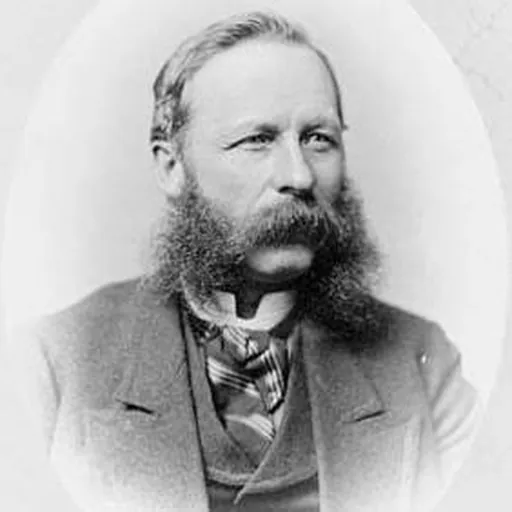
About Thomas Paxton
Lived 1820 – 1887 (aged 66). Thomas Paxton was a Canadian politician and sheriff.
Thomas Charles Paxton (November 27, 1820 – July 3, 1887) was a Canadian politician, businessman and sheriff. As a partner in industrial business ventures, he was one of the founding fathers of Port Perry. He helped establish the first steam-powered sawmill on Lake Scugog in 1846, then later operated a flour mill and was a partner in a foundry which manufactured machinery for agriculture and mills. He turned to politics in 1854, served as the second reeve of Reach and Scugog Townships, and he was the first person to represent the Ontario North electoral district in the Legislative Assembly of Ontario. He won four elections to the provincial parliament, where he served in office from 1867 to 1881, and took interest in legislation for railways and the timber industry. He partnered with other local businessmen in 1867 to construct the Port Whitby and Port Perry Railway which was completed in 1872. He resigned from the legislature in 1881 to serve as sheriff of Ontario County until 1887, when succeeded by his son, J. F. Paxton.
Port Perry businessman Thomas Charles Paxton was born on November 27, 1820, in Whitby, the eldest son of William Paxton and Elizabeth Dryden, who had emigrated earlier that year to Upper Canada from Walsingham, England. Paxton became one of the founding fathers of Port Perry, where he settled in 1846. Paxton later partnered with local postmaster Joseph Bigelow, with whom he operated a flour mill for 20 years. They also became partners in the Paxton and Tate Foundry, which manufactured agricultural implements and mill machinery.
Paxton was elected reeve of Reach and Scugog Townships in 1854; he was the second person to hold the position after the townships were founded in 1853. He was a member of the Municipal Council of Ontario County, and sat on the committees for finance and assessment, and county property.
Paxton was the deputy reeve of Reach and Scugog Townships in 1856, a councillor for Reach Township in 1858, and was a grammar school trustee from 1857 to 1859, and again from 1867 to 1869. He petitioned the township council in 1867 for a license to operate a saloon in Port Perry, but the council did not have the authority to permit a saloon in a village at the time.
Ontario legislator
The Legislative Assembly of Ontario was established with Canadian Confederation, and Paxton became the first person to represent the Ontario North electoral district. He was elected as an Ontario Liberal Party candidate in the 1867 Ontario general election,
Paxton and Bigelow began efforts in late 1867 to construct the Port Whitby and Port Perry Railway, which was chartered in March 1868. Bigelow became the railway's president and Paxton was named to its board of directors.
Paxton was returned to the legislature for a third term in the 1875 Ontario general election. Paxton won the original election by 129 votes, and won the by-election by 185 votes to retain his seat. He was appointed secretary of the Port Perry United School Section in January 1878.
Paxton was returned to the legislature for a fourth term in the 1879 Ontario general election. Paxton resigned from the legislature on May 10, 1881.
Later life and legacy
Paxton began serving as sheriff of Ontario County on June 20, 1881, and soon after relocated his family to Whitby. He operated an iron ore mine in Lutterworth Township which supplied foundries in Canada and the United States during the early 1880s.
Paxton died on July 3, 1887, following a lengthy illness. His funeral was well attended by people from Port Perry with many businesses closed for the day. He was interred at Dryden's burial ground – later known as the Pioneer Baptist Cemetery – in Brooklin, Ontario. His son, J. F. Paxton, was appointed to succeed him as sheriff of Ontario County.
Historian J. Peter Hvidsten opined that it was common knowledge that Paxton had too many business interests at once and entrusted too much to the decisions of others, but would have died one of the wealthiest men in Ontario County had he not put public affairs before his own business ventures.
Electoral history
Don’t just read it —
keep it.
Full-length biographies made to live with: read them, listen on the way to work, watch them tonight.
- E-book
- Audio
- Video
Instant download · yours to keep · every purchase keeps this site free
Important facts
Family & relationships
People in Thomas Paxton's life
Named in this biography and alive at the same time
Related people
Same field, nearest in time






Contemporaries
People whose lives overlapped Thomas Paxton's






Frequently asked questions
Who was Thomas Paxton?
Canadian politician (1820-1887)
When was Thomas Paxton born?
Thomas Paxton was born on 27 November 1820 in Whitby.
When did Thomas Paxton die?
Thomas Paxton died on 3 July 1887 in Whitby.
What was Thomas Paxton's occupation?
Thomas Paxton was a politician and sheriff.
What nationality was Thomas Paxton?
Thomas Paxton was Canadian.
Sources & further reading
Cite this page
APA: Biography.guide. (2026). Thomas Paxton. https://biography.guide/thomas-paxton/
MLA: "Thomas Paxton." Biography.guide, https://biography.guide/thomas-paxton/.
Chicago: "Thomas Paxton." Biography.guide. https://biography.guide/thomas-paxton/.
Data last updated: 2026-09-23 · Spot an error? Report a correction.
Portrait: Wikimedia Commons · author & licence
Page generated 2026-09-27 05:06 UTC