
About Thomas K. Gaisser
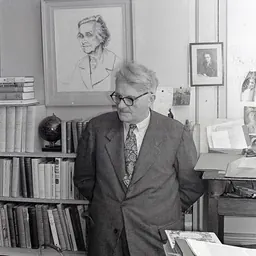
Lived 1940 – 2022 (aged 81). Thomas K. Gaisser was an American physicist, astrophysicist and university teacher.
Thomas Korff Gaisser (March 12, 1940, Evansville, Indiana – February 20, 2022, Swarthmore, Pennsylvania) was a particle physicist, cosmic ray researcher, and a pioneer of astroparticle physics. He is known for his book Cosmic Rays and Particle Physics and the Gaisser–Hillas function.
Biography Thomas K. Gaisser graduated in 1962 from Wabash College with a B.A. in physics. Supported by a Marshall Scholarship, Gaisser sailed in 1962 to England on RMS Queen Elizabeth. Aboard ship, he met Julia Haig, who also held a Marshall Scholarship. In England the two studied at different universities, but their romance deepened when Gaisser wrote to her asking if she would like to see some plays in London during the academic holidays. They married in 1964 and, over decades, he pursued an academic career in physics, while she pursued an academic career in classics and eventually became a professor of Latin at Bryn Mawr College. In 1965 Thomas Gaisser graduated with an M.Sc. in physics from England's University of Bristol. In 1967 he graduated with a Ph.D. from Brown University. His Ph.D. thesis is entitled Solutions of a Model Field Theoretical Equation for the Neutron-Proton Mass Difference.
From 1967 to 1969, Gaisser was a research associate at Massachusetts Institute of Technology (MIT) and, for the academic year 1969–1970, a NATO postdoctoral fellow at England's University of Cambridge. In 1970, he became an assistant professor at the Bartol Research Foundation, which in 1970 was located at Swarthmore College. In 1977, the Bartol Research Foundation moved to the University of Delaware and was renamed the Bartol Research Institute. (In 2000, the institute was integrated as a center of the University of Delaware's Department of Physics and Astronomy.) At Bartol, Tom transitioned from particle physics to cosmic ray physics. He stayed at Bartol for the remainder of his career. He was promoted in 1974 from assistant professor to associate professor and in 1979 to full professor. From 1976 to 1978, Gaisser was one of the organizers of the Bartol Conference, held in October 1978, in particle astrophysics, bringing together cosmic ray researchers and particle physicists with expertise involving particle accelerators.
Gaisser's research involved calculating the parameters of air showers caused by cosmic rays, computing the antiproton yields of such air showers, and, with Michael Hillas, parameterizing the longitudinal particle density in such air showers. He actively participated in the design and construction of experiments at the Amundsen–Scott South Pole Station. He contributed to the South Pole Air Shower Experiment (SPASE), the Antarctic Muon And Neutrino Detector Array (AMANDA), and, especially, the IceCube Neutrino Observatory with its IceTop surface array measuring air showers. From 2007 to 2011 Gaisser was a spokesperson for the IceCube Neutrino Observatory.
Don’t just read it —
keep it.
Full-length biographies made to live with: read them, listen on the way to work, watch them tonight.
- E-book
- Audio
- Video
Instant download · yours to keep · every purchase keeps this site free
Important facts
Related people
Same field, nearest in time


Contemporaries
People whose lives overlapped Thomas K. Gaisser's



Frequently asked questions
Who was Thomas K. Gaisser?
American physicist
When was Thomas K. Gaisser born?
Thomas K. Gaisser was born on 12 March 1940 in Evansville.
When did Thomas K. Gaisser die?
Thomas K. Gaisser died on 20 February 2022 in Swarthmore.
What was Thomas K. Gaisser's occupation?
Thomas K. Gaisser was a physicist, astrophysicist and university teacher.
What nationality was Thomas K. Gaisser?
Thomas K. Gaisser was American.
Sources & further reading
· Wikipedia: Thomas K. Gaisser
Cite this page
APA: Biography.guide. (2026). Thomas K. Gaisser. https://biography.guide/thomas-k-gaisser/
MLA: "Thomas K. Gaisser." Biography.guide, https://biography.guide/thomas-k-gaisser/.
Chicago: "Thomas K. Gaisser." Biography.guide. https://biography.guide/thomas-k-gaisser/.
Data last updated: 2026-09-20 · Spot an error? Report a correction.
Page generated 2026-09-27 05:27 UTC