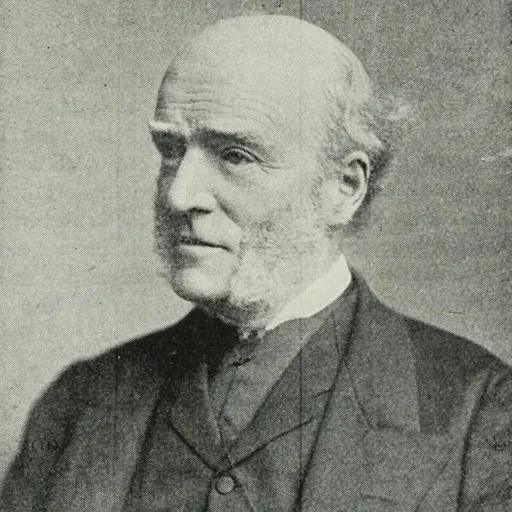
About Thomas Hughes
Lived 1822 – 1896 (aged 73). Thomas Hughes was a British judge, cricketer, writer, politician, children's writer and novelist.
Thomas Hughes (20 October 1822 – 22 March 1896) was an English barrister, judge, politician and author. He is most famous for his novel Tom Brown's School Days, a semi-autobiographical work set at Rugby School, which Hughes and his brother had attended. It had a lesser-known sequel, Tom Brown at Oxford (1861).
Hughes had numerous other interests, in particular as a Member of Parliament, in the British co-operative movement, and in a settlement—Rugby, Tennessee, US—reflecting his values.
Early life Hughes was the second son of John Hughes, editor of the Boscobel Tracts (1830), and was born in Uffington, Berkshire (now in Oxfordshire). He had six brothers, and one sister, Jane Senior, who later became Britain's first female civil servant. At the age of eight he was sent to Twyford School, a prep school near Winchester, where he remained until the age of eleven. In February 1834 he went to Rugby School, which was then under the celebrated Thomas Arnold, a contemporary of his father at Oriel College, Oxford.
Hughes excelled at sports rather than in scholarship, and his school career culminated in a cricket match at Lord's Cricket Ground. In 1842 he went on to Oriel College, and graduated BA in 1845. At Oxford, he played cricket for the Oxford University Cricket Club in the annual University Match against Cambridge, also played at Lord's, a match still regarded as first-class cricket.
Legal career Hughes was called to the bar in 1848, became a Queen's Counsel in 1869 and a bencher in 1870. He was appointed as a county court judge in the Chester district in July 1882.
In 1850, Hughes gave evidence to a House of Commons committee on savings. In so doing, he participated in a Christian Socialist initiative, which led shortly to the Industrial and Provident Societies Partnership Act 1852 and the emergence of the industrial and provident society. The Act was the work of Robert Aglionby Slaney, with whom Hughes worked in alliance.
Hughes was involved also in the formation of some early trade unions, and helped finance the printing of Liberal publications; and acted as the first President of the Co-operative Congress in 1869, serving on the Co-operative Central Board. He invested with William Romaine Callender in co-operative mills, in 1866.
In politics Caricature by Adriano Cecioni published in Vanity Fair in 1872. Hughes was elected to Parliament as a Liberal for Lambeth (1865–68), and for Frome (1868–74). He stood as candidate in 1874 for Marylebone in 1874, but dropped out just before the election, despite support from Octavia Hill. The context for the end of his political career was the unpopularity with Hughes's Frome constituents of his support for the Elementary Education Act 1870.
As an MP, Hughes worked on trade union legislation, but was not in a position to have major changes passed. Hughes then worked with Harrison and Robert Applegarth to diminish the effect of some of the testimony from employers.
The outcome of this commission was that Harrison, Hughes and Lord Lichfield produced a minority report (1869), recommending that all the legal restrictions should be dropped.
Volunteers During the French invasion scare of 1859, Hughes raised the 19th (Bloomsbury) Middlesex Rifle Volunteer Corps from among the students of the Working Men's College, and commanded it with the rank of Lieutenant-Colonel until 1869, when he became the unit's first Honorary Colonel. The battalion was known as 'Tom Brown's Corps'. Hughes estimated that it was the poorest in the metropolis, the Rifle Volunteer Corps at the time being predominantly middle class. He also served as deputy editor of the Volunteer Services Gazette.
Later life In 1878–79, Hughes began writing The Manual for Co-operators (1881), with Vansittart Neale, for the Co-operative Congress. As a side-product he developed an interest in the model village. In 1880, he acquired the ownership of Franklin W. Smith's Plateau City and founded a settlement in America—Rugby, Tennessee—which was designed as an experiment in utopian living for the younger sons of the English gentry. It followed closely on the failed colony of Buckthorn (existing about 1872 to 1879), established by another Englishman, Charles Lempriere, in western Virginia; this settlement is reported to have been suggested by Hughes. Rugby was also unsuccessful on its own terms, but it still exists and is listed on the US National Register of Historic Places.
Hughes was also a prominent figure in the anti-opium movement, and a member of the Society for the Suppression of the Opium Trade.
At the end of the 1880s Hughes clashed with John Thomas Whitehead Mitchell of the Co-operative Wholesale Society, over the vertical integration Mitchell favoured for the Society. Hughes died in 1896 aged 73, at Brighton, of heart failure, and was buried there.
Works While living at Wimbledon, Hughes wrote his famous story Tom Brown's School Days, which was published in April 1857. He is associated with the novelists of the "muscular school", a loose classification but centred on the fiction of the Crimean War period. Although Hughes had never been a member of the sixth form at Rugby, his brother George Hughes was educated there and was the model for his Tom Brown character. Both of them had great respect for the school's headmaster, Thomas Arnold.
Hughes also wrote The Scouring of the White Horse (1859), a novel which centres on the village festival of 1857 which saw to the periodic cleaning of the Uffington White Horse. The book deals with Victorian rural life, traditional sports, and local folklore. Other works include Tom Brown at Oxford (1861), Religio Laici (1868), Life of Alfred the Great (1869) and Memoir of a Brother.
Family In 1847, Hughes married Frances Ford, daughter of Rev. James Ford, and niece of Richard Ford, and they settled in 1853 at Wimbledon. Ludlow already shared barristers' chambers with Hughes, and the arrangement lasted four years.
Lilian Hughes perished in the sinking of the RMS Titanic in 1912, along with her husband, Rev. Ernest Carter. The youngest child Mary Hughes was a well-known Poor Law guardian and volunteer visitor to the local Poor Law infirmary and children's home.
Legacy
A Hughes Scholarship was founded at Oriel College, Oxford. It was a closed award, open only to members, or sons of members, of some Co-operative Societies, in which aspect the award reflected Hughes's involvement with the Co-operative Movement. The first scholar was elected to Oriel in 1884. It was later combined with an award honouring the social reformer Edward Vansittart Neale.
A statue of Hughes (pictured right) stands outside Rugby School Library: the sculptor was Thomas Brock, and the statue was unveiled in 1899.
Don’t just read it —
keep it.
Full-length biographies made to live with: read them, listen on the way to work, watch them tonight.
- E-book
- Audio
- Video
Instant download · yours to keep · every purchase keeps this site free
Important facts
People in Thomas Hughes's life
Named in this biography and alive at the same time




Related people
Same field, nearest in time

Contemporaries
People whose lives overlapped Thomas Hughes's





Frequently asked questions
Who was Thomas Hughes?
English lawyer, judge, politician and author (1822–1896)
When was Thomas Hughes born?
Thomas Hughes was born on 20 October 1822 in Oxfordshire.
When did Thomas Hughes die?
Thomas Hughes died on 22 March 1896 in Brighton.
What was Thomas Hughes's occupation?
Thomas Hughes was a judge, cricketer, writer, politician, children's writer and novelist.
What nationality was Thomas Hughes?
Thomas Hughes was British.
Sources & further reading
Cite this page
APA: Biography.guide. (2026). Thomas Hughes. https://biography.guide/thomas-hughes-judge/
MLA: "Thomas Hughes." Biography.guide, https://biography.guide/thomas-hughes-judge/.
Chicago: "Thomas Hughes." Biography.guide. https://biography.guide/thomas-hughes-judge/.
Data last updated: 2026-09-20 · Spot an error? Report a correction.
Portrait: Wikimedia Commons · author & licence
Page generated 2026-09-27 04:57 UTC