
About Thomas Erpingham
Lived 1357 – 1428 (aged 70–71). Thomas Erpingham was an English military personnel.
Sir Thomas Erpingham (27 June 1428) was an English soldier and administrator who loyally served three generations of the House of Lancaster, including Henry IV and Henry V, and whose military career spanned four decades. After the Lancastrian usurpation of the English throne in 1399, his career in their service was transformed as he rose to national prominence, and through his access to royal patronage he acquired great wealth and influence.
Erpingham was born in the English county of Norfolk, and knighted when a young man. During the reign of Richard II he served under the King's uncle John of Gaunt, Duke of Lancaster, in Spain and Scotland, and was with Gaunt's son Henry Bolingbroke on crusades in Lithuania, Prussia and the Holy Land. Erpingham accompanied Bolingbroke into exile in October 1398, and was with him when he landed at Ravenspur in July 1399 to reclaim his inheritance as Duke of Lancaster, after his lands had been forfeited by Richard. Bolingbroke rewarded Erpingham by appointing him as constable of Dover Castle and warden of the Cinque Ports, and after ascending the throne as Henry IV he made him chamberlain of the royal household. Erpingham later helped to suppress the Epiphany Rising and was appointed guardian of Henry's second son Thomas. He was a member of the Privy Council, acting at one point as marshal of England. He attempted to have Henry le Despenser, the anti-Lancastrian bishop of Norwich, impeached as a rebel.
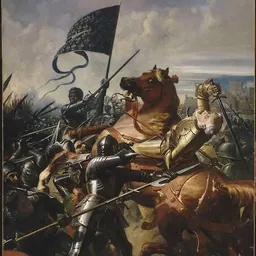
On becoming king in 1413, Henry IV's son Henry of Monmouth appointed Erpingham as steward of the royal household. Henry IV's reign had been marked by lawlessness, but Henry V and his administrators proved to be unusually talented, and within twelve months law and order had been re-established throughout England. In 1415 Erpingham was indentured to serve as a knight banneret, and joined Henry's campaign to recover his lost ancestral lands in France and Normandy. Erpingham presided over the surrender of Harfleur. On 25 October 1415, he commanded the archers in the Battle of Agincourt, where he was positioned alongside the king.
Erpingham married twice, but both marriages were childless. He was a benefactor to the city of Norwich, where he had built the main cathedral gate which bears his name. He died on 27 June 1428, and was buried in Norwich Cathedral.
Ancestry and early life Thomas Erpingham was born in about 1357, the son of Sir John de Erpingham His grandfather, Sir Robert de Erpingham was recorded as holding Erpingham manor in 1316 and Erpingham and Wickmere in 1346. Sir Robert represented Norfolk in Parliaments during the 1330s and 1340s. In 1350, Sir Robert and his son Sir John de Erpingham both witnessed a deed of feoffment by Nicholas de Snyterle, rector of "Matelask" (Matlaske near Erpingham), to Philip Tynker and Maud his wife of a messuage there.
Sir John owned a house in Norwich in Conisford Lane, now King Street. Thomas, who would have known the house, was possibly born there. The identity of Erpingham's mother is not mentioned by his biographers. In September 1368 he may have travelled with his father to Aquitaine in the service of Edward the Black Prince.
His grandfather died in 1370, after 8 March but before 1 August, the date of death of the father of Thomas. On 8 March 1370 at Erpingham, Sir Robert de Erpingham and his son Sir John, both signed their names and left seals on a charter of an inescutcheon between eight martlets. In his will, Robert left legacies to all the friars of Norwich. He was buried near the south door of Erpingham church.
Revolution of 1399 The historian Helen Castor has described the Lancastrian presence in East Anglia as a "disparate collection” that lacked coherence or a single identity. Erpingham rose to become the most important of Lancaster's retainers in the region. He was appointed to a commission of peace, and given powers to preserve order in Norfolk in the aftermath of the Peasants' Revolt in the summer of 1381. He had a part in supervising the defence of Norfolk in 1385, when a French invasion seemed imminent. In 1396 Lancaster granted him the legal right to use the land within the hundred of South Erpingham, a reward for his loyal service to the Duchy of Lancaster.
In January 1398 a dispute erupted between Bolingbroke and Thomas de Mowbray, 1st Duke of Norfolk, after Mowbray had attempted to ambush and kill Lancaster, and which the King ordered be settled by a trial by battle between the two men. During the five months before 16 September, the day the trial was due to take place, Bolingbroke travelled throughout England on a tour of the Lancastrian lands. Richard stopped the contest as it was about to begin and banished Bolingbroke from the kingdom for ten years, and exiled Mowbray for life. Those assembled were told that the trial had been stopped to avoid dishonouring the loser and to prevent a feud from arising, but chroniclers (writing after Henry IV's accession) considered Richard's decision an act of revenge. Bolingbroke, as one of the five Lords Appellant, had rebelled in November 1387; for a year they maintained Richard as a figurehead with little actual power.
Erpingham was one of 17 named companions who volunteered to accompany Henry Bolingbroke into exile. He entrusted his lands and property to Sir Robert Berney and others. (1=Berney, who lived at Gunton, was Erpingham's neighbour in North Norfolk.) They fought together in the retinue of John of Gaunt, and were discharged from the commission of array in Norfolk, when Gaunt marched with Richard II's army to Scotland in 1385. Erpingham appointed Berney as the deputy constable of Dover Castle in 1400. Berney remained there until he was replaced by Sir Andrew Butler in 1406.
Personal life
When staying in Norwich, Erpingham and his family and servants lived in a large house located between Norwich Cathedral and the River Wensum, with his land going down to the river. The house was acquired from Sir Robert Berney in 1409. Erpingham's position in court helped the elder son William to become a member of Henry IV's personal household; William's brother John held a similar position at the court of Henry of Monmouth. The brothers remained closely attached to their uncle. William and Erpingham were often recorded as co-feoffees of estates in East Anglia, and William stood surety for his uncle at the Exchequer. The family's fortunes improved still further when Henry of Monmouth became king, although John died at Harfleur in 1415. His brother was knighted on the eve of the coronation and later fought at Agincourt. The west tower of St. Mary's Church, in the village of Erpingham, was paid for by him.
In 1419, Erpingham paid for the east chancel window of the church of St. Austin's Friary in Norwich to be glazed. The window contained eight panes, containing dedications to 107 noblemen or knights who died without producing an heir since the reign of Edward III. The building was demolished in 1547 after the priory was suppressed in 1538.
Appearance in the Henriad Sir Thomas Erpingham appears twice in Act IV of William Shakespeare's play Henry V, first printed in 1600, and is mentioned (but does not appear) in Act II of Richard II. According to the Shakespearean scholar Thomas M. Cranfill, Erpingham plays a "considerable, affecting role". Just after the beginning of Scene 1, Erpingham enters and is acknowledged by the King. and in a simple line conveys the burden of being a ruler. Erpingham is a counterpart to the character of John Falstaff, his brief appearance in the Henriad contrasting with the much larger part given to Falstaff. Henry emphasises the knight's old age and marks him apart by consistently referring him by his full name, and the character is used to accentuate the connection between old age and goodness.
In film depictions of the play, Erpingham's part is largely silent, as in Laurence Olivier's film of 1944. Erpingham first appears near the end of the film, during the night before the battle of Agincourt. Kenneth Branagh, in his 1989 film, used the character more often and in, according to Curry, in a way that was "notably more inventive" than Olivier and showed more of an awareness of Erpingham's place in history. Identifiable in both films by his distinctive coat of arms and his white hair—in contrast with that of the youthful looking Henry and his courtiers—Branagh includes Erpingham to good effect in the court scenes set in England, as well as during the battle and its aftermath. The character is given a more central (if largely silent) role by Branagh, without distorting Shakespeare's original intentions for the part.
Don’t just read it —
keep it.
Full-length biographies made to live with: read them, listen on the way to work, watch them tonight.
- E-book
- Audio
- Video
Instant download · yours to keep · every purchase keeps this site free
Important facts
People in Thomas Erpingham's life
Named in this biography and alive at the same time

Related people
Same field, nearest in time

Contemporaries
People whose lives overlapped Thomas Erpingham's



Frequently asked questions
Who was Thomas Erpingham?
English noble
When was Thomas Erpingham born?
Thomas Erpingham was born in 1357 in Norfolk.
When did Thomas Erpingham die?
Thomas Erpingham died in 1428 in Norwich.
What was Thomas Erpingham's occupation?
Thomas Erpingham was a military personnel.
What nationality was Thomas Erpingham?
Thomas Erpingham was English.
Sources & further reading
Cite this page
APA: Biography.guide. (2026). Thomas Erpingham. https://biography.guide/thomas-erpingham/
MLA: "Thomas Erpingham." Biography.guide, https://biography.guide/thomas-erpingham/.
Chicago: "Thomas Erpingham." Biography.guide. https://biography.guide/thomas-erpingham/.
Data last updated: 2026-09-22 · Spot an error? Report a correction.
Page generated 2026-09-27 05:32 UTC