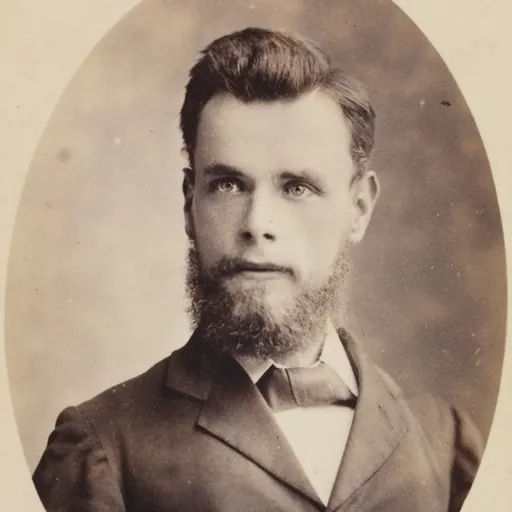
About Thomas Curnow
Lived 1855 – 1922 (aged 66–67). Thomas Curnow was a British school teacher.
Thomas Curnow (4 June 1855 – 20 December 1922) was an English-born Australian schoolteacher who helped prevent the derailment of a police train by the Kelly gang, led by bushranger and outlaw Ned Kelly. Curnow's actions are credited with saving the lives of 27 passengers, including civilians.
Raised in Ballarat, Victoria, Curnow taught at the state school in Glenrowan, a small town north-east of Melbourne. In 1880, the Kelly gang took over the town and held many of its residents hostage, including Curnow and his wife. The outlaws had nearby railway tracks torn up in order to derail and ambush a police special train. After learning of the plot, Curnow aimed to thwart it by pretending to be a sympathiser of the gang. Having won Kelly's confidence, the outlaw allowed him and his wife to return home. Curnow then headed to the railway line and, as the train approached, he improvised a warning signal using a lit candle behind a red scarf. This successfully flagged down the pilot engine, which had been sent in advance of the police special as a lookout. After telling the driver of the Kellys and sabotaged track, Curnow returned home while the police proceeded to Glenrowan. In the resulting siege and shootout, Kelly was captured and the other three gang members (Joe Byrne, Steve Hart and Dan Kelly) were killed.
Due to his role in the gang's demise, Curnow received death threats from Kelly sympathisers, and the Victorian government subsequently relocated him and his family to Ballarat, where he spent the rest of his life. Among the claimants for the £8,000 bounty on the gang's heads, Curnow received the largest portion with £1,000, and was awarded the Victorian Humane Society's annual medal for bravery. Today, Curnow is a relatively obscure figure in Australian history, overshadowed by the widespread fame of the Kelly gang.
Family and early life Curnow was born on 4 June 1855 at Gwennap, Cornwall, to Thomas, who worked as a copper miner, and Ann (née Trewartha). His parents married in April 1852 and would eventually have seven children, Thomas being the second eldest. The Curnows resided at the small village of Trevarth, outside Gwennap.
The Curnows migrated to the Colony of Victoria, Australia, by 1857, settling in Ballarat. In the 1870s, Thomas Curnow studied to be a teacher, and in July 1876 he was appointed the head teacher at the state school in Glenrowan, a small country town north-east of Melbourne.
Hostages dancing with the outlaws. Curnow danced with Dan Kelly. Curnow also learned that, after derailing and ambushing the train, the gang planned to raid Benalla. While scheming of ways to thwart their plans, Curnow resolved to pretend to be a sympathiser of the gang, to gain their trust. As the hours passed without sight of the train, the outlaws staged sporting games and held dances to keep the hostages entertained. Upon Kelly's request, Curnow's brother-in-law Mortimer supplied music on a concertina. When Dan invited Curnow to dance, the schoolteacher said he needed to go home first and fetch his dancing shoes, and asked Ned to accompany him. On the way, they would have to pass the police barracks, Curnow hoping that the town policeman, Constable Hugh Bracken, would see Ned and raise the alarm.
Curnow flagging down the pilot engine. The police special train can be seen in the distance. Meanwhile, Ned and Byrne had taken Curnow and a few other hostages to the police barracks to capture Constable Bracken. Curnow convinced Ned to use Mortimer to lure Bracken out, "as the trooper knew his voice well, and would suspect nothing". The Minister of Education, Robert Ramsay, praised Curnow's actions as highly meritorious, emphasising that had he not flagged down the train, many lives would have been lost.
That same month, a Kelly Reward Board was established to assess claims for the £8,000 reward for the gang's capture. It was largely distributed among the police involved in the hunt for the gang and in the Glenrowan shootout. Superintendent Hare, who left the gun battle early due to a bullet wound, received the largest portion with £800. Curnow initially received £550 but appealed for more, pointing out that his family had suffered financially from the forced relocation and that £550 barely covered his losses, including the pay cut he had taken teaching at a new school in Ballarat. and according to The Argus, "ninety-nine men out of a hundred will, we are sure, agree that the substantial donation should be awarded to the schoolmaster instead of the police officer." Premier Graham Berry was also highly critical of the distribution of the funds, saying during a speech in Geelong that "Curnow ought to have received the whole of the money". Curnow eventually received an additional £450 and a mantle clock, making him the recipient of the largest award.
On 22 July 1881, the Victorian Humane Society awarded Curnow its silver medal, then the society's highest honour and given annually for acts of great courage. In presenting the medal to Curnow at the Melbourne Town Hall, the governor of Victoria, George Phipps, 2nd Marquess of Normanby, said "owing to your courage and presence of mind, not only that the special train which contained the police was saved from being wrecked as the outlaws intended, but also that those outlaws were brought to justice."
Despite having left "Kelly Country", Curnow continued to receive death threats, and he told one reporter in 1881 that even in Ballarat, he and his wife "[lived] in a state of constant watchfulness and expectation of something injurious being done to us." One relative recalled Curnow being threatened as he walked through a Ballarat park, but he pretended not to hear. Owing to such incidents, he was reportedly granted a permit to carry firearms. False reports were also circulated that Curnow was living under an assumed name in Gippsland, possibly as a smokescreen.
Later life After the birth of Muriel (1879–1952), Curnow and Jean had three more children: Isobel (1881–1934), Thomas (1883–1918) and Leonard (1887–1958). The couple also gave birth to stillborn twins in 1886.
Curnow rarely talked about the Glenrowan affair, and out of respect, those close to him seldom mentioned or alluded to it. Even so, he was said to have no regrets. One journalist who met Curnow in old age wrote:
Curnow retired from teaching on 30 June 1915. His retirement received press coverage throughout Australia.
In most plays and films about the Kelly gang, Curnow is a minor character—often depicted, according to Geoffrey Robertson, as "an ugly, elderly pedant, a caricature dobber-inner". Reviewing a 1956 performance of Douglas Stewart's play Ned Kelly (1942), The Bulletin wrote that actor Frank Lloyd's Curnow "is a good version of the character as conceived—a sly and wily little schoolteacher who brings Ned down... sufficiently unimpressive for Ned to let him leave the hotel without worrying about the consequences." In Peter Carey's Booker Prize–winning novel True History of the Kelly Gang (2000), Curnow is elevated as an important character who encourages Kelly to write the autobiography that becomes the bulk of the text. After betraying Kelly to the police, and during the outlaw's last stand and capture at Glenrowan, Curnow takes possession of Kelly's manuscript. At the end of the novel, a third-person narrative, signed "S.C." and dating from the year after Curnow's death, describes both the schoolteacher's public outrage at Kelly's celebrity, and his private, lifelong obsession with the manuscript, which, according to S.C., "seems to have made its own private demands upon his sympathy".
Efforts have been made to bring Curnow greater public recognition and highlight his heroism. The Argus ran a comic in 1947 titled The School Teacher Who Did Not Fear Ned Kelly. In a 1949 article attacking Ned Kelly hagiography, Sydney journalist James Taylor wrote that Curnow "was, as far as I have been able to discover, the only man to show the slightest initiative during the whole costly chase". In 1973, when a plaque was unveiled marking the spot where Kelly had the railway tracks torn up, journalist Keith Dunstan argued: "Actually, Curnow, the schoolteacher who risked death to warn the train, is the man who deserved a mention in bronze." When invited to contribute an essay to a book on Australian Greats, Geoffrey Robertson submitted "As Game as Tom Curnow", the title referencing and challenging the Australian expression for bravery, "as game as Ned Kelly". In 2016, playwright and screenwriter Kenneth G. Ross said he was writing a novel about Curnow.
The red scarf used by Curnow to flag down the train was cut up and distributed among relatives. These fragments have ended up in various public and private collections, and have also appeared at auction. Fragments are held at the State Library of New South Wales, Sydney, and the Victorian branch of the National Trust. Another featured in a 2024 episode of the British television series Antiques Roadshow.
Don’t just read it —
keep it.
Full-length biographies made to live with: read them, listen on the way to work, watch them tonight.
- E-book
- Audio
- Video
Instant download · yours to keep · every purchase keeps this site free
Important facts
People in Thomas Curnow's life
Named in this biography and alive at the same time





Related people
Same field, nearest in time


Contemporaries
People whose lives overlapped Thomas Curnow's


Frequently asked questions
Who was Thomas Curnow?
Australian schoolteacher
When was Thomas Curnow born?
Thomas Curnow was born in 1855.
When did Thomas Curnow die?
Thomas Curnow died in 1922.
What was Thomas Curnow's occupation?
Thomas Curnow was a school teacher.
What nationality was Thomas Curnow?
Thomas Curnow was British.
Sources & further reading
Cite this page
APA: Biography.guide. (2026). Thomas Curnow. https://biography.guide/thomas-curnow/
MLA: "Thomas Curnow." Biography.guide, https://biography.guide/thomas-curnow/.
Chicago: "Thomas Curnow." Biography.guide. https://biography.guide/thomas-curnow/.
Data last updated: 2026-09-20 · Spot an error? Report a correction.
Portrait: Wikimedia Commons · author & licence
Page generated 2026-09-27 04:58 UTC