
About Thomas Connolly
Lived 1909 – 1996 (aged 86). Thomas Connolly was an American artistic gymnast.
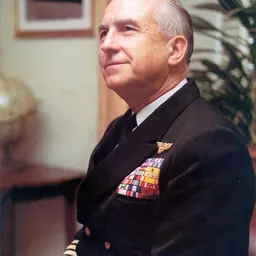
Vice Admiral Thomas Francis Connolly Jr. (October 24, 1909 – May 24, 1996) was a three-star rank admiral in the United States Navy, aviator, and gymnast. As a member of the United States men's national artistic gymnastics team, he won an Olympic bronze medal at the 1932 Summer Olympics.
Connolly served in the Navy for 38 years. Over his career he served in World War II, oversaw the development of a program that later evolved into the United States Naval Test Pilot School, commanded two aircraft carriers, and served as Deputy Chief of Naval Operations for Air Warfare, retiring from that post in 1971.
Connolly was instrumental in developing the Grumman F-14 Tomcat. The plane was named in his honor and for Thomas Hinman Moorer, then Chief of Naval Operations.
Early life and education Connolly was born in St. Paul, Minnesota. Most of his childhood was spent in Los Angeles.
Naval career Connolly graduated 52nd out of a class of 435 at the Naval Academy. Following graduation from the Naval Academy in 1933, Connolly was ordered to Naval Air Station Pensacola for flight training and subsequently received his naval aviator wings. In 1939 he was assigned to conduct postgraduate studies in aeronautical engineering at the Naval Academy. He received a master's degree in the subject at the Massachusetts Institute of Technology in 1942. He remained at that posting until September 1944. During his time in command, the unit saw action at the Gilbert Islands, the Marshall Islands, and bombed Wake Island. While serving in command of this unit, he was awarded the Distinguished Flying Cross and the Air Medal, both with two gold stars indicating additional awards. During his time at Patuxent, Connolly found nobody communicated in the same technical language as he worked with multiple personnel from different fields. As a result, he recommended starting a school within the command to train pilots and engineers to use the same language. This school began operating in 1945. This school became the Test Pilot Training Division, and would later evolve into the United States Navy Test Pilot School. In early 1947, he commenced a tour at sea as executive officer of , completing the tour in September 1948. Connolly returned to Patuxent and became the second commander of the Test Pilot School in December 1948. While in command of the school, he qualified as a helicopter pilot. Connolly remained the commander of the school until April 1951.
On August 21, 1957, he assumed command of the aircraft carrier . During his time as commander, Hornet deployed to the Western Pacific in the United States Seventh Fleet area of operations. He remained in command until August 25, 1958. In 1958, he assumed the position of Assistant Chief of the Pacific Missile Range within the Bureau of Aeronautics. It was during this time that he put together a group that came to be known as the "Connolly Committee". That group's seminal work was "The Navy in the Space Age". This group's work and recommendations were approved by the Chief of Naval Operations on July 13, 1959, and became pivotal in the development of the Navy Navigation Satellite System, the first system of its kind in the world. Following this posting, Connolly was Commander, Carrier Division Seven.
From May 18, 1964, to August 28, 1965, he was Assistant Chief of Naval Operations for Fleet Operations and Readiness. During this posting, he was the Director of the Combat Consumables Requirement Study (Non-Nuclear Ordnance Study), for which he received the Legion of Merit. On October 30, 1965, he became Commander, Naval Air Forces Pacific in a ceremony held onboard the carrier . On November 1, 1966, he was appointed to the position of Deputy Chief of Naval Operations for Air Warfare.
Role in F-14 development During the time of his posting as DCNO for Air Warfare, the Navy was developing the TFX Program together with the Air Force. The Navy's version of this replacement for the F4 Phantom II was the General Dynamics–Grumman F-111B. As American air operations in the Vietnam War ramped up, the Navy's requirements for the plane evolved to include capabilities for air combat manoeuvring, a task for which the F-111 was not designed. In 1968, during testimony before the United States Senate Committee on Armed Services, Connolly was asked by chairman John C. Stennis for his opinion on what would make the F-111B work for naval service. He responded, "There isn't enough power in all Christendom to make that airplane what we want!". On being contradicted by Secretary of the Navy Paul Ignatius, who referenced a report written by Connolly the prior year that praised the F-111B, Connolly reversed himself. Nevertheless, Connolly's testimony was the death knell for the F-111B project, with it being cancelled in May 1968. Subsequently, Connolly effectively became the F-14 project manager.
Honors Connolly was awarded Tailhooker Of The Year in 1969 by the Tailhook Association. In 1998 he was inducted into the Naval Aviation Hall of Honor, and in 1999, he was inducted into the Michigan Aviation Hall of Fame.
Don’t just read it —
keep it.
Full-length biographies made to live with: read them, listen on the way to work, watch them tonight.
- E-book
- Audio
- Video
Instant download · yours to keep · every purchase keeps this site free
Important facts
People in Thomas Connolly's life
Named in this biography and alive at the same time


Related people
Same field, nearest in time
Contemporaries
People whose lives overlapped Thomas Connolly's




Frequently asked questions
Who was Thomas Connolly?
gymnast (1909-1996)
When was Thomas Connolly born?
Thomas Connolly was born on 24 October 1909 in Saint Paul.
When did Thomas Connolly die?
Thomas Connolly died on 24 May 1996 in Holland.
What was Thomas Connolly's occupation?
Thomas Connolly was an artistic gymnast.
What nationality was Thomas Connolly?
Thomas Connolly was American.
Sources & further reading
Cite this page
APA: Biography.guide. (2026). Thomas Connolly. https://biography.guide/thomas-connolly/
MLA: "Thomas Connolly." Biography.guide, https://biography.guide/thomas-connolly/.
Chicago: "Thomas Connolly." Biography.guide. https://biography.guide/thomas-connolly/.
Data last updated: 2026-09-26 · Spot an error? Report a correction.
Page generated 2026-09-27 05:15 UTC