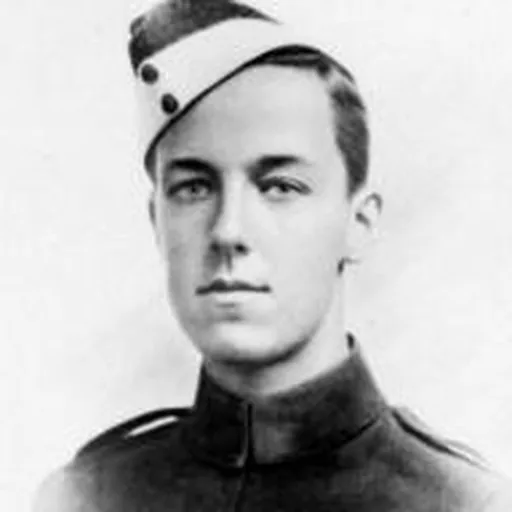
Thomas Baker
Australian soldier, aviator and flying ace of the First World War
About Thomas Baker
Lived 1897 – 1918 (aged 21). Thomas Baker was an Australian aircraft pilot and flying ace.
Thomas Charles Richmond Baker, (2 May 1897 – 4 November 1918) was an Australian soldier, aviator, and flying ace of the First World War. Born in Smithfield, South Australia, he was an active sportsman in his youth and developed a keen interest in aviation. He was employed as a clerk with the Bank of New South Wales, before he enlisted in the Australian Imperial Force in July 1915, for service in World War I. Posted to an artillery unit on the Western Front, he was awarded the Military Medal for carrying out numerous repairs on a communications line while subject to severe artillery fire. In June 1917, Baker was awarded a bar to his decoration for his part in quelling a fire in one of the artillery gun pits that was endangering approximately 300 rounds of shrapnel and high explosive.
In September 1917, Baker applied for a position as a mechanic in the Australian Flying Corps. He was instead selected for flight training, and was posted to courses in the United Kingdom. He graduated as a pilot and was commissioned a second lieutenant in March 1918. Posted for active duty in France that June, Baker joined the ranks of No. 4 Squadron AFC. Over the next four months, he rose to the rank of captain and was credited with bringing down 12 German aircraft. He was shot down and killed on 4 November 1918. In February 1919, he was posthumously awarded the Distinguished Flying Cross.
Early life Thomas Charles Richmond Baker was born in Smithfield, South Australia, on 2 May 1897, the eldest son of Richmond Baker, a schoolmaster and farmer, and his wife Annie Martha (née Gardner). He was educated at St Peter's College in Adelaide. During his school years Baker was an active sportsman, taking part in rowing, tennis and football, in addition to being a member of the cadet corps. In his youth, he acquired an avid interest in aviation, and the construction of model aeroplanes became "his chief hobby". Graduating from secondary school in 1914, he gained employment as a clerk with the Adelaide branch of the Bank of New South Wales. During this time, he joined the 11th Royal Australian Engineers of the Citizens Military Force.
First World War Australian Imperial Force On 29 July 1915, Baker enlisted in the Australian Imperial Force for service during the First World War. Allocated as a reinforcement to the 6th Field Artillery Brigade with the rank of gunner, he embarked from Melbourne aboard HMAT Persic on 22 November, bound for Egypt. On arrival, Baker was posted to the 16th Battery before moving to France for service on the Western Front. The announcement for the decoration was published in a supplement to The London Gazette on 19 February 1917.
In 1917, the 16th Battery was relocated to the Messines sector of the frontline in Belgium. During the afternoon of 21 June, the unit's position was subject to a severe bombardment of artillery shelling, resulting in an order for all men to evacuate the gun pits and seek cover. As a consequence of the barrage, the camouflage covering one of the gun pits caught fire, endangering approximately 300 rounds of shrapnel and high explosives. The battery sergeant major immediately called for men to assist him in quelling the blaze; Baker and three others volunteered. Despite the continuous shellfire, the four men promptly set about retrieving water from a nearby well and shellholes with buckets "at great personal risk", dousing the fire. The camouflage had been completely destroyed, several sand bags had caught fire, and a few rounds of ammunition were charred. As a result of their actions, Baker's three companions were recommended for the Military Medal, and Baker for a bar to his. The announcement of the decorations was promogulated in a supplement to the London Gazette on 21 August 1917.
Australian Flying Corps alt=Two men in military uniform in a building. The man on the left has something in his mouth and is sitting down looking at some papers, angled away from the camera. The men on the right is smiling and looking at the camera. The roof of the structure is curved. Gunners Baker and Harrison of the 16th Battery relax in a dugout c. 1916
In September 1917, Baker followed his ambition of joining the Australian Flying Corps and applied for a transfer to become an air mechanic when the opportunity arose. His application proved successful, though he was instead selected to become a pilot and was posted for flight training.
Throughout August 1918, No. 4 Squadron "maintained a high operational tempo" as the Allies launched a new offensive on the Western Front. On 7 August, Baker and two others took off from their squadron aerodrome at Reclinghem; all three machines were carrying a heavy load of bombs. Airborne over Pont-du-Hem, the trio released their bombs over German billets in the area, before spotting two Albatros D.Vs. The three Australians closed in on the two aircraft. Baker engaged an Albatros, his fire severing the left wing of the aircraft, effectively destroying the machine. Nine days later, a formation of 65 aircraft was assembled from No. 88 Squadron RAF, No. 92 Squadron RAF, No. 2 Squadron AFC and Baker's No. 4 Squadron AFC to execute a mass raid on the German aerodrome at Haubourdin. The fleet of aircraft was equipped with a range of incendiary and explosive bombs, in addition to machine gun ammunition. Led by Captain Harry Cobby, the aircraft from No. 4 Squadron were the first to sweep down and assault the target. At one point, Baker pursued a staff car until the vehicle ran up an embankment and flipped over. He later reported that "No one left the car". The raid, which was the largest aerial attack by Allied forces to that date, was highly successful; British estimates concluded that 37 German aeroplanes had been destroyed.
alt=A dresser with a large mirror and a bottle of wine, a glass and some papers sitting on top. A man in military uniform can be seen in the mirror's reflection. He has his hand in his pocket, and is using a camera on a tripod.
On 19 August, Baker led a patrol of six aircraft over Lys. Five days later, he shot down a German balloon while on a lone mission in poor weather, scoring his third aerial victory. At dawn on 30 August, Baker took off on a sortie with Lieutenants Roy King and Oscar Ramsay. Over Laventie, the trio encountered three DFW C.Vs; Baker and King each disposed of one of the aircraft. Baker was granted two weeks' leave to the United Kingdom in early September. In all, the Australians destroyed five of the Fokkers before the engagement ended. During the second excursion, he brought one Fokker down out of control, before shooting the other down over Ath. He was airborne again on an offensive patrol the next day. Fifteen Snipes from No. 4 Squadron were detailed for the patrol, and as the party drew near Tournai they encountered approximately 60 Fokker planes already engaged with several British aircraft. Baker led five of the Snipes into the assault, but confusion reigned for several minutes before the men could gain their bearings in the fight. Baker assailed two Fokkers that had been pursuing another Snipe, and was able to destroy one of the aircraft. The Fokker proved to be Baker's twelfth, and final, aerial victory of the war; he had scored his last five victories in a period of three days. Baker and fellow ace Lieutenant Arthur Palliser were initially recorded as missing, but were later found to have fallen victim to Rittmeister Carl Bolle during the battle. His aerial victories were broken down as seven aircraft and one balloon destroyed with an additional four planes driven down out of control, making him No. 4 Squadron's fourth highest scoring ace after Harry Cobby, Roy King and Edgar McCloughry. A stained-glass window at St John's Church of England in Adelaide is dedicated to his memory.
Don’t just read it —
keep it.
Full-length biographies made to live with: read them, listen on the way to work, watch them tonight.
- E-book
- Audio
- Video
Instant download · yours to keep · every purchase keeps this site free
Important facts
People in Thomas Baker's life
Named in this biography and alive at the same time




Related people
Same field, nearest in time
Contemporaries
People whose lives overlapped Thomas Baker's



Frequently asked questions
Who was Thomas Baker?
Australian soldier, aviator and flying ace of the First World War
When was Thomas Baker born?
Thomas Baker was born on 2 May 1897 in Smithfield.
When did Thomas Baker die?
Thomas Baker died on 4 November 1918 in Ath.
What was Thomas Baker's occupation?
Thomas Baker was an aircraft pilot and flying ace.
What nationality was Thomas Baker?
Thomas Baker was Australian.
Sources & further reading
· DBpedia: Thomas Baker (aviator)
Cite this page
APA: Biography.guide. (2026). Thomas Baker. https://biography.guide/thomas-baker-aircraft-pilot/
MLA: "Thomas Baker." Biography.guide, https://biography.guide/thomas-baker-aircraft-pilot/.
Chicago: "Thomas Baker." Biography.guide. https://biography.guide/thomas-baker-aircraft-pilot/.
Data last updated: 2026-09-21 · Spot an error? Report a correction.
Portrait: Wikimedia Commons · author & licence
Page generated 2026-09-27 04:59 UTC