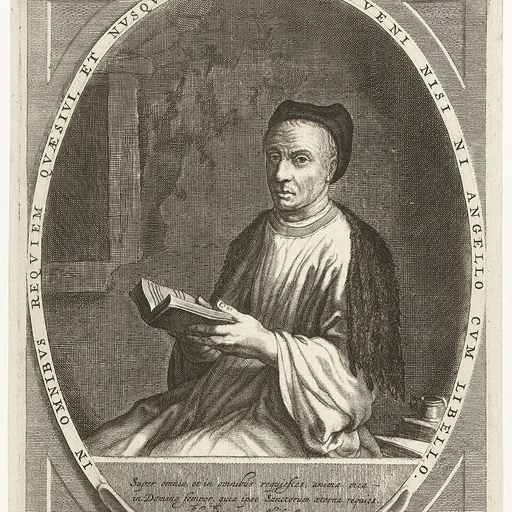
About Thomas à Kempis
Lived 1380 – 1471 (aged 90–91). Thomas à Kempis was a writer, philosopher, catholic priest, poet, canon and mystic.
Monument on Mount Saint Agnes in Zwolle "Here lived Thomas van Kempen in the service of the Lord and wrote his Imitation of Christ, 1406–1471"
Thomas à Kempis ( – 1 May 1471; ; ) was a German-Dutch Catholic canon regular of the Augustinians and the author of The Imitation of Christ, one of the best known Christian devotional books. His name means "Thomas of Kempen", Kempen, Germany, being his home town.
He was a member of the Congregation of Windesheim, which was part of the Modern Devotion, a reform movement during the late medieval period. Therein, he was a follower of Geert Groote and Florens Radewyns, the founders of the Brethren of the Common Life, of which the Windesheim Augustinians were an offshoot.
Life Thomas was born in Kempen in the Rhineland. His surname at birth was Hemerken (or Hammerlein, Latinized as Malleolus). His father, Johann, was a blacksmith, and his mother, Gertrud, was a schoolmistress.
In 1392, Thomas followed his brother, Johann, to Deventer in the Netherlands in order to attend the noted Latin school there. While attending this school, Thomas encountered the Brethren of the Common Life, followers of Gerard Groote's Modern Devotion. He attended school in Deventer from 1392 to 1399.
His first tenure of office as subprior was interrupted by the exile of the community from Agnetenberg in 1429. A dispute had arisen in connection with an appointment to the vacant See of Utrecht. Pope Martin V rejected the nomination of Bishop-elect Rudolf van Diepholt, and imposed an interdict. The Canons remained in exile in observance of the interdict until the question was settled in 1432. During this time, Thomas was sent to Arnhem to care for his ailing brother, where he remained until his brother died in November 1432.
Otherwise, Thomas spent his time between devotional exercises in writing and in copying manuscripts. He copied the Bible no fewer than four times, one of the copies being preserved at Darmstadt, Germany, in five volumes. In its teachings he was widely read and his works abound with biblical quotations, especially from the New Testament.
As subprior he was charged with instructing novices, and in that capacity wrote four booklets between 1418 and 1427, later collected and named after the title of the first chapter of the first booklet: The Imitation of Christ. Thomas More said it was one of the three books everybody ought to own. Thirteen translations of The Imitation of Christ and three paraphrases in English seem to have been published between 1500 and 1700. Thomas died near Zwolle in 1471. There is a legend that he was denied canonization some 200 years after his death by the Catholic Church due to the presence of scratch marks on the interior of his coffin lid, which supposedly disqualifies him from sainthood as it would mean he did not peacefully embrace death. However, there is scant evidence to support that he was buried alive or the idea that the Church would have denied him sainthood if they did discover he died in this manner.
Works
Kempis's 1441 autograph manuscript of The Imitation of Christ is available in the Bibliothèque Royale in Brussels (shelfmark: MS 5455-61). His important works include a series of sermons to the novices of St. Augustine Monastery, including Prayers and Meditations on the Life of Christ, Meditations on the Incarnation of Christ, Of True Compunction of Heart, Soliloquy of the Soul, Garden of Roses, Valley of Lilies, and a Life of St. Lidwina of Schiedam.
Quotations The following quotes are attributed to him:
Veneration A monument was dedicated to his memory in the presence of the archbishop of Utrecht in St Michael's Church, Zwolle, on 11 November 1897. In 1964, this church closed, causing his shrine to be moved to a new St Michael's Church outside the centre of Zwolle. In 2005, this church also closed and his shrine was moved to the Onze-Lieve-Vrouw-ten-Hemelopneming kerk (Assumption of Mary church) in the centre of Zwolle.
Don’t just read it —
keep it.
Full-length biographies made to live with: read them, listen on the way to work, watch them tonight.
- E-book
- Audio
- Video
Instant download · yours to keep · every purchase keeps this site free
Important facts
more
Thomas von Kempen à Kempis, Thomas Hammerlein, Thomas von KempenPeople in Thomas à Kempis's life
Named in this biography and alive at the same time




Related people
Same field, nearest in time


Contemporaries
People whose lives overlapped Thomas à Kempis's



Frequently asked questions
Who was Thomas à Kempis?
German canon regular
When was Thomas à Kempis born?
Thomas à Kempis was born in 1380 in Kempen.
When did Thomas à Kempis die?
Thomas à Kempis died on 25 July 1471 in Zwolle.
What was Thomas à Kempis's occupation?
Thomas à Kempis was a writer, philosopher, catholic priest, poet, canon and mystic.
What nationality was Thomas à Kempis?
Thomas à Kempis's recorded nationality: Burgundian Netherlands.
Sources & further reading
Cite this page
APA: Biography.guide. (2026). Thomas à Kempis. https://biography.guide/thomas-a-kempis/
MLA: "Thomas à Kempis." Biography.guide, https://biography.guide/thomas-a-kempis/.
Chicago: "Thomas à Kempis." Biography.guide. https://biography.guide/thomas-a-kempis/.
Data last updated: 2026-09-23 · Spot an error? Report a correction.
Portrait: Wikimedia Commons · author & licence
Page generated 2026-09-27 05:06 UTC