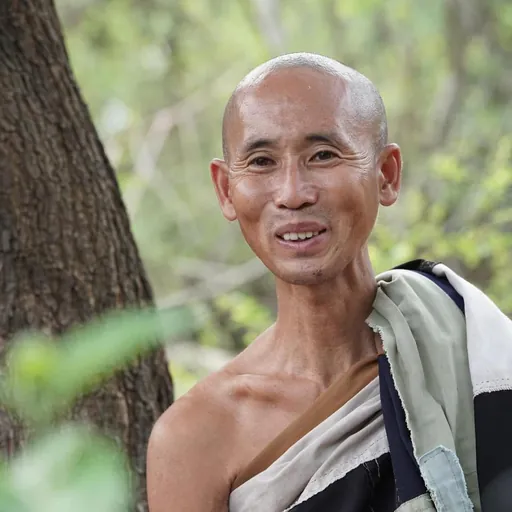
Thich Minh Tue
Vietnamese Dhutanga practitioner
About Thich Minh Tue
Born 1981. Thich Minh Tue is a Vietnamese cadastral surveyor and mendicant.
Thích Minh Tuệ (born 1981), birth name Lê Anh Tú is a Vietnamese Buddhist mendicant monk and Dhutanga practitioner. After briefly practicing at a pagoda after giving up his job as a land surveyor, Thich Minh Tue decided to "learn and follow the Buddha's teachings" by observing the 13 ascetic practices of Primitive Buddhism and walking for alms across the country for many years. His 2024 walking journey attracted the attention of the Vietnamese public, with thousands meeting him and at times up to hundreds following him, leading to many social and security disturbances, and turning him into an "unwilling" Internet celebrity. Although Thích Minh Tuệ does not see himself as a monk, his simple, ascetic lifestyle has led many to view him as one. Walking barefoot across Vietnam with few possessions, he embodies the spirit of renunciation and mindfulness. To his followers and many in the public, he represents a return to the core values of Buddhism—compassion, humility, and inner peace—challenging traditional definitions of monastic life. His legitimacy is also a widely discussed topic. The state-controlled Vietnam Buddhist Sangha does not accept calling him a "Buddhist monk", Following this, Thích Minh Tuệ went into seclusion, and restrictions were imposed on others attempting to join or emulate his ascetic practices. These actions have sparked significant concerns among international human rights organizations regarding the state of religious freedom in Vietnam. Thich Minh Tue began his barefoot pilgrimage to India on December 12, 2024, walking with several mendicants through Laos, Thailand, Malaysia, Sri Lanka, India and Nepal after consulting with individuals familiar with administrative procedures. Thích Minh Tuệ has been accompanied by a retired Vietnamese police officer, appointed by authorities as his "bodyguard", whose tight control over logistics and media, including restricting journalists’ access and questions, has sparked criticism for suppressing his influence.
Biography Lê Anh Tú was born in 1981 in Ky Van commune, Ky Anh district, Ha Tinh province, Vietnam. He was the second child in a family of four children. In 1994, he moved with his family to Ia To commune, Ia Grai district, Gia Lai province.
In Gia Lai, after completing high school, he served in the military for three years. After demobilization, he attended the Tay Nguyen College of Forestry; after graduating, he worked as a land surveyor for a private company based in Gia Lai province.
In 2015, Le Anh Tu decided to leave the secular world and become a monk, taking the dharma name Thích Minh Tuệ, or shortly Minh Tuệ. He then left the monastery and went into solitary retreat in the mountains, living in a cave and begging for food daily. From 2018 to 2023, Minh Tue embarked on three walking pilgrimages as part of his "Dhutanga" practice, but these went nearly unnoticed, although there are some videos about him leaked on YouTube. His fourth pilgrimage in 2024, however, drew widespread attention, with crowds of up to thousands of people following him on his journey. He ended his alms-begging pilgrimage in early June of the following year after discussions with Vietnamese authorities.
VnExpress quoted Thích Minh Tuệ as saying that he has never claimed to be a monk and he himself also "feels unworthy of being a monk because his morality has not yet reached that level". The Vietnam Buddhist Sangha also affirmed that he is not a Buddhist monk, does not practice, and is not a staff member of any temple or monastery of the Vietnam Buddhist Sangha.
Pilgrimage to India He started his journey on foot to India in December 2024, traveling from Vietnam through Laos and Thailand, with plans to cross into Myanmar before continuing westward. However, he faces significant challenges, including visa issues in Thailand, extreme weather conditions, and a knee injury among his companions. The greatest obstacle is crossing into Myanmar, where ongoing conflict has made his intended route through Mae Sot dangerous, forcing him to consider an alternative entry via Shan State.
Impact Adopting the image of an anonymous person who states he is 'learning' according to Buddha's teachings and walking barefoot across the country, Thích Minh Tuệ has become an internet phenomenon in Vietnam. Some people have also used his image on social media to increase interaction for online businesses. Even on e-commerce platforms and social networks, there have been clothes and accessories designed in the colors of his attire. His personal activities such as sleeping, bathing, and using the toilet have also been disturbed. This internet phenomenon was likened to "view parties" by Dân Việt newspaper, reflecting the problem of excessive praise by content creators on digital platforms. Father Anton Maria Vu Quoc Thinh of the Society of Jesus called to inquire about Venerable Minh Dao after hearing that he had been disciplined. In the following days, several cases of heatstroke were reported. The crowds following Thich Minh Tue caused traffic congestion, refused to give way to ambulances, littered, and defecated indiscriminately, causing unsanitary conditions, according to state press.
According to information from the Committee for Religious Affairs of the Vietnamese government, Mr. Thich Minh Tue has voluntarily stopped his pilgrimage on foot since June 3, 2024.
Reception Professor Dr. Nguyễn Hữu Liêm commented that the almsgiving of Buddhist monks from the past to the present is not unusual, so he also considers Thích Minh Tuệ's journey as normal. According to Venerable Thích Thanh Huân, the "Thích Minh Tuệ phenomenon" is not noteworthy. The newspaper Công Thương observed that although he does not reside in any temple and has chosen his own path for his practice, Thích Minh Tuệ has become "inadvertently famous". Without delving much into Thích Minh Tuệ's practice, the newspaper focused on criticizing the public's interest in him, calling it "a disaster born from social media addiction". Journalist Nguyễn Mạnh Hà, in an article for BBC News, commented that following Thích Minh Tuệ's journey has become a daily habit for many Vietnamese, but also noted that he is "inadvertently" taking on the role of the abbot of a "mobile temple". The news outlet also emphasized that it is Thích Minh Tuệ's "simple, rustic" words that attract the public, even though he does not deliver profound sermons.
Thích Minh Tuệ's fame has drawn members of the Vietnamese entertainment industry into the debate. Actress frequently posted critical comments about him and his followers on her social media accounts, even calling him a "villain." She is a disciple of Venerable , the abbot of Thiền Tôn Phật Quang mega temple in Bà Rịa–Vũng Tàu province, who has also harshly criticized Thích Minh Tuệ, referring to him as a "con man." She later issued an apology, deleted all comments directed at Thích Minh Tuệ, and expressed hope for public understanding, stating that she is "still on the path of learning the way."
In response to the Vietnamese Buddhist Sangha's document not recognizing Thích Minh Tuệ as a Buddhist monk, Dr. Hoàng Văn Chung, Head of the Department of Theoretical Research and Religious Policy at the Institute for Religious Studies, expressed his opinion: "As long as people believe and practice Buddhism, they have their rights. It is not necessary for them to have recognition from the Buddhist Sangha to be considered a Buddhist monk. Buddhism does not belong to anyone in particular." According to monk Thích Đồng Long from the Unified Buddhist Sangha of Vietnam, an organization not under the control of the Vietnamese government, the notion that one is not a true monk if not recognized by the Vietnamese Buddhist Sangha is "mistaken," indicating a lack of religious freedom in the country. On June 4, 2024, following reports that Thích Minh Tuệ had been forcibly stopped from his pilgrimage and taken away, the Unified Buddhist Sangha of Vietnam issued a statement affirming that he had maintained the proper conduct of a Buddhist monk and called on the Vietnamese authorities to allow him to practice his faith freely.
Don’t just read it —
keep it.
Full-length biographies made to live with: read them, listen on the way to work, watch them tonight.
- E-book
- Audio
- Video
Instant download · yours to keep · every purchase keeps this site free
Important facts
People in Thich Minh Tue's life
Named in this biography and alive at the same time

Contemporaries
People whose lives overlapped Thich Minh Tue's


Frequently asked questions
Who is Thich Minh Tue?
Vietnamese Dhutanga practitioner
When was Thich Minh Tue born?
Thich Minh Tue was born in 1981 in Kỳ Anh.
What is Thich Minh Tue's occupation?
Thich Minh Tue is a cadastral surveyor and mendicant.
What nationality is Thich Minh Tue?
Thich Minh Tue is Vietnamese.
Sources & further reading
Cite this page
APA: Biography.guide. (2026). Thich Minh Tue. https://biography.guide/thich-minh-tue/
MLA: "Thich Minh Tue." Biography.guide, https://biography.guide/thich-minh-tue/.
Chicago: "Thich Minh Tue." Biography.guide. https://biography.guide/thich-minh-tue/.
Data last updated: 2026-09-22 · Spot an error? Report a correction.
Portrait: Wikimedia Commons · author & licence
Page generated 2026-09-27 05:04 UTC