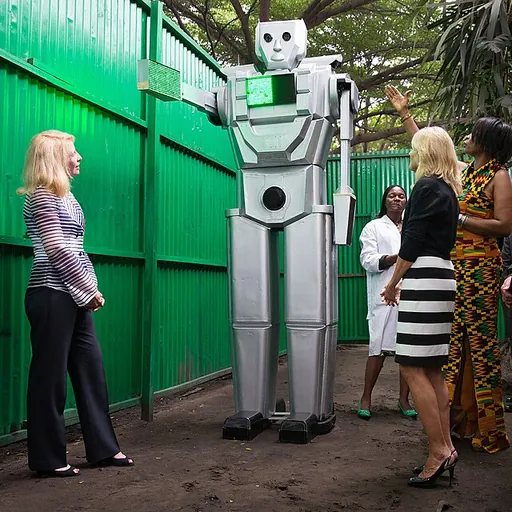
About Thérèse Kirongozi
Born 1973. Thérèse Kirongozi is a Congolese engineer and businessperson.
Thérèse Izay Kirongozi (born 3 June 1973) is a Congolese industrial engineer. She is notable for designing traffic robots that were initially placed in two locations in Kinshasa towards the end of 2013. By 2015 five robots were in use in Kinshasa and one in Lubumbashi. The use of robots as traffic lights may be unique to the Democratic Republic of Congo.
Early life Kirongozi was born in Kinshasa, Zaire (now the Democratic Republic of Congo) on 3 June 1973. She studied in her hometown before starting undergraduate studies at the Higher Institute of Applied Techniques. From an early age, Kirongozi had an interest in traffic safety after witnessing her brother being crushed by a vehicle.
Traffic robots Kirongozi is known for her development of humanoid robots that regulate traffic in Kinshasa. The idea for traffic robots first came to Kirongozi and a few of her peers at the Higher Institute of Applied Technique. Kirongozi has stated she was motivated by the ease with which people could speed, run red lights, and flee or bribe their way out of consequences. She wanted something more reliable and incorruptible on the roads to enforce traffic laws. Robots, she thought, could make sure that people were accountable to the rule of law, and could help the state recoup some revenue, potentially funding further infrastructure developments. The robots are manufactured by Women's Technology (Wotech), an association headed by Kirongozi.
Early stages and design The first generation of robots was commissioned in 2013 and cost about 15,000 dollars each to manufacture, while the latest generation unveiled on 4 March 2015, cost about 27,500 dollars each. They weigh each, are high and are made of aluminium to better withstand the equatorial climate. The autonomy of the robots is provided by a solar panel placed over their head. The solar panels that power the robots could prove a major asset in a city where whole districts still lack electrical power. Made of aluminium, the robots are designed to resist a harsh equatorial climate with high temperatures, humidity and massive downpours. These humanoid traffic robots can rotate their chest and raise their arms like a human traffic officer would do to stop vehicles in one direction, and allow their flow in another one. Some of these robots can detect pedestrians and are programmed to “speak” to tell them when the road can be crossed or not. When they wait to cross, he sings a song that recalls the principles of road traffic.
Tamuke, Mwaluke and Kisanga are the names given to the last three robots developed by Kirongozi and her team. They were purchased by the police authorities and handed over on 4 March 2015. There are at least five of them that are regulating traffic in Kinshasa.
Innovation The new generation of robots conceived by the inventor has cameras set in their “eyes” and “shoulders” that film traffic continuously. Thanks to the antenna fixed on top of their head, data can be transmitted to a control center via an Internet Protocol (IP) transmission. Kirongozi is already envisioning the manufacturing of robot soldiers, road cleaning robots, robots that can intervene in a toxic environment, etc. She is proof that women have an important role to play in the industrialization process of the African continent, and that they are just as talented as men.
Reception The local population accepted the robots enthusiastically. An editorial writer, Sam Sturgis, acknowledged the benefits the robots bring to managing traffic but also raised concerns that they may take attention away from the issue of uncontrolled urban expansion on the outskirts of the city. Brian Sokol, a photographer for Panos Pictures, observed, "People on the streets seem to obey the robots in a way that they don't obey human traffic officers at busy intersections in Kinshasa."
The government of the Democratic Republic of Congo was satisfied with the performance of the robots and as a result, added three more units to the city of Kinshasa (Women's Technology named them Kisanga, Mwaluke, and Tamuke) and sent five to the southeastern mining district of Katanga, at a cost of $27,500 per robot. These new models are supposed to react more quickly than previous ones and have speed radars. Kirongozi, a traffic engineer, submitted a proposal to the government for purchasing an additional 30 traffic robots, which are expected to pay for themselves through decreased accident costs and increased fines, and also replace unreliable human traffic officers at a lower cost. One of the claimed advantages of the robots is that, unlike local traffic police, they are not susceptible to bribery. Their human-like appearance is also believed to encourage drivers to slow down more than a simple sign. Celestin Kanyama, chief of Kinshasa's police force, said the new electronic officers were a valuable addition to the city, where 2,276 people have died in traffic accidents since 2007. However, Kinshasa governor Andre Kimbuta stated that while the machines could regulate traffic, they were not a replacement for real policemen who could chase after motorists who jump red lights and raise civic awareness.
Don’t just read it —
keep it.
Full-length biographies made to live with: read them, listen on the way to work, watch them tonight.
- E-book
- Audio
- Video
Instant download · yours to keep · every purchase keeps this site free
Important facts
People in Thérèse Kirongozi's life
Named in this biography and alive at the same time

Related people
Same field, nearest in time

Contemporaries
People whose lives overlapped Thérèse Kirongozi's


Frequently asked questions
Who is Thérèse Kirongozi?
Congolese robotics engineer
When was Thérèse Kirongozi born?
Thérèse Kirongozi was born on 3 June 1973 in Kinshasa.
What is Thérèse Kirongozi's occupation?
Thérèse Kirongozi is an engineer and businessperson.
What nationality is Thérèse Kirongozi?
Thérèse Kirongozi is Congolese.
Sources & further reading
· Wikipedia: Thérèse Kirongozi
Cite this page
APA: Biography.guide. (2026). Thérèse Kirongozi. https://biography.guide/therese-kirongozi/
MLA: "Thérèse Kirongozi." Biography.guide, https://biography.guide/therese-kirongozi/.
Chicago: "Thérèse Kirongozi." Biography.guide. https://biography.guide/therese-kirongozi/.
Data last updated: 2026-09-23 · Spot an error? Report a correction.
Portrait: Wikimedia Commons · author & licence
Page generated 2026-09-27 05:07 UTC