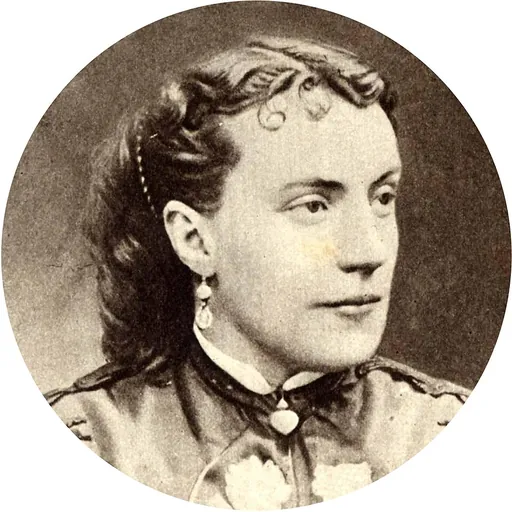
About Thérésa
Lived 1837 – 1913 (aged 76). Thérésa was a French singer and modiste.
Thérésa (born Désirée Emma Valladon but cited simply as Emma Valladon; 7 September 1836 — 14 May 1913) was a French singer. She often worked with Suzanne Lagier and had cartoons (caricatures) drawn by André Gill of her for the newspaper La Lune. les canards tyroliens (the yodling ducks) is an 1869 French song on the freedom of assembly created by Thérésa and performed in 1930 by Yvonne Gabaroche.
Biography Désirée Emma Valladon (but often cited simply as Emma Valladon) was born the daughter of a musician in La Bazoche-Gouet in the Eure-et-Loir department of France on 7 September 1836. As a child, Valladon dreamt of being a singer but began her career working in fashion studios.
She began her singing career by performing in small café chantants (cafe concerts) in Paris, such as in the Café Moka, Théâtre de la Porte Saint-Martin and the Café des Giants, enjoying modest success. During a Christmas show, Valladon was noticed by Arsène Goubert, the director of the café chantant Alcazar, who offered her three hundred francs to sing there; at this she began to use the stage name Thérésa. Within a month of her arrival at the Alcazar, Thérésa enjoyed great success both with the public and critics, and also later went to perform in Rome, Italy, and Saint Petersburg, Russia. She often worked with Suzanne Lagier and in the case of "El", they were appreciated by the public but not the critics. Increasing her popularity, Thérésa was depicted in several cartoons (caricatures) by André Gill in the newspaper La Lune. From 1867 to 1869, she took a break from singing as a result of laryngitis, which made her lose her voice, but then returned with the "popular" Les canards tyroliens.
Some of her most successful songs' choruses were sung by many people, including La gardeuse d'ours del (1863), Rien n'est sacré pour un sapeur! (1864) and La femme à barbe del (1865). She was "admired" by Alexandre Dumas, Théodore de Banville, Pauline von Metternich and Napoleon III. She was financially very successful; earning around 100,000 francs a year. She retired in 1893, but returned to the stage for an evening to perform Le Chat Noir the following year. She retired for good in 1895 when she went to live in Sarthe, where she died in 1913. She was buried at Père Lachaise Cemetery.
Caricatures
Don’t just read it —
keep it.
Full-length biographies made to live with: read them, listen on the way to work, watch them tonight.
- E-book
- Audio
- Video
Instant download · yours to keep · every purchase keeps this site free
Important facts
People in Thérésa's life
Named in this biography and alive at the same time



Related people
Same field, nearest in time


Contemporaries
People whose lives overlapped Thérésa's



Frequently asked questions
Who was Thérésa?
singer (1836–1913)
When was Thérésa born?
Thérésa was born on 25 April 1837 in La Bazoche-Gouet.
When did Thérésa die?
Thérésa died on 14 May 1913 in Neufchâtel-en-Saosnois.
What was Thérésa's occupation?
Thérésa was a singer and modiste.
What nationality was Thérésa?
Thérésa was French.
Sources & further reading
Cite this page
APA: Biography.guide. (2026). Thérésa. https://biography.guide/theresa/
MLA: "Thérésa." Biography.guide, https://biography.guide/theresa/.
Chicago: "Thérésa." Biography.guide. https://biography.guide/theresa/.
Data last updated: 2026-09-23 · Spot an error? Report a correction.
Portrait: Wikimedia Commons · author & licence
Page generated 2026-09-27 05:07 UTC