
Thanatos Painter
Athenian painter of the 5th century BC
About Thanatos Painter
Thanatos Painter was an attic vase-painter.
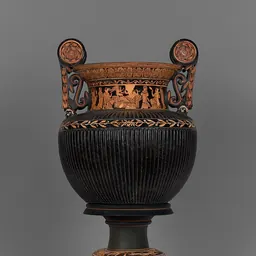
The Thanatos Painter (5th century BCE) was an Athenian Ancient Greek vase painter who painted scenes of death on white-ground cylindrical lekythoi. All of the Thanatos Painter's found lekythoi have scenes of or related to death (thanatos in Greek) on them, including the eponymous god of death Thanatos carrying away dead bodies.
Lekythoi
Women mourning Lekythos One example of a white-ground lekythos by the Thanatos Painter is a vase in the Art Walters Museum (440–430 BCE). The women are mourning over a deceased family member. There is a male figure approaching from the right side of the lekythos that is unseen by the women. He is a representation of the deceased family member.
The deceased man is the main focus of the painting due to the red color of his clothes. Since this is a lekythos from his grave he is the main focus as a reminder to mourn his death. The women is also bent over which leads the eye to the grave stele and finally to the man, making him even more of the main focus. The grave has ribbon or rope that swoops back and forth which pulls the eye back and forth between the two figures. On the lekythos Hypnos, the Greek personification of sleep, and Thanatos, the Greek god of death, are carrying Sarpedon who was Zeus' son. Sarpedon was one of Zeus' favorite sons and he entrusted Hynos and Thanatos to deliver Sarpedon's body to where he would be buried in Lycia.
Sleep is near Sarpedon's head and Death is near his feet. Sleep is almost cradling Sarpedon’s head and it is laid on top Sleep’s heart. This could be symbolic of the fact that Zeus holds Sarpedon near. The grave stele is in an area to help there from being a giant blank area. If it was not where it is, there would be a huge gap between the head of Death and the other two figures heads. The stele allows for continuity throughout the painting. This oil was used to wash the deceases body, and then the body would be wrapped in clean cloth. This would help prepare the body for the afterlife. Lekythoi had different scenes on them that depicted death, such as: inhumation, procession, and visitations to graves.
They had vibrantly painted, detailed scenes of death as the main focal point of the pottery. Marble lekythoi could be used as grave markers and had relief sculpture that was painted, instead of just painting like terracotta lekythoi had. Some marble lekythoi were used as a grave marker for a family plot, instead of for a single person. They were also a symbol of status as any elaborate grave marker would have been at this time.
Don’t just read it —
keep it.
Full-length biographies made to live with: read them, listen on the way to work, watch them tonight.
- E-book
- Audio
- Video
Instant download · yours to keep · every purchase keeps this site free
Important facts
Related people
Same field, nearest in time




Frequently asked questions
Who was Thanatos Painter?
athenian painter of the 5th century BC
What was Thanatos Painter's occupation?
Thanatos Painter was an attic vase-painter.
Sources & further reading
Cite this page
APA: Biography.guide. (2026). Thanatos Painter. https://biography.guide/thanatos-painter/
MLA: "Thanatos Painter." Biography.guide, https://biography.guide/thanatos-painter/.
Chicago: "Thanatos Painter." Biography.guide. https://biography.guide/thanatos-painter/.
Data last updated: 2026-09-20 · Spot an error? Report a correction.
Page generated 2026-09-27 05:25 UTC