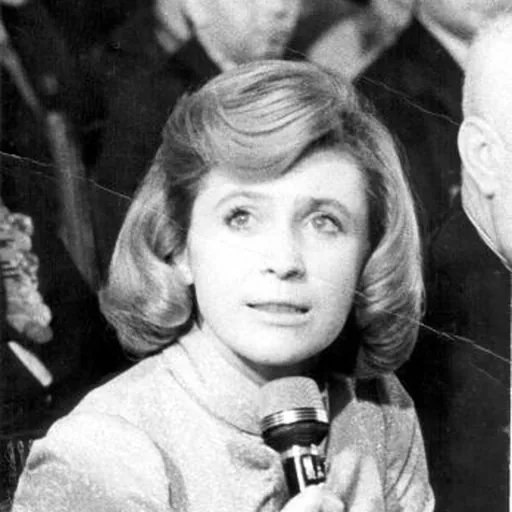
Tetyana Vasilіvna Cimbal
Speaker and leading programs of Ukrainian television. People's Artist of Ukraine. Academician of the Television Academy of Ukraine.
About Tetyana Vasilіvna Cimbal
Born 1946. Tetyana Vasilіvna Cimbal is a Ukrainian and Russian announcer, television presenter, presenter and screenwriter.
Tatiana Vasilyvna Tsymbal (; born September 14, 1946) is a Ukrainian journalist, news presenter, producer, and broadcaster. She is a member of the Ukrainian Association of Cinematographers. She also earned the prize. She was on the ground as a journalist during the Chernobyl disaster. She hosted the Teletriumph Awards for the first three years of their existence. She was on Ukrainian television for over 50 years, and recently retired.
Tsymbal teaches journalism at the National University of Life and Environmental Sciences, and was formerly a professor at Kyiv International University. Studying and working under the first television broadcasters in Ukraine, she eventually helped shape the modern Ukrainian television industry, and has been named by Focus as one of the most influential women in Ukraine.
Early life Tsymbal's father was a Ukrainian soldier who was deployed to the Eastern Front during World War II. He was captured on the island of Eisele, in the Baltic sea, during a campaign in Finland, but managed to escape. He was captured two more times by the Germans, but escaped. Her mother remained in Ukraine, living in the Volynsyva post, and was caring for a son during the German occupation of Ukraine. Tsymbal's older brother died during the German occupation, before she was born.
Her father was an engineer before the war, and after the war returned home and worked in the "South-West Transbud," working to rebuild the city of Kyiv. The family lived in a small communal apartment. informally referred to by the name of its street address, Khreshchatyk 26, on Khreshchatyk Street in Kyiv. This facility, purpose-built for state broadcasting, featured sound-insulated oak doors and specialized studios, including a prominent 300-meter main studio and a smaller color studio—among the first of their kind in Ukraine. Khreshchatyk 26 was a center of pioneering techniques in television; the first remote broadcasts were performed only a few years before by rolling corded cameras onto the street to capture B roll, and producers were creating new formats that had never existed. This site became a central hub not only for employees and on-air talent but also for guests, filmmakers, and viewers who engaged with the programming being produced. The broadcasting facilities were heavily secured, with police presence. Danylenko was celebrated for her poise and appearance, and her public visibility was considered an event in itself during the Soviet era. The cultural status of television figures in early Ukrainian media were often perceived with the reverence typically reserved for public icons or even cosmonauts. For several generations of viewers, she represented the familiar face of Soviet state broadcasting. Now though, color television could show flaws that otherwise might have not been seen on black and white television. Acknowledging this, station and Committee leadership arranged for special access to clothing through the Soviet Kyiv Department of Commerce. As a result, presenters were granted entry to a special department within the Central Department Store (TsUM), typically reserved for diplomats and scientists, where they could obtain quality garments suited to their on-air responsibilities. Tsymbal was then dispatched with her team to the disaster zone, where they took part in a special program dedicated to meetings and dialogues in the affected region, called The Consequences of Chernobyl. The broadcasts and interviews they conducted contributed to early public understanding of the scale of the tragedy and helped humanize the experiences of those directly impacted –and especially contributed to a growing sense of public distrust in the Soviet government. At the time, she was still working at the studio on Khreshchatyk Street, where she participated in programming that included "political roundtables," precursors to modern talk shows. In interviews with journalists, Tsymbal has described the atmosphere in the station as "a powerful sense of unity across Ukraine’s diverse population despite previous hardships and tensions."
In an interview given in 2023, Tsymbal said:"We knew at the time that Ukraine was rich. We had black soil. We had mountains, and we had the forest, and the seas. We had a thriving aircraft industry. We knew that Lviv created televisions... but what we didn't know at the time, and soon learned, was that the Russians had designed the system of the Soviet Union so that if cathode ray TVs were made in Lviv, the cathode rays were made in Russia. This system created a lot of problems." In 1992, construction was completed on the new Kyiv Television Center, a large building that would house public television from that point. Tsymbal made the move to the new building, but also participated in a ceremony when departing the old building.
Move to the New Channel In 1998, Tsymbal became one of the founding members and news presenters of the New Channel. Her move to the New Channel came as a surprise to many, especially given her primary new role, not in culture or news, but as an expert on local Kyiv issues and consumer goods. Despite the shift in focus, Tsymbal successfully adapted to the new format. While many of the professionals who contributed to earlier phases of Ukrainian television remained involved in UT-1, the channel itself developed a new identity, different from its origins. The new format of UT-1 was a hybrid model, combining features of public service broadcasting with operational elements influenced by commercial television. Her daughter Olga is an amateur tennis player, who played for the Canadian national tennis team, and physical education teacher who lives in Canada and started a charity to raise funds for Ukrainian defense forces in 2022.
Elder fraud impersonators Tsymbal has had a problem with fake Facebook profiles being created in her name and running elder financial abuse scams on her friends, and also especially on viewers who used to watch her on television. Several such profiles have been taken down, but Tsymbal has complained to journalists that all she can do is issue takedown notices.
Don’t just read it —
keep it.
Full-length biographies made to live with: read them, listen on the way to work, watch them tonight.
- E-book
- Audio
- Video
Instant download · yours to keep · every purchase keeps this site free
Important facts
Related people
Same field, nearest in time


Contemporaries
People whose lives overlapped Tetyana Vasilіvna Cimbal's


Frequently asked questions
Who is Tetyana Vasilіvna Cimbal?
Speaker and leading programs of Ukrainian television. People's Artist of Ukraine. Academician of the Television Academy of Ukraine.
When was Tetyana Vasilіvna Cimbal born?
Tetyana Vasilіvna Cimbal was born on 14 September 1946 in Kyiv.
What is Tetyana Vasilіvna Cimbal's occupation?
Tetyana Vasilіvna Cimbal is an announcer, television presenter, presenter and screenwriter.
What nationality is Tetyana Vasilіvna Cimbal?
Tetyana Vasilіvna Cimbal is Ukrainian and Russian.
Sources & further reading
· Wikipedia: Tetyana Vasilіvna Cimbal
Cite this page
APA: Biography.guide. (2026). Tetyana Vasilіvna Cimbal. https://biography.guide/tetyana-vasilivna-cimbal/
MLA: "Tetyana Vasilіvna Cimbal." Biography.guide, https://biography.guide/tetyana-vasilivna-cimbal/.
Chicago: "Tetyana Vasilіvna Cimbal." Biography.guide. https://biography.guide/tetyana-vasilivna-cimbal/.
Data last updated: 2026-09-23 · Spot an error? Report a correction.
Portrait: Wikimedia Commons · author & licence
Page generated 2026-09-27 05:05 UTC