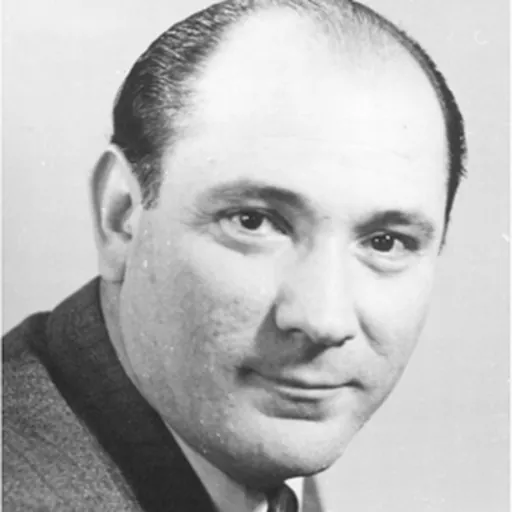
About Teohari Georgescu
Lived 1908 – 1976 (aged 68). Teohari Georgescu was a Romanian minister, politician and trade unionist.
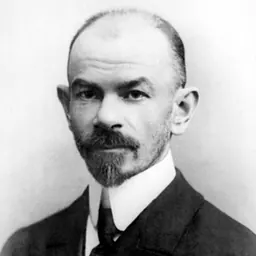
Teohari Georgescu (January 31, 1908 – December 31, 1976) was a Romanian statesman and a high-ranking member of the Romanian Communist Party during the Stalinist period.
Early life Born in Chitila, near Bucharest, he was the third of seven children of Constantin and Aneta Georgescu. Georgescu, whose formal education ended after the fourth grade, began his career as an assistant in his father's store. In 1923, he was sent to the main printing house in Bucharest, Cartea Românească, to apprentice as a typesetter. Three years later, his father now dead, he joined the Gutenberg printers' union and secretly began to read Communist leaflets. He soon joined the Communist party, then illegal.
Underground activity Georgescu became a member of the party's Central Committee and its secretariat, participating in secret meetings, organising strikes, and spreading leaflets. Siguranța Statului, the Kingdom of Romania's secret services, began to keep an eye on him, and he was first arrested in 1933 for authoring leaflets that were spread in the typesetters' room at Cartea Românească. A young and capable lawyer, Iosif Schraer, ensured that Georgescu was released after only two months in prison and a few beatings.
In 1940, while in Moscow, Georgescu received training from NKVD agents, coordinated by Georgi Dimitrov; he learned both the secret code for corresponding with the Comintern, and a special technique for writing messages on glass.
Further arrests followed; finally, after being detained in April 1941, the next month he was sentenced to ten years' imprisonment at Caransebeș. Gheorghe Gheorghiu-Dej named him leader of the prison's communist group before being transferred to Târgu Jiu prison in 1943.
Career peak (1944-52)
He was released after the arrival of the Red Army in August 1944, and at Ana Pauker's suggestion he became undersecretary of state at the Ministry of Interior on November 4. He was considered by the Communists to be well-qualified for the clandestine work the job required, given his NKVD training and experience after 1940. Together with Pauker and Luca, Georgescu was purged at the plenum of May 26–27, 1952, simultaneously accused of left-wing and right-wing deviationism. He was also accused of a conciliatory stance regarding Luca's deviation and, ironically, of insufficient militancy against the class enemy and revolutionary vigilance. He was thus dismissed from his ministerial post on May 28, losing all his other party and state posts as well: vice-premier, member of the secretariat, politburo and orgburo. Unlike the other two, he had not spent World War II in Moscow, but the Comintern's suggestion in 1940 that Georgescu be made General Secretary kept Gheorghiu-Dej wary of his influence. Furthermore, as Luca and Pauker began to fall from grace in early 1952 (their fate having been decided in Moscow), he made the mistake of standing by them. Initially "assigned to work at a lower level", he was arrested on February 18, 1953, and investigated by his former subordinates at the Securitate for three years. At one point, his wife and two children (one of them an infant) were arrested in order to induce him to give evidence against Lucrețiu Pătrășcanu. He confessed guilt to all charges, but was nevertheless released in April 1956.
Georgescu returned to his old workplace, Cartea Românească, now called "Întreprinderea 13 Decembrie", first working as a proofreader and then being appointed manager before retiring in 1963.
Rehabilition under Ceaușescu (1968–1974) After Nicolae Ceaușescu came to power in 1965, he was rehabilitated at the April 1968 plenary. He was appointed candidate member of the Central Committee at the party's 1972 national conference, holding the post until 1974. He died in obscurity; after cremation, his ashes were placed in the Monument of the Heroes for the Freedom of the People and of the Motherland, for Socialism in Bucharest's Carol Park, being removed after the Romanian Revolution of 1989.
Don’t just read it —
keep it.
Full-length biographies made to live with: read them, listen on the way to work, watch them tonight.
- E-book
- Audio
- Video
Instant download · yours to keep · every purchase keeps this site free
Important facts
People in Teohari Georgescu's life
Named in this biography and alive at the same time

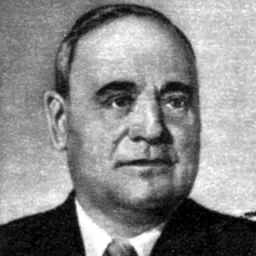
Related people
Same field, nearest in time

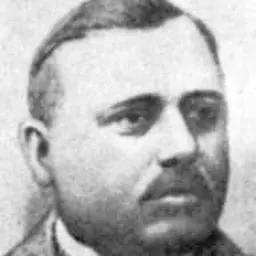

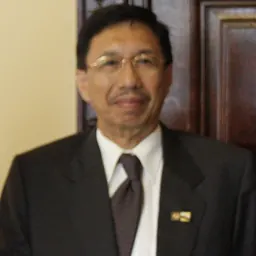


Contemporaries
People whose lives overlapped Teohari Georgescu's


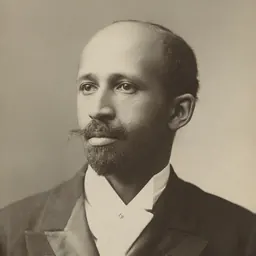

Frequently asked questions
Who was Teohari Georgescu?
Romanian politician
When was Teohari Georgescu born?
Teohari Georgescu was born on 31 January 1908 in Bacău.
When did Teohari Georgescu die?
Teohari Georgescu died on 31 December 1976 in Bucharest.
What was Teohari Georgescu's occupation?
Teohari Georgescu was a minister, politician and trade unionist.
What nationality was Teohari Georgescu?
Teohari Georgescu was Romanian.
Sources & further reading
· Wikipedia: Teohari Georgescu
Cite this page
APA: Biography.guide. (2026). Teohari Georgescu. https://biography.guide/teohari-georgescu/
MLA: "Teohari Georgescu." Biography.guide, https://biography.guide/teohari-georgescu/.
Chicago: "Teohari Georgescu." Biography.guide. https://biography.guide/teohari-georgescu/.
Data last updated: 2026-09-20 · Spot an error? Report a correction.
Page generated 2026-09-27 05:09 UTC