
About Teohari Antonescu
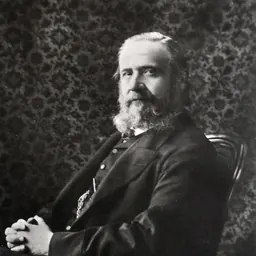
Lived 1866 – 1910 (aged 43). Teohari Antonescu was a Romanian historian, archaeologist, pedagogue and epigrapher.
Teohari or Teochari Antonescu ( 1865/1867 – January 11, 1910) was a Romanian archeologist and historian of antiquity. He was born in either Bucharest or Giurgiu, possibly out of wedlock, and had a destitute childhood; he compensated with his scholastic achievements, emerging as a disciple and imitator of Alexandru Odobescu. Like Odobescu, he pioneered Dacology—his acclaimed graduation paper from the University of Bucharest was focused on the Cabeiri cult in Roman Dacia. He was also discovered as both an intellectual and political ally by political philosopher Titu Maiorescu, who inducted him into Junimea society. With Odobescu and Maiorescu's support, Antonescu was able to study abroad, then to return home to teaching posts at Saint Sava National College, and then at the University of Iași. From Iași, he directed the effort to revive Junimist activities. For a while, he mainly expressed himself through Convorbiri Literare, a Junimist review of which he was also editor; it hosted his numerous essays on ancient art and history, going as far back as the origin and evolution of mankind.
Antonescu impressed his contemporaries with his modern teaching methods and his familiarity with developments in archeology. He was also commended for his incidental contributions to Oriental studies, which included his sample translations from Vedic Sanskrit and Sumerian. He nevertheless generated controversy by directly attacking older historians such as Grigore Tocilescu and A. D. Xenopol, and by presenting dissenting views on ancient monuments and complexes, from Tropaeum Traiani to Ulpia Traiana Sarmizegetusa. Antonescu was also at times vocal in his support for political Junimism: like the faction itself, he joined, quit, then rejoined the Conservative Party, becoming the focus of scrutiny with his violent rhetoric. He was similarly active within the Cultural League for the Unity of All Romanians, which he used as a venue for his practical-minded, conservative, version of Romanian nationalism. Antonescu's diverse public involvements were always secondary to his scholarly work; they were also interrupted by his neglected cancer, which killed him in 1910, when he was in his nearly forties. Posterity rediscovered him as a political diarist.
Biography Mysterious origin and early life Antonescu’s precise origins are uncertain, and no birth certificate has been found. His obituary note in Opinia daily informs that he was born in Bucharest, capital of the Principality of Romania, on September 1, 1866. Two encyclopedias state the same date and place, while a third gives 1867. Researchers Valeriu and Sanda Râpeanu also advance "1866" as the birth year, while Antonescu's fellow historian, Nicolae Iorga, ambiguously refers to him as "a Bucharester from Giurgiu". In 1992, museologist Emil Păunescu proposed that Antonescu was born at Giurgiu "in winter 1866 or in spring of the following year". Several 21st-century books also give Giurgiu as the birthplace, while favoring 1867 as the year.
Writing in 1936, scholar Constantin Rădulescu-Motru recalled that Antonescu was raised in a poor household by a Greek monk, Antonie, relaying a rumor that he was the monk's illegitimate son. The name Teohari ("gift of God"), and the surname that may be linked to the monk's first name, lend credence to this notion. His mother Alexandrina (Lucșița) was very poor, washing clothes for the wealthy families of Giurgiu. As observed by Păunescu, it was the work of a "brilliant student", and still cited as mandatory reading 100 years after its first print. Antonescu himself wrote that it was only a matter of serendipity that he was ever coached by Odobescu, who then helped advance his career. More precisely, he happened to take unsolicited advice from historian Bogdan Petriceicu Hasdeu, who told him that his original adviser, Gian-Luigi Frollo, was not well-liked in the community.
Academic rise and Junimea relaunch Antonescu's other mentor was Titu Maiorescu, who taught him logic, and whom he regarded as "the greatest man ever born in this Romanian land of ours". He also attended Grigore Tocilescu's course on ancient history, and V. A. Urechia also taught him. Upon Maiorescu's intervention, and with direct support from Odobescu, he received a generous scholarship for specialized studies in Western Europe; the former hoped he would become a scholar of archeology and ancient history. Iorga remembers Antonescu as "haughty" from the praise of Odobescu and Maiorescu; in his account, Antonescu also appears as a moralizer, who once stepped into the Latin Quarter and humiliated a Romanian student whom he found to be gambling. He and Iorga, while never close, exchanged career advice in a series of letters. Antonescu privately referred to Iorga as "that annoying creature". Overall, he disliked modern Greece, describing it as engulfed by the "filthy Orient"—and only finding solace on the Acropolis, "the world's most attractive spot". joining there his university colleague, Petre P. Negulescu. Like Negulescu and Rădulescu-Motru, Antonescu was also a faithful disciple of Maiorescu, joining a new wave of inductees into Maiorescu's own Junimea literary-and-political society. However, by his own account, he only came in contact with the club when it was declining rapidly: Maiorescu and others were settled in Bucharest just as he was at Iași, where a local chapter was barely surviving through meetings held by Anton Naum. Antonescu's first self-recorded presence at Junimea came in January 1895. The session was held in the Volenti home, and involved various figures—ranging from Miron Pompiliu (rated by Antonescu as "perhaps the quickest-witted" in that room) to "one very fat guy whose name I never learned". In June 1899, he was serving as Iași treasurer of the Cultural League for the Unity of All Romanians—serving the cause of Romanian nationalism. However, he and Nicolae Culianu effectively produced a schism within the League, by refusing to recognize its elected leadership. He resigned shortly after due to widespread disapproval.
The influence of his Western education was apparent in his synthesis of archeology and history, and in his use of the most up-to-date scholarship. Antonescu's early works in book form include Lumi uitate (1901), a collection of groundbreaking literary and archeological studies about Dacia and the Ancient Middle East. It also hosted his overview of archeological research. Andrieșescu reports that, although dedicated to Maiorescu, this particular tract was mostly focused on validating and avenging Odobescu; it was also remarkable in that "nothing is missing", and as such comparable to Adolf Michaelis' more famous contributions, which it technically preceded.
Antonescu was also an incidental contributor to Oriental studies, after he had to replace his colleague Petre Râșcanu, who was unavailable. As Andrieșescu observes, he managed to expand the field of research, with monographs on the Egyptians' origin (1897), "Izdubar" (1898), the Upanishads as a philosophical corpus (1899), and Buddhism (1903). More private notations describe Maiorescu's claims about Eminescu terminal illness. As observed by literary historian Liviu Papuc, they feature unflattering detail, likely to spark "ample debates", about Eminescu's aquaphobia and economic materialism, both of which had allegedly shown up during his final years. Museums were an early interest of his; he was particularly enthralled by the Skulpturensammlung in Dresden, also admiring certain works at the Kunsthistorisches Museum and bringing back plaster casts from Greece as a reward for touring the Acropolis with a consul's daughter. Dismayed by the lack of a university museum in Iași, he made strenuous efforts to obtain funds and organize a collection, but the work was still in its early stages at the time of his death.
Antonescu was again received into the Cultural League's regional executive board around May 1900. Though he admitted that the body itself was less enthusiastically backed by the public than in previous decades, he insisted that it was also more professional and persistent in reaching its goals. The section had effectively seceded from the national group, which had declared it dissolved; also that month, Culianu sent Antonescu and A. C. Cuza to Bucharest, as a means of discussing reunification. According to Nastasă, he was "somewhat charming and capable of provoking enthusiasm, but always reserved and in his place, too little active in the cultural or political fields". The work arose controversy, especially since Sarmizegetusa, located in Austria-Hungary, had been neglected—making viewers unaware of its past splendors. In February 1905, Antonescu was present for negotiations between the Junimists and the National Liberal Party, and spoke at the latter group's congress. The event was covered by the Conservative newspaper, Evenimentul, in unceremonious terms: an "illustrious nobody on our political scene", Antonescu had depicted the anti-Conservative alliance as one prompted by the need for rejuvenation; as Evenimentul noted, the rejuvenators, on the Junimea side, included people in their seventies. During July, Antonescu and Cuza sided with a "Conservative dissidence", which presented its own lists of candidates for the local council elections. The contemporary press cited him as having previously had Conservative affiliations.
Final work, illness, and death Antonescu participated in the Junimist (or "Opposition Conservative") congress, held in Bucharest in February 1906. All speakers targeted the Second Cantacuzino cabinet, whom Antonescu himself accused of having presided over "moral dissolution in the very bosom of our society". He claimed that his university had been forced to crerate entire new departments just to accommodate Conservative favorites of unsatisfactory qualifications. The left-wing commentators at Adevărul viewed the affair as a "political academy" dominated by Iorga, observing that the group had no real-life influence.
In early 1907, the pro-Junimist daily, Epoca, hosted Antonescu's political essay, Lupta și credința noastră ("Our Combat and Credo"). The piece was ridiculed in Iași's Conservative press by Lascăr Antoniu, who argued that its "pompous" verbiage clashed badly with the Junimist cultivation of brevity and clarity. Antoniu also noted that Antonescu had a history of insulting fellow scholars, from Tocilescu to A. D. Xenopol. The words he used against Xenopol were reportedly harsh enough as to be condemned by Matei B. Cantacuzino on behalf of Junimea. In November 1908, Antonescu tried to prevent leftist Garabet Ibrăileanu from being re-appointed provisional head of the university's Romanian Literature Department, observing that Ibrăileanu did not yet hold a Ph. D..
Junimea was eventually reattached to the mainline Conservatives. During his final years, Antonescu was regularly featured in the consolidated group's political newspapers. and was the first such monograph in Romanian scholarship. He died at 3 PM The Romanian Orthodox service was performed at Saint Spyridon. Orations were delivered there by linguist Ilie Bărbulescu, by philosopher Ion Petrovici, and, on behalf of the Conservative Party, by Leon Cosmovici; Petrovici's words, which described Antonescu's return to the earth as a relic, where seen by Andrieșescu as particularly poignant. Păunescu argues that most of Antonescu's own contributions were unfairly forgotten; if he remained at all influential, it was through admirers such as Iorga and students such as Andrieșescu and Vasile Bogrea. In her eighties, she offered encouragement to Păunescu, who was making efforts to complete a biography of her father.
Don’t just read it —
keep it.
Full-length biographies made to live with: read them, listen on the way to work, watch them tonight.
- E-book
- Audio
- Video
Instant download · yours to keep · every purchase keeps this site free
Important facts
People in Teohari Antonescu's life
Named in this biography and alive at the same time



Related people
Same field, nearest in time
Contemporaries
People whose lives overlapped Teohari Antonescu's


Frequently asked questions
Who was Teohari Antonescu?
archaeologist (1866-1910)
When was Teohari Antonescu born?
Teohari Antonescu was born on 1 September 1866 in Bucharest.
When did Teohari Antonescu die?
Teohari Antonescu died on 11 January 1910 in Iași.
What was Teohari Antonescu's occupation?
Teohari Antonescu was a historian, archaeologist, pedagogue and epigrapher.
What nationality was Teohari Antonescu?
Teohari Antonescu was Romanian.
Sources & further reading
· Wikipedia: Teohari Antonescu
Cite this page
APA: Biography.guide. (2026). Teohari Antonescu. https://biography.guide/teohari-antonescu/
MLA: "Teohari Antonescu." Biography.guide, https://biography.guide/teohari-antonescu/.
Chicago: "Teohari Antonescu." Biography.guide. https://biography.guide/teohari-antonescu/.
Data last updated: 2026-09-20 · Spot an error? Report a correction.
Page generated 2026-09-27 05:22 UTC