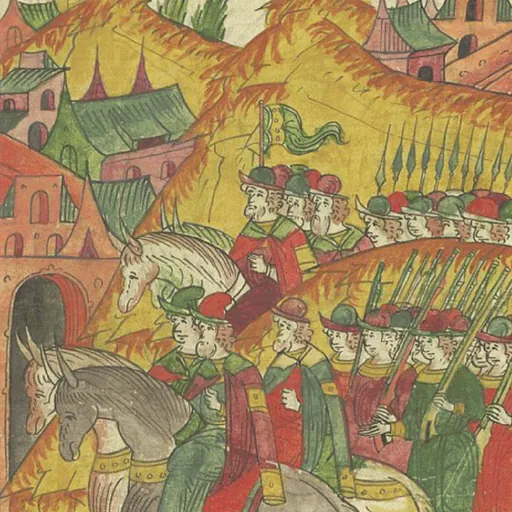
Temryuk
Kabardian prince
About Temryuk
Temruqo Yidar, also known as Temruqo the Brave, was a Kabardian prince of the House of Yidar who served as Grand Prince of Kabardia during the mid-to-late 16th century. He is regarded as one of the most influential Circassian rulers of the period, known for consolidating Kabardian power, leading military campaigns across the North Caucasus, and establishing an alliance with the Tsardom of Russia under Tsar Ivan IV.
Early life Temruqo was born around 1502.
In his youth, Temruqo was regarded as a capable military leader. This description closely resembles the classic chronicle portrayal of Sviatoslav I.
In the early 16th century, Temruqo entered into conflict with the sons of Qeytuqo, including Aslanbech and Shiapshoqo. As a result of this struggle, Temruqo was forced to migrate with his family to Lesser Kabardia. The conflict is generally considered to have stemmed from a dynastic dispute over the title of supreme prince of Kabardia. After the death of Prince Jilakhstan in the 1550s, Temruqo became the senior prince of Lesser Kabardia, and the territory under his control became known as “Yidarey”.
In the summer of 1552, Devlet I Giray led a campaign to Circassia, marking his first military expedition against the Circassians and his first campaign against a foreign polity. The campaign ended in a Crimean victory, during which the Kabardian prince Elbozdu (Albuzduy), brother of Temruqo, was captured together with his wife and children. However, later in the same year, the Tatar army was defeated by Temruqo.
Supreme command of the allied Kabardian forces was entrusted to the Besleney prince Yelzheruqo, son of Qanoqo. As the Avar Utsmi crossed the Terek River, Prince Yelzheruqo and his advance guard met the invading force and attempted negotiations. After negotiations failed, Yelzheruqo withdrew to prepared defensive positions. Two days later, the Utsmi advanced toward the trenches, and Yelzheruqo engaged the enemy. A fierce battle followed, reportedly lasting two days. On the third day, hostilities resumed. During the renewed fighting, the Utsmi was killed, causing confusion among his forces. According to tradition, the Kabardians exploited this disorder, launched a coordinated assault, and drove the opposing army toward the Terek River. It is claimed that only one-third of the invading force managed to escape. During the battle, Prince Koshkao—described as one of the instigators of the campaign—was also killed.
Crimean invasions In 1553, a large Crimean Tatar horde led by Khan Devlet I Giray entered Kabardian lands. Significant destruction was inflicted; however, the Crimeans failed to establish a foothold in Kabardia and were eventually expelled by the Kabardians. Later in the summer of 1554, Devlet I Giray marched against the Circassians of the "Five Mountains" and returned with substantial spoils. At the same time, the Kabardians dealt significant damage to Devlet Giray, forcing him to suspend his campaign and retreat. There, Temruqo constructed a fortress and named it after himself; the settlement continues to bear his name.
I have come from the brethren, from the Kabardian princes of Circassia, from Temryuk Idarov and from Prince Tazryut, to petition that the sovereign grant them favor, order them to serve him and make them serfs, and that the sovereign grant them favor to Shavkal and order the Astrokhan voivodes to provide assistance. And Kanklych Murza Cherkassky spoke. “Only the sovereign will grant them favor, make them his serfs and help them against their enemies in the same way as he granted the Cherkassian Zhazhen princes Mashuk and Sebok and their brothers to their brothers, and with the Kabardian Cherkassians in one truth and in the Iverian conspiracy, the prince and the entire Iverian land and the sovereign with them bow to the sovereign, so that the sovereign Tsar Grand Prince Ivan IV would grant them the same favor as all of those others
In response to the embassy, Ivan the Terrible accepted Kabardia and the Western Circassians under his protection. A similar appeal was made in October 1558 by the sons of Temruqo Yidar, Ulgairuk and Saltankul. According to sources, information about these negotiations reached the Kumyks, and in 1559 a Kumyk embassy arrived at the Russian court requesting protection from Circassian princes who had entered Russian allegiance. At the same time, Kabardian complaints accused the Kumyks of conducting raids against them. In response, the Russian government dispatched a military expedition against the Shamkhalate of Tarki in support of the Kabardians.
The Russian attack on Tarki led Caucasologist E. N. Kusheva to suggest that by the mid-16th century, Tarki had already emerged as the political center of the Shamkhalate. The defense of the town was reportedly led by the shamkhal himself, who retreated into the mountains following the defeat. Although his name is not recorded in the Russian chronicles, researcher L. I. Lavrov, relying on epigraphic evidence, proposed that he may have been Buday I ibn Umal-Muhammad.
Russian-Kabardian ties were significantly strengthened after Ivan IV's marriage in August 1561 to Temruqo's daughter Maria Temryukovna. Ivan the Terrible's marriage had political significance for both Kabardia and Russia, primarily contributing to the weakening of Crimea's position in the North Caucasus. E. N. Kusheva writes:
The Facial Chronicle describes the campaign as follows:
“And Prince Temryuk and his son Domanuk-Mirza came to Cherkasy on December 6, and Grigory came to Cherkasy with them, and with him the head of the Streltsy Grigory Vrazhsky, and with them 500 Streltsy people and five Cossack atamans with Cossacks, and the Cossacks with them 500 people. "And Temryuk and the sovereign's people brought enmity to their enemies and brought them to their will, and fought against the Shepshukov uluses and fought against the Tatar lands near the Skinnye towns, and took three towns: the town of Mokhan, the town of Engir, the town of Kavan, and killed Mirza Telishka and massacred their people. And those towns belonged to the Shepshukov princes, and the people of those towns bowed to Prince Temryuk, and Prince Temryuk imposed tribute on them. And they fought for eleven days on their land, and took one hundred and sixty-four Mshansky and Sonsky taverns, and massacred their people and took four murzas prisoner: Burnat, Ezdonur, Burnak, Dudyl. And Temryuk released Grigory to the Tsar, the Grand Prince"
In September 1565, military forces led by Ivan Dashkov were sent against Shiapshoqo and his vassals Tazrit and Manta. These forces included boyar detachments from the Murom and Meshcheryan people, Cossacks from the "Ryazan Ukraine", and a detachment of Matthew Rzhevsky with "Circassian Cossacks and archers." The allied army entered Kabardia in October 1566 and encountered fierce resistance. Although the source provides limited detail on the intensity of the fighting, the battle ended in a victory for Temruqo.
War with Ottomans In the summer of 1569, the Ottomans launched a war against Russia, the first in a long series of conflicts between the two powers. A massive combined Ottoman–Crimean army, which contemporary Russian sources claim numbered up to 130,000 men, set out on a campaign against Astrakhan, under the command of Kasim Bey. The main objectives of the campaign were to “open the Astrakhan road” and to abandon the city built on the Terek (Terki). Both the Ottoman Empire and the Crimean Khanate attached great importance to the expedition, as its success would have disrupted Russia’s connections with the Caucasus and Central Asia and expelled Russian influence from the Ciscaucasia and the lower Volga. This, in turn, would have granted the Ottomans and the Crimeans significant strategic advantages in their struggle against both Iran and Russia.
Despite careful preparation, the campaign ended in failure. Kabardian cavalry took part in defeating the retreating Ottoman–Crimean forces, and sources emphasize that the retreat cost the Turks far greater losses than the campaign itself. By 24 October, only about one-third of the Ottoman troops had reached Azov. The remnants were loaded onto seagoing vessels and sent to Kaffa, but many ships were wrecked during a storm, resulting in heavy losses by drowning. According to the Russian ambassador to the Ottoman Empire, I. P. Novosiltsev, no more than 700 men from the Ottoman army ultimately returned to Constantinople. Nogmov’s account contains inconsistencies, as he attributes command of the invading army to Devlet I Giray, while Russian sources identify Kalga Adil Giray as the commander. Estimates of the Crimean force vary widely: some sources place it at no fewer than 20,000 men, while higher estimates—including reinforcements from Astrakhan and Kazan Tatars—raise the figure to as many as 130,000. Even so, the force was relatively small compared to other Crimean campaigns during Devlet Giray’s reign, as Adil Giray was operating primarily with troops from his own appanage. The Circassians’ reliance on defensive tactics further suggests that they were numerically inferior. During the battle, one such arrow pierced Temruqo , inflicting a mortal wound, while the fortress he had built was captured by the Tatars. Despite his injury, Temruqo continued to fight, and repeated Crimean attempts to cross the river were repelled. Nevertheless, two of his sons, Beberyuk and Mamstruk, were captured by the Tatars.
In folklore The following Circassian song was composed for Temruqo and was translated by Shora Nogmov:
Seven days passed in anticipation of the enemy, and nothing was seen or heard in the steppe. Our army stood idle on the waters of the Akhunsa.
Thanks to the good king; he informed us of the enemy’s approach, and the valiant prince Temryuk is ready to strike the common enemy.
A cruel battle flared up and Crimean arrows flew at Temryuk, like winter frost whitening the fields and trees.
But one fatal arrow found a way to pierce the brave prince and the wound was so deep that it was difficult to remove it.
A formidable warrior with countless forces came to us from a distant land, from across the sea through the isthmus, and took our fortress. The Crimeans tried hard to cross the Akhups and completely dislodge ours; it was bad without brave Temryuk, but ours held out.
And Qaytaq Yethluq with his golden mustache distinguished himself with courage; the hero of heroes Temryuk only sighed from a cruel wound. Yidar Tambiy, noticing our men's timidity, charged into the enemy's midst.
From the thickness of the bow came a sound like a gun, and from the fired arrow the bowstring rang. Upon his recovery, Prince Temryuk immediately gathered the Kabardians and hastened to the aid of the Russian Tsar, with whom they joined forces near the Sea of Azov. The Tsar greatly thanked Prince Temryuk for his loyalty and generously rewarded the Kabardians.
In this way, Prince Temryuk helped Russia many times; upon his return to his homeland, this kind, brave, and best of all our princes died of an old wound that had relapsed. The people said of him: “There is no greater valiant hero, no more courageous knight of ours, Prince Temryuk.”
Legacy
The military and political alliance between Kabardia and Russia, concluded in 1557 on behalf of the Supreme Prince of Kabardia, Temruqo, marked the beginning of sustained bilateral relations and a gradual political and cultural rapprochement between the two sides. This alliance was further strengthened in 1561 through a dynastic marriage between Tsar Ivan IV and Temruqo’s daughter, an event that symbolized the formalization of Kabardian–Russian cooperation at the highest level. In the decades that followed, representatives of the Kabardian feudal aristocracy assumed an important intermediary role in fostering relations between the Russian state and other peoples of the North Caucasus. Among these, the Cherkassky princely family—descendants and associates of Temruqo—emerged as particularly influential. It would not be an exaggeration to state that they played a leading role in consolidating political and diplomatic ties between Kabardia and Russia. From the mid-16th century onward, members of this family became actively involved in the political life of the Russian state, contributing to its administrative and military structures and helping to ensure its stability.
Temruqo’s descendants and their allies largely remained aligned with Russia, forming what became known as the Cherkassky princely dynasty within the Russian nobility. Despite the relatively limited resources at their disposal, Kabardian forces—particularly cavalry units associated with this lineage—participated in many of Russia’s military campaigns. Beginning with the Livonian War, Kabardian contingents were involved in numerous conflicts fought by the Russian state in the years following Temruqo’s death, reinforcing the long-term military dimension of the Kabardian–Russian alliance. Malhurub Temryukovna, who married Tin Ahmed, beg of Nogai Horde. Mazlov, ambassador of Kabardia to Moscow in 1567,
Don’t just read it —
keep it.
Full-length biographies made to live with: read them, listen on the way to work, watch them tonight.
- E-book
- Audio
- Video
Instant download · yours to keep · every purchase keeps this site free
Important facts
Frequently asked questions
Who was Temryuk?
Kabardian prince
When was Temryuk born?
Temryuk was born in Kabardia.
When did Temryuk die?
Temryuk died in 1571 in Kabardia.
Sources & further reading
Cite this page
APA: Biography.guide. (2026). Temryuk. https://biography.guide/temryuk/
MLA: "Temryuk." Biography.guide, https://biography.guide/temryuk/.
Chicago: "Temryuk." Biography.guide. https://biography.guide/temryuk/.
Data last updated: 2026-09-20 · Spot an error? Report a correction.
Portrait: Wikimedia Commons · author & licence
Page generated 2026-09-27 04:57 UTC