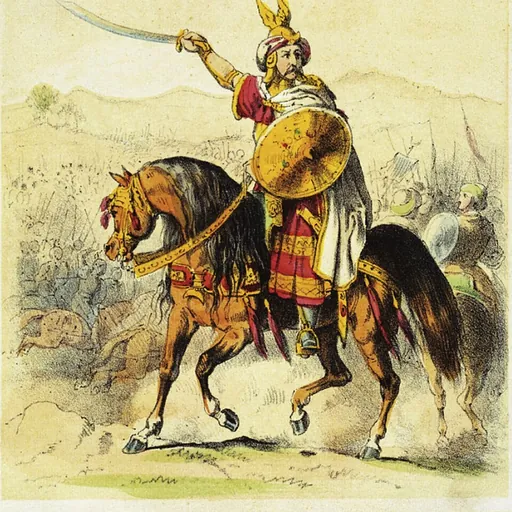
About Tariq ibn Ziyad
Lived 670 – 720 (aged 49–50). Tariq ibn Ziyad was an Arab warrior, military leader, al-Andalus and tangier.
Tariq ibn Ziyad ( ; ), also known simply as Tarik in English, was an Umayyad commander who initiated the Muslim conquest of the Iberian Peninsula (present-day Spain and Portugal) against the Visigothic Kingdom in 711–718 AD. He led an army and crossed the Strait of Gibraltar from the North African coast, consolidating his troops at what is today known as the Rock of Gibraltar (named after him, from Arabic , literally 'mountain of Tariq).
Origins Medieval Arabic historians give contradictory accounts of Tariq's origins and ethnicity, and details about his personality and the circumstances of his entry into al-Andalus are surrounded by uncertainty. The vast majority of modern sources state that Tariq was a Berber mawla of Musa ibn Nusayr, the Umayyad governor of Ifriqiya.
According to Ibn Khaldun, Tariq Ibn Ziyad was from a Berber tribe in what is now Algeria. Heinrich Barth mentions that Tariq Ibn Ziyad was a Berber from the tribe of the Ulhassa, a tribe native to the Tafna. It currently inhabits the Béni Saf region in Algeria. According to David Nicolle, Tariq Ibn Ziyad is first mentioned in historical records as the governor of Tangier.
History
According to Ibn Abd al-Hakam (803–871), Musa ibn Nusayr appointed Tariq as governor of Tangier after its conquest in 710–711, but an unconquered Visigothic outpost remained nearby at Ceuta, a stronghold commanded by a nobleman named Julian, Count of Ceuta.
After Roderic came to power in Spain, Julian had, as was the custom, sent his daughter, Florinda la Cava, to the court of the Visigothic king for education. It is said that Roderic raped her, and that Julian was so incensed he resolved to have the Muslims bring down the Visigothic Kingdom. Accordingly, he entered into a treaty with Tariq (Musa having returned to Qayrawan) to secretly convoy the Muslim army across the Straits of Gibraltar, as he owned a number of merchant ships and had his own forts on the Spanish mainland.
On or about April 26, 711, the army of Tariq Bin Ziyad, composed of recent Berber converts to Islam, was landed on the Iberian peninsula (in what is now Spain) by Julian. They debarked at the foothills of a mountain which was henceforth named after him, Gibraltar (Jabal Tariq).
Tariq's army contained about 7,000 soldiers, composed largely of Berber stock but also Arab troops. Roderic, to meet the threat of the Umayyads, assembled an army said to number 100,000, though the real number may well have been much lower. Most of the army was commanded by, and loyal to, the sons of Wittiza, whom Roderic had brutally deposed. Tariq won a decisive victory when Roderic was defeated and killed on July 19 at the Battle of Guadalete.
Tariq Bin Ziyad split his army into four divisions, which went on to capture Córdoba under Mughith al-Rumi, Granada, and other places, while he remained at the head of the division which captured Toledo. Afterwards, he continued advancing towards the north, reaching Guadalajara and Astorga. Tariq was de facto governor of Hispania until the arrival of Musa a year later. Tariq's success led Musa to assemble 12,000 (mostly Arab) troops to plan a second invasion. Within a few years, Tariq and Musa had captured two-thirds of the Iberian peninsula from the Visigoths.
Both Tariq and Musa were simultaneously ordered back to Damascus by the Umayyad Caliph al-Walid I in 714, where they spent the rest of their lives. The son of Musa, Abd al-Aziz, who took command of the troops of al-Andalus, was assassinated in 716. In the many Arabic histories written about the conquest of southern Spain, there is a definite division of opinion regarding the relationship between Tariq and Musa bin Nusayr. Some relate episodes of anger and envy on the part of Musa that his freedman had conquered an entire country. Others do not mention, or play down, any such bad blood. On the other hand, another early historian, al-Baladhuri, writing in the 9th century, merely states that Musa wrote Tariq a "severe letter" and that the two were later reconciled.
Speech
A 13th-century historian Ibn Khallikan in his 1274 work Wafayāt al-ʾAʿyān [Deaths of Eminent Men and later a 16th-century historian Ahmed Mohammed al-Maqqari, in his , attribute a long khuṭba speech to Tariq, which he is supposed to have given to his troops before the Battle of Guadalete.
Legends and cultural references
Tariq appears in one story of the One Thousand and One Nights (nights 272–273). He is referenced as having killed the king of the city of Labtayt (probably Toledo), in accordance to a prophesy.
Don’t just read it —
keep it.
Full-length biographies made to live with: read them, listen on the way to work, watch them tonight.
- E-book
- Audio
- Video
Instant download · yours to keep · every purchase keeps this site free
Important facts
People in Tariq ibn Ziyad's life
Named in this biography and alive at the same time
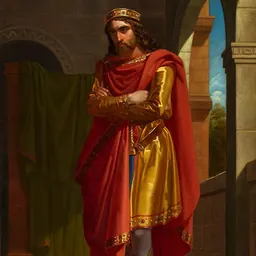
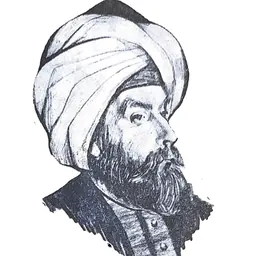
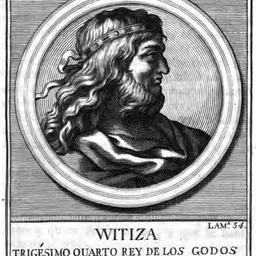
Related people
Same field, nearest in time




Contemporaries
People whose lives overlapped Tariq ibn Ziyad's


Frequently asked questions
Who was Tariq ibn Ziyad?
8th-century Muslim general
When was Tariq ibn Ziyad born?
Tariq ibn Ziyad was born in 670 in Khenchela.
When did Tariq ibn Ziyad die?
Tariq ibn Ziyad died in 720 in Damascus.
What was Tariq ibn Ziyad's occupation?
Tariq ibn Ziyad was a warrior, military leader, al-Andalus and tangier.
What nationality was Tariq ibn Ziyad?
Tariq ibn Ziyad was Arab.
Sources & further reading
Cite this page
APA: Biography.guide. (2026). Tariq ibn Ziyad. https://biography.guide/tariq-ibn-ziyad/
MLA: "Tariq ibn Ziyad." Biography.guide, https://biography.guide/tariq-ibn-ziyad/.
Chicago: "Tariq ibn Ziyad." Biography.guide. https://biography.guide/tariq-ibn-ziyad/.
Data last updated: 2026-09-23 · Spot an error? Report a correction.
Portrait: Wikimedia Commons · author & licence
Page generated 2026-09-27 05:05 UTC