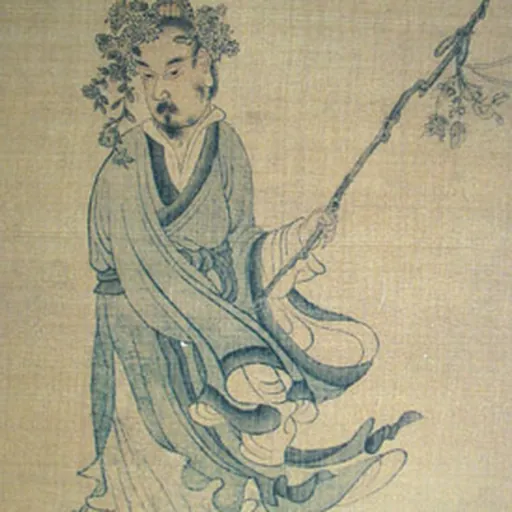
About Tao Yuanming
Lived 365 – 427 (aged 62). Tao Yuanming was a Chinese poet and writer.
Tao Yuanming (陶淵明; 365–427), also known as Tao Qian (陶潜), courtesy name Yuanliang (元亮), was a Chinese poet and politician. He was one of the best-known poets who lived during the Six Dynasties period. Tao Yuanming spent much of his life in reclusion, living in the countryside, farming, reading, drinking wine, receiving the occasional guest, and writing poems in which he reflected on the pleasures and difficulties of life and his decision to withdraw from civil service.
Tao's simple and direct style was somewhat at odds with the norms for literary writing in his time. From the Tang dynasty onward, he was closely associated with the practice of farming as a recluse. During the Northern Song dynasty, influential literati figures such as Su Shi declared him a paragon of authenticity and spontaneity in poetry, predicting that he would achieve lasting literary fame. But Tao's inclusion in the 6th-century literary anthology Wen Xuan implies he began to gain fame in his own era, at least in his birth area. Tao is now regarded as the foremost representative of Fields and Gardens poetry. He is also known for owning and appreciating an unstrung guqin, claiming that he did not need to bother with the sounds of the strings to value the instrument; this became a common literary reference, and also appears in later depictions of Tao such as his portrait by Chen Hongshou. Tao is also depicted in Jin Guliang's Wu Shuang Pu.
Names In the middle of his life, Tao changed his name (keeping his family name) from Tao Yuanming to Tao Qian . "Master of the Five Willows", another name he used when quite young, seems to be a sobriquet of his own invention. There is a surviving autobiographical essay from his youth in which Tao uses "Five Willows" to allude to himself. After this, he refers to himself in his earlier writings as "Yuanming"; but it is thought that with the Eastern Jin dynasty's demise in 420, he began to call himself "Qian", meaning "hiding", to signify his final withdrawal into the quiet life in the country and decision to avoid participation in the political scene. Tao Qian could also be translated "Recluse Tao", but this does not imply an eremitic lifestyle or extreme asceticism but rather a comfortable dwelling with family, friends, neighbors, musical instruments, wine, a nice library, and the beautiful scenery of a mountain farm—Tao Qing's compensation for giving up the lifestyle of Tao Yuanming, government servant.
The names Yuanliang , Shenming , and Quanming are all associated with Tao Yuanming. Some of this results from a naming taboo during the Tang dynasty, specifically that the characters for an emperor's name were impermissible to use either to write or even to casually pronounce. This taboo required the substitution of similar characters or words. As the "High Founder" of the Tang dynasty (posthumously titled Emperor Gaozu of Tang) had the personal name Li Yuan, the yuan character became taboo. Since this was the same as the yuan in Yuanming, various authors substituted the synonymous shen for yuan—both referring to "depths".
Life Ancestry Tao Yuanming's great-grandfather was the eminent Jin dynasty general and governor Tao Kan (259–334). His grandfather and father both served as government officials, But the family circumstances into which Tao Yuanming was born were moderate poverty and lack of much political influence.
Personal background
Tao Yuanming is considered a person of the Eastern Jin dynasty (316/317 – 419/420 CE) who outlived it. The last stable period in Chinese history had been during the Han dynasty (206 BCE – 220 CE), which was followed by the various political permutations known as the Three Kingdoms, one of these successor states being Cao Wei, founded and ruled by the Cao clan and briefly reunifying China. The Jin dynasty was founded and controlled by the Sima clan, the leading members of which were known for gaining and retaining power through corruption. This began before Tao Yuanming's birth, when Sima Yan usurped the throne of the Cao Wei dynasty's monarchal ruler, establishing its headquarters at the western capital of Chang'an and renaming the kingdom Jin. The dynasty was characterized by nepotism, corrupt politics, civil disorder, and violence. Various other clans vied for power. The Sima fought these as well as each other. The weaknesses inherent in the system culminated in the War of the Eight Princes (291–306), all eight princes being Simas. Immediate subsequent events resulted in certain rebels and bandits overruning the country. Many of these rebels were not ethnic Han Chinese, and they were generally referred to as the Five Barbarians, or Wu Hu, one of which was the Xiongnu empire; this event is thus known as the Uprising of the Five Barbarians. The Xiongnu founded their state of Han-Zhao and overthrew remnants of the Jin north of the Yangzi river, capturing and killing the two last Sima rulers of Western Jin, and in the process capturing the ancient capitals Luoyang and Chang'an. When the territory north of the Yangzi was captured, a prince in the south, Sima Rui, set up a new Jin dynasty state with a capital at Jiankang. This new Jin empire continued the traditions of violence and corruption of its predecessor, and this manifestation of Jin, known as Eastern Jin, was the one in which Tao Yuanming was born and lived most of his life. Control of Eastern Jin was usurped by a series of successors of various clans, and also subject to less successful rebellions by various warlords, while also facing external threats from other states such as Northern Wei, whose dynastic rulers were of the Tuoba (Tabgach) clan of the Xianbei. Eventually the whole Jin state was replaced by Liu Song, in 419/420. This new dynasty was named Song (like the much later, larger dynasty) and was ruled by the Liu family, and was also corrupt and short-lived. Versions of Tao Yuanming's biography in the Chinese source material vary as to his name and age during the various historical events of Eastern Jin and Liu Song known from other sources. Nearby sights have included Mountain Lu, Poyang Lake (then known as P'eng-li), as well as a good selection of natural features. which he did in five stints. Tao served in both civil and military capacities, making several trips down the Yangzi to the capital Jiankang, For the last 22 years of his life, he lived in retirement on his small farmstead.
Children and family
Tao Yuanming married two times. His first wife died when he was in his thirties.
Tao Yuanming had five sons. The oldest son was Tao Yan, as mentioned in his letter "A Letter to My Sons Yan, Etc.", a sort of apology for any hunger or cold which they suffered as a result of following his ideal and conscience and not working for the government anymore. The daughters, if any, were unrecorded (as customary). If, however, he was in fact born in 352, he would instead have been 76 years old when he died.
Don’t just read it —
keep it.
Full-length biographies made to live with: read them, listen on the way to work, watch them tonight.
- E-book
- Audio
- Video
Instant download · yours to keep · every purchase keeps this site free
Important facts
Related people
Same field, nearest in time


Contemporaries
People whose lives overlapped Tao Yuanming's



Frequently asked questions
Who was Tao Yuanming?
Chinese poet (365–427)
When was Tao Yuanming born?
Tao Yuanming was born on 11 February 365 in Lushan City.
When did Tao Yuanming die?
Tao Yuanming died on 21 November 427.
What was Tao Yuanming's occupation?
Tao Yuanming was a poet and writer.
What nationality was Tao Yuanming?
Tao Yuanming was Chinese.
Sources & further reading
Cite this page
APA: Biography.guide. (2026). Tao Yuanming. https://biography.guide/tao-yuanming/
MLA: "Tao Yuanming." Biography.guide, https://biography.guide/tao-yuanming/.
Chicago: "Tao Yuanming." Biography.guide. https://biography.guide/tao-yuanming/.
Data last updated: 2026-09-22 · Spot an error? Report a correction.
Portrait: Wikimedia Commons · author & licence
Page generated 2026-09-27 05:02 UTC