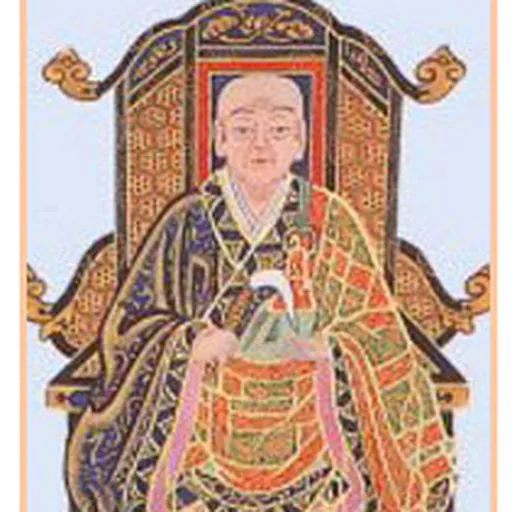
About Tan-luan
Lived 476 – 542 (aged 65–66). Tan-luan was a Chinese buddhist monk.
Tanluan (, 476–554) was a Chinese Buddhist monk who wrote on Pure Land Buddhism.
Tanluan was the first East Asian Buddhist to stress the importance of the Buddha's Other Power as a liberating force. He held that through the practice of nianfo (buddha recollection), the Buddha's power would take them to the pure land after death. This doctrine would become very important in later Pure Land Buddhism.
Tanluan's main work is his Jingtu lun zhu (浄土論註; T. 1819), a Commentary to Vasubandhu's Discourse on the Pure Land.
Tanluan is considered to be the Third Patriarch of Pure land Buddhism by the Japanese Pure Land sects like Jōdo-shu and Jōdo Shinshū. He was a significant influence on later Pure Land masters like Shandao and Shinran.
Life Tanluan was born in Shanxi, in an area near Wu-t’ai shan. As a young boy he climbed the mountain and visited its holy sites. He joined the Buddhist monastic community early on and became a scholar, studying the Sanlun (Madhyamaka) and Yogacara schools. Tanluan's reputation grew, eventually drawing the attention of the Emperor of the Wei Dynasty, who honored him with the title “Shen-Luan” (Divine Bird). In recognition of his achievements, the Emperor entrusted him with the Ta-yen Ssu Monastery in Ping-chou.
This commentary focuses on how all beings can swiftly attain the bodhisattva stage of non-retrogression by attaining birth in Sukhavati, the pure land of the Buddha Amitābha, through the sincere practice of nianfo (buddha recollection, or mindfulness of the buddha).
In this world, where the Buddha’s presence is absent, the presence of deluded people, evil people, non-Buddhists, and non-Mahayana teachings lead bodhisattvas away from their practice, confusing and obstructing them. He also compares the Buddha's name to a light which can illuminate a dark room, even if that room has been dark for eons. Tanluan also compares relying on other power to following in the procession of a Cakravartin king, which allows one to travel to any continent with ease. His account of these key vows become a major source for this topic later Pure Land authors like Shinran. According to Tanluan's account: He also compares the pure land to a wish fulfilling jewel (cintāmaṇi) that can magically transform the nature of any waters it is placed in. According to Corless, Tanluan's teaching draws on images of light and on the beauty of the pure land's arrays (vyūha) and shining ornaments to draw people to attain birth there, where true wisdom will be attained. As such, Tanluan is able to present a theory of non-duality which supports the pure land practice of nianfo (buddha recollection), seeing that the Name of Amitābha Buddha is the skillful means which is supremely adorned with pure forms and boundless Buddha qualities. In detail, these five gates of Buddha recollection (念門, nianmen) are:
Thus, according to Tanluan, when the Name is cast into a person's defiled mind, even just ten times, "his transgressions will be extinguished from thought to thought, his mind will become pure, and he will attain rebirth." He also claims that:If all who hear the meritorious Name of Amitabha but have faith in, and take joy in what they have heard, and if for one instant of thought they have utmost sincerity, and if they transfer these merits and desire rebirth, then they shall attain rebirth. Tanluan comments:When beings create a mental representation of the Buddha, the Buddha’s body, with its marks and signs, appears in the mind of beings. It is like an image appearing in clear water: the water and the image are neither the same nor different. So we can say that the Buddha’s body with its marks and signs is the same as one’s mental representation of it....Outside of the mind there is no Buddha. For example, fire comes from wood: without wood, one cannot have fire. But, because it is not separate from wood, it consumes the wood. The wood becomes fire, and, being fire, consumes the wood.
Being in accordance with the meaning of the Name Tanluan writes that "The name of the Tathāgata of Unhindered Light (Amitābha) can destroy all the ignorance of sentient beings and fulfill all their aspirations". This possible because the name "embodies infinite merit through his skillful means and adornments." However, he also says that if beings say the name and their ignorance is not removed, this is because they are not "yoked with" or "in accordance with" (Ch. xiangying, 相応) with the ultimate meaning of the Buddha's name and thus, with the ultimate reality.
In spite of his emphasis on yogic union with the meaning of the Name, Tanluan also makes it clear that even the lowest class of person, who have no understanding of emptiness and non-arising, can attain birth in the pure land through ten recitations of the Buddha's name. Tanluan argues that the name is like a wish fulfilling jewel, and so it can the purify muddy water of the mind. He also states:Further, it is like ice thrown onto a blazing fire. The fire is fierce, so the ice disappears: but as the ice disappears, the fire goes out. Although the man of the lowest class does not know that dharmatā is unarisen, simply by the power of invoking the Buddha’s name, he makes the rebirth wish and resolves to be born in that land. That land is the realm of non-arising, so, though he falsely views it as birth, the fire [of his false view] is automatically put out.
Influence Tánluán is influential in the history of Pure Land Buddhism since he was the first thinker to apply the term Other-power (Chinese: tālì 他力) to a Pure Land context.
Tánluán also had a strong impact on Daochuo, who once visited his temple. His work also influenced Shandao.
Tánluán's discussion of self-power and other-power clearly influenced the Japanese Pure Land traditions, who emphasize the other-power of the Buddha Amitabha as the only cause of rebirth in the Pure land. As such, Tánluán was seen by Hōnen and Shinran as the founder of Pure Land Buddhism in China. Tánluán's works were very influential on the Japanese Jōdo Shinshū school since they were relied upon by Shinran in his writings.
Don’t just read it —
keep it.
Full-length biographies made to live with: read them, listen on the way to work, watch them tonight.
- E-book
- Audio
- Video
Instant download · yours to keep · every purchase keeps this site free
Important facts
Related people
Same field, nearest in time




Contemporaries
People whose lives overlapped Tan-luan's



Frequently asked questions
Who was Tan-luan?
Chinese Buddhist monk
When was Tan-luan born?
Tan-luan was born in 476.
When did Tan-luan die?
Tan-luan died in 542.
What was Tan-luan's occupation?
Tan-luan was a buddhist monk.
What nationality was Tan-luan?
Tan-luan was Chinese.
Sources & further reading
Cite this page
APA: Biography.guide. (2026). Tan-luan. https://biography.guide/tan-luan/
MLA: "Tan-luan." Biography.guide, https://biography.guide/tan-luan/.
Chicago: "Tan-luan." Biography.guide. https://biography.guide/tan-luan/.
Data last updated: 2026-09-23 · Spot an error? Report a correction.
Portrait: Wikimedia Commons · author & licence
Page generated 2026-09-27 05:07 UTC