
About Tadashi Kawamata
Born 1953. Tadashi Kawamata is a Japanese visual artist, sculptor, photographer, university teacher, painter and installation artist.
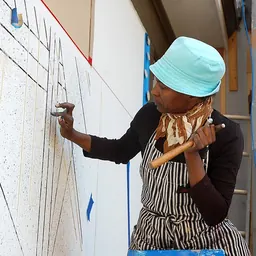
Tadashi Kawamata (川俣正, Kawamata Tadashi, born July 24, 1953) is a Japanese installation artist. After first studying painting at Tokyo University of the Arts, Kawamata discovered his interest in the practice of installation. Using recuperated construction materials, like wood planks, he began building rudimentary partitions in gallery spaces and apartments to explore the perception of space.
Kawamata's fascination for Tokyo's urban landscape and its constant transformation soon led to the development of larger-scale installations in situ in cities in Japan and abroad. After having participated in the Venice Biennale in 1982 at only 28 years old, Kawamata's subsequent projects led him to work across Europe, North America, and South America.
These ephemeral installations raise questions about architecture and its permanence, and have drawn attention to social realities, such as the stark class difference apparent in large cities. Since the 2000s, the artist's installations have taken on an increasingly ecological charge, confronting environmental disasters, such as the accumulation of waste or the aftermath of the 2011 Tōhoku earthquake and tsunami.
He has lived and worked between Paris and Tokyo since 2006.
Biography Tadashi Kawamata was born in Mikasa, a mining town on the island of Hokkaido, and was raised in a rural, agricultural environment.
As an oil painting student at Tokyo University of the Arts, Kawamata read translations of works by French philosophers Maurice Merleau-Ponty, Jean-Paul Sartre, Michel Foucault, Michel Serres and Roland Barthes. Kawamata began his practice of installation in 1979, using lumber as his predominant material to intervene outside of traditional exhibition spaces. The practice of installation in non-traditional spaces dates back to the 1960s in Japan, when artists who couldn't afford to store their art or expose their works in rental galleries regularly organized exhibitions of transient nature. However, installation artists like Kawamata were also interested in the "physicality" (shintai-sei) of installations, and wished for spectators to be able to enter them.
After receiving his BFA in 1979 and his MFA in 1981 from Tokyo University of the Arts, Kawamata had the opportunity to present his work for the first time in Europe. He was selected as one of three artists to present at the Japanese pavilion at the Venice Biennale in 1982, at 28 years old, and traveled around Europe for six months after the opening.
Kawamata settled in New York for two years during the 1980s. During this time, he developed a strong interest in graffiti artists and their clandestine and often anonymous practices that existed outside of the art market and museum systems.
Another defining element of Kawamata's practice is its collective nature. The artist depends on the help of others for the realization of many of his works, especially those on a larger scale. He says that he appreciates developing his ideas with others, whether they be students, carpenters, architects, engineers, or anyone else that may be open to making suggestions. The artist has organized "workshops" to develop projects collectively, like in 2008 at the Ecole nationale supérieure d'architecture de Versailles, when he worked with 150 students to create the installation Gandamaison. While the artist does use preliminary sketches and drawings, he affirms that it is impossible to know what the installation will look like upon completion as the installation only takes its final shape during the process of construction.
Early installations Kawamata's first three-dimensional installations were simple wooden partitions that allowed him to restructure interiors, like Measure Scene 2, presented in 1979. Upon completion, the bombed-out church appeared to be cradled by Kawamata's precarious gathering of planks, embodying fragility and determined strength all at once. Writer Yvette Biro recounts her experience of visiting the site: On the one hand, we had the impression of witnessing a normal construction process...on the other hand, inside the space we found an unexpected peaceful zone. The silence and the energy of the action collided and - much more - supported each other, lending a sense of liveliness, the illusion of dynamic existence to these odd ruins. Art historian Mouna Mekouar argues that Kawamata "does not seek to define a form, to erect an architecture, or to close off a space; on the contrary, he tears down the foundations of Architectonics and interferes in the interstices so as to dig passages, to recycle time." The Field works are intended to bear a strong resemblance to the temporary, transitory shelters of the homeless in cities around the world, drawing attention to otherwise unnoticed architectures. Kawamata has left behind Field works in cities such as Tokyo, Chicago, New York and Montreal.
In São Paulo and Rio de Janeiro, Kawamata was struck by the prevalence of favelas, shanty towns that sprawled across the city. "Near the hotel where I was staying, right close to the favelas, the police arrived and destroyed everything. A week later, the people had started to rebuild it. It's like a natural cycle...destroying, throwing away, rebuilding. It's a non-site situation, a situation of non-history."
In 1991, Kawamata erected his own Favela in Houston. About twenty fragile plywood shacks were built on the riverbank, against the backdrop of the gleaming Houston skyline. Art historian Mouna Mekouar argues that Kawamata's installation reveals "social disparity, the brutal cleavage between the rich and the poor". The result was a layer of colorful garbage - fishing rope, plastic, ropes, bottles, utensils, electrical appliances - that hung above visitors' heads.
Since 2008, Kawamata has also constructed Tree Huts, somewhat whimsical structures sometimes resembling birds' nests, sometimes resembling rudimentary tree houses. Kawamata has exposed these structures within gallery spaces, but also in the public sphere. Rugged, asymmetrical and crude in construction, they appear to sprout organically from the city's architecture like parasites. Art historian Caroline Cros suggests that these interventions are meant to remind the viewer that "architecture is not the privilege of humans alone", noting importantly that, like Kawamata, "animals and plants are magnificent architects that work collectively".
Gallery
Don’t just read it —
keep it.
Full-length biographies made to live with: read them, listen on the way to work, watch them tonight.
- E-book
- Audio
- Video
Instant download · yours to keep · every purchase keeps this site free
Important facts
People in Tadashi Kawamata's life
Named in this biography and alive at the same time



Related people
Same field, nearest in time



Contemporaries
People whose lives overlapped Tadashi Kawamata's

Frequently asked questions
Who is Tadashi Kawamata?
Japanese artist (born 1953)
When was Tadashi Kawamata born?
Tadashi Kawamata was born on 24 July 1953 in Mikasa.
What is Tadashi Kawamata's occupation?
Tadashi Kawamata is a visual artist, sculptor, photographer, university teacher, painter and installation artist.
What nationality is Tadashi Kawamata?
Tadashi Kawamata is Japanese.
Sources & further reading
Cite this page
APA: Biography.guide. (2026). Tadashi Kawamata. https://biography.guide/tadashi-kawamata/
MLA: "Tadashi Kawamata." Biography.guide, https://biography.guide/tadashi-kawamata/.
Chicago: "Tadashi Kawamata." Biography.guide. https://biography.guide/tadashi-kawamata/.
Data last updated: 2026-09-20 · Spot an error? Report a correction.
Page generated 2026-09-27 05:33 UTC