
About Syed Abul Fazal Sultan Ahmad
Lived 1909 – 1984 (aged 75). Syed Abul Fazal Sultan Ahmad was a Bangladeshi writer.
Syed Abul Fazal Sultan Ahmad (; 1909–1984), also known as Chandrapuri according to his birthplace, was a Bangladeshi Sufi saint, spiritual leader and Islamic scholar. He is most widely recognized as the founder of Chandrapara Pak Darbar Sharif in the Faridpur district and as the spiritual guide (Murshīd) of the late Syed Mahbub E Khoda Dewanbagi, the founder of Dewanbag Sharif.
Titles He is widely revered by his followers as Sultan al-Awliya and the Imam of the Sultania-Mujaddidi Tariqa (a Sufi order).
His nisba al-Chāndrāpurī or Chandrapuri indicates his origin from Chandrapara village in Dhaukhali Union under Sadarpur upazila of Faridpur district.
Early life and education Ahmad was born in 1909 in Chandrapara village of Faridpur District, Eastern Bengal and Assam, British India. His father was Syed Muhammad Qurban Ali Khan and his mother was Begum Khadiza Khatun. His maternal grand-father was Mohammad Amin Uddin Munshi.
His ancestors came to Bengal region from distant Arabia via Anatolia and first settled in Chittagong. Then they went to Faridpur and settled first in Kishtpur village and later in Dashajar village. Finally, they settled in Chandrapara village.
Ahmad studied at Rajachar Madrasa in Faridpur for 6 years. He then studied at Osmania Madrasa in Chandpur, Kamranga Madrasa in Matlab, and finally Hammadia Madrasa in Dhaka.
Religious leadership and teaching Ahmad belonged to the Naqshbandi-Mujaddidi spiritual lineage. He was a disciple (khalifa) of the renowned Sufi saint Khwaja Yunus Ali Enayetpuri of Sirajganj. He later introduced the Sultania-Mujaddidi order.
His teachings focused heavily on Tazkiyah-e-Nafs (self-purification), Zikar-e-Qalbi (Heart awakening), and the strict observance of Islamic rituals combined with spiritual devotion (Marifat).
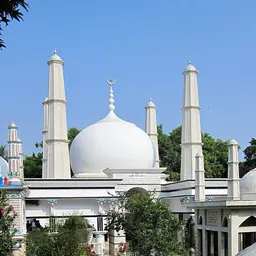
Religious Career He established the Chandrapara Pak Darbar Sharif in the Faridpur district. This institution serves as a center for spiritual learning and currently draws thousands of devotees, particularly during the annual Urs (religious gathering commemorating a saint's demise).
Personal life Ahmad's first wife was named Chamirunnesa Khanom. They had five daughters. Their fourth daughter, Syeda Hamida Begum, was married to Syed Mahbub-e-Khoda, the chief caliph of Ahmad.
Ahmad's second wife was named Khodeza Begum. They had five daughters and one son.
Death and burial Ahmad died in his Darbar Sharif on March 28, 1984. He was buried in the Darbar Sharif he established.
Writings and publications Ahmad has authored books on Sufism in Bengali. Notable works include: Books Nurul Asrar (Parts 1 and 2) Hakkul Yakin Sultaniya Khabnama
Legacy
His demise anniversary (Urs) is a major event at the Chandrapara Darbar, usually celebrated in January (often mid-January) each year, attracting a large number of followers from Bangladesh.
He is credited with spreading the teachings of the Naqshbandi-Mujaddidi order extensively in the region, emphasizing the "Dhikr" of Allah within the heart (Qalb). He is credited with being a "reformer of the age" in the context of Sufi traditions in Bangladesh. He later established the Sultania-Mujaddidi Tariqah (spiritual order).
His chief caliph and successor, Syed Mahbub E Khoda Dewanbagi (founder of Dewanbag Sharif), organized 8 World Sufi Conferences from 1989 to 1996 and 20 World Ashek-e-Rasul (PBUH) Conferences from 1997 to 2018 to commemorate his birth anniversary.
Naqshbandi Sufism Naqshbandi Sufis claim that Sultan Ahmad is descended from a long line of "spiritual masters" which were claimed by the order: Muhammad, d. 11 AH, buried in al-Masjid al-Nabawī, al-Madinah al-Munawwarah, Kingdom of Saudi Arabia (570/571–632 CE). Abī Bakr al-Ṣiddīq, d. 13 AH, buried in al-Masjid al-Nabawī, al-Madinah al-Munawwarah, Kingdom of Saudi Arabia (573–634 CE). Salman al-Farsi, d. 35 AH, buried in Al-Mada'in, Iraq (568–653 CE). Al-Qāsim ibn Muḥammad ibn Abī Bakr, d. 107 AH, buried in Medina, Saudi Arabia (668–738 CE). Ja'far ibn Muhammad al-Sadiq, d. 148 AH, buried in Medina, Saudi Arabia (702–765 CE). Bāyazīd Basṭāmī, d. 261 AH, buried in Bastaam, Iran (804 - 874 CE). Abu 'l-Hassan Ali ibn Ahmad ibn Salmān al-Kharaqāni, d. 425 AH, buried Kharqaan, Iran (963–1033 CE). Abu ali Farmadi, d. 477 AH, buried in Tous, Khorasan, Iran (1016–1084 CE). Abū Yaʿqūb Yūsuf al-Hammandinā, d. 535 AH, buried in Maru, Khorasan, Iran (1048–1140 CE). Abdul Khaliq Ghijduwani, d. 575 AH, buried in Ghajdawan, Bukhara, Uzbekistan. Khwaja Muhammad Arif Riwgari, d. 616 AH, buried in Reogar, Bukhara, Uzbekistan. Khwaja Mahmood al-Anjir al-Faghnawi, d. 715 AH, buried in Waabakni, Mawarannahr, Uzbekistan (1231–1317 CE). Azizan Ali Ramitani, d. 715 AH, buried in Khwarezm, Bukhara, Uzbekistan (1194–1315 CE). Mohammad as-Samasi, d. 755 AH, buried in Samaas, Bukhara, Uzbekistan (1195–1257 CE). Sayyid Shams ud-Dīn Amir Kulāl, d. 772 AH, buried in Saukhaar, Bukhara, Uzbekistan (1278–1370 CE). Imam Baha' al-Din Naqshband Bukhari, d. 791 AH, buried in Qasr-e-Aarifan, Bukhara, Uzbekistan (1318–1389 CE). Sayyid Alauddin Attar Bukhari, buried in Jafaaniyan, Mawranahar, Uzbekistan (1338–1402 CE). Yaʿqūb ibn ʿUthmān ibn Maḥmūd al-Charkhī, d. 851 AH, buried in Dushanbe, Tajikistan (1360–1447 CE). Nāṣir ad-Dīn ʿUbaydullāh ibn Maḥmūd ibn Shihāb ad-Dīn Khwaja Ahrar, d. 895 AH, buried in Samarkand, Uzbekistan (1404–1490 CE). Muhammad Zahid Wakhshi, d. 936 AH, buried in Wakhsh, Malk Hasaar, Tajikistan (1448–1530 CE). Khwaja Darwish Muhammad, d. 970 AH, buried in Samarkand, Uzbekistan (1443–1562 CE). Khwaja Muhammad Amkanagi, d. 1008 AH, buried in Akang, Bukhara, Uzbekistan. Khwaja Muhammad Baqi Billah, d. 1012 AH, buried in Delhi, India (1564–1603 CE). Imam Ahmad al-Farūqī al-Sirhindī Mūjaddīd al-Alf al-Thanī, d. 1034 AH, buried in Sirhindi, Punjab, India (1564–1624 CE). Sayyid Adam Banuri, d. 1053 AH, buried in Jannat al-Baqī, al-Madinah al-Munawwarah, Kingdom of Saudi Arabia (1503–1643 CE). Sayyid Abdullah Akbarabadi, buried in Agra, India. ʿAbd-ur-Rahim al-ʿUmari ad-Dehlawi, d. 1131 AH, buried in Delhi, India (1644–1719 CE). Qutb ud-Din Ahmad ibn ʿAbd-ur-Rahim al-ʿUmari ad-Dehlawi, d. 1176 AH, buried in Delhi, India (1703–1762). Shah Abdul Aziz Muhaddith Dehlavi, d. 1239 AH, buried in Delhi, India (1746–1824 CE). Sayyid Ahmad Shahid Barelvi, d. 1246 AH, buried in Balakot, Pakistan (1786–1831 CE). Noor Muhammad Nizampuri, d. 1275 AH, buried in Chattogram, Bangladesh (1790–1858 CE). Sayyid Fateh Ali Waisi, d. 1303/04 AH, buried in Kolkata, India (1820–1886 CE). Sayyid Wazed Ali Mehedibagi, d. 1338 AH, buried in Kolkata, India (1854–1919 CE). Khwaja Yunus Ali Enayetpuri, d. 1371 AH, buried in Sirajganj, Bangladesh (1886–1952 CE). Imam Sayyid Abul Fazal Sultan Ahmad Chandrapuri (subject of this article), d. 1404 AH, buried in Faridpur, Bangladesh (1909–1984 CE).
Don’t just read it —
keep it.
Full-length biographies made to live with: read them, listen on the way to work, watch them tonight.
- E-book
- Audio
- Video
Instant download · yours to keep · every purchase keeps this site free
Important facts
People in Syed Abul Fazal Sultan Ahmad's life
Named in this biography and alive at the same time




Related people
Same field, nearest in time

Contemporaries
People whose lives overlapped Syed Abul Fazal Sultan Ahmad's



Frequently asked questions
Who was Syed Abul Fazal Sultan Ahmad?
Sufi Islamic Scholar and Spiritual Leader
When was Syed Abul Fazal Sultan Ahmad born?
Syed Abul Fazal Sultan Ahmad was born on 25 February 1909.
When did Syed Abul Fazal Sultan Ahmad die?
Syed Abul Fazal Sultan Ahmad died on 28 March 1984.
What was Syed Abul Fazal Sultan Ahmad's occupation?
Syed Abul Fazal Sultan Ahmad was a writer.
What nationality was Syed Abul Fazal Sultan Ahmad?
Syed Abul Fazal Sultan Ahmad was Bangladeshi.
Sources & further reading
· Wikipedia: Syed Abul Fazal Sultan Ahmad
· DBpedia: Syed Abul Fazal Sultan Ahmad
Cite this page
APA: Biography.guide. (2026). Syed Abul Fazal Sultan Ahmad. https://biography.guide/syed-abul-fazal-sultan-ahmad/
MLA: "Syed Abul Fazal Sultan Ahmad." Biography.guide, https://biography.guide/syed-abul-fazal-sultan-ahmad/.
Chicago: "Syed Abul Fazal Sultan Ahmad." Biography.guide. https://biography.guide/syed-abul-fazal-sultan-ahmad/.
Data last updated: 2026-09-20 · Spot an error? Report a correction.
Page generated 2026-09-27 05:04 UTC