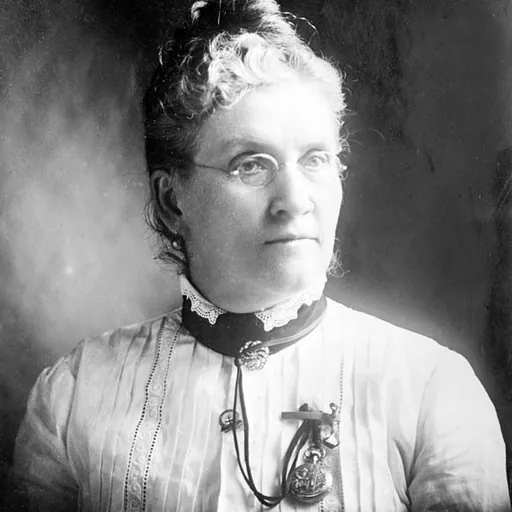
About Susa Young Gates
Lived 1856 – 1933 (aged 77). Susa Young Gates was an American historian, novelist, genealogist, suffragette and writer.
Susa Gates ( Young, formerly Dunford; March 18, 1856 – May 27, 1933) was an American writer, periodical editor, president of the Daughters of Utah Pioneers, and women's rights advocate. She was a daughter of LDS Church president Brigham Young. Throughout her life, Gates wrote many articles, poems, short stories, novels, and other literary works. According to R. Paul Cracroft's thesis, Gates wrote more than other Mormon writers. Gates was also actively involved in the Church of Jesus Christ of Latter-day Saints (LDS Church) where, among other things, she wrote the lesson manuals, was a member of the Relief Society general board, lead genealogical efforts, and served as a missionary.
Early life Gates was born in Salt Lake City, Utah Territory, to Lucy Bigelow, Brigham Young's twenty-second wife. Gates was named Susanna, but went by Susa for most of her life. She was Brigham's forty-second child and the second child to be born to Lucy Bigelow and Brigham Young. Due to a series of natural disasters, Utah experienced a food shortage and the people living in Utah were required to live off food rations. Gates was also a child during the Utah War which also contributed to the hardship that her family experienced. As a result of the war, Gates moved south temporarily with some of her family to what is now known as Provo. However, her father withdrew her from school and moved her (along with two of his wives and their children) to St. George, Utah. In St. George, Gates continued pursuing an education, but struggled to get along with her new teacher and peers. According to multiple articles she wrote, Gates greatly enjoyed school.
When Gates was fourteen, she became the associate editor of "The College Lantern," a literary magazine published by the University of Deseret where she was a student. "The College Lantern" was one of the first campus publication in the west. According to Cracroft's thesis, Gates was one of the first people in Utah to learn shorthand.
Career
Academic
Gates was involved in different educational institutions in Utah. Gates entered Brigham Young Academy in Provo, Utah, in 1878 where she taught music lessons and founded the music department.
Genealogy
Gates was also active in genealogy and LDS Church temple work. Gates also published a book called "Surname Book and Racial History" that alphabetically listed common surnames in Utah and the history and original nationality of the name. In her thesis, Lisa Olsen Tait explains the significance of Gates' pen name. Tait explains that during the time when Gates was publishing, the church was encouraged to manufacture items by themselves in order to avoid spending money at "Gentile" establishments. Brigham Young described this practice as a way to not "please and pamper that power which is opposed to the kingdom of God on earth." Tait argues that Gates selected the pen name of Homespun as a tribute to that council and as a way to show that she was also dedicated to supporting Mormon products and industry and living separately from the world.
Gates tended to write in a very plain and simple way. According to personal writings from Gates, Gates believed that her readers were unable to understand stories on concepts if she did not write plainly. In her published writings, Gates does not often use complicated or confusing metaphors or analogies. She continued to contribute occasionally until it ceased publication in 1929.
In 1915, Gates founded Relief Society Magazine, a periodical targeted at members of the Relief Society. The magazine became the official publication of the church's Relief Society, and Gates edited it until 1922.
Throughout her life, Gates had writings published in multiple non-Mormon journals, such as North American Review and Godey's Lady's Book. However, outside of the publications she founded, most of Gates' articles appeared in other LDS magazines such as the Juvenile Instructor, the official publication of the church's Sunday School.
Poems Gates' poems include:
"From a Mother to Her Babes" Hymn of the Mothers of Men" "What, When, Who?" "The House that Elizabeth Built" "A Love Lyric" "Reflections" "Life's Interludes" "Sunset" "Consecration"
Short stories Some of Gates' published short stories include:
"Aunt Fanny's Rocking Chair" "Worse Than Death" "Three Mormon Boys" "Which Path?" "Harry's Wife" "Why Helen Did Not Attend the Christmas Ball" "All is Well! All is Well!" "Whatsoever a Man Soweth"
Other works Gates wrote a cantata about the life of Brigham Young. Music for the performance was composed by H.E. Giles, a professor at Brigham Young Academy. Gates' cantata was performed on June 4, 1890, at the Provo Opera House as part of celebratory events commemorating Brigham Young's birthday. Gates also wrote some plays, her longest one being "Dialogue from the Book of Mormon." Gates also turned some of her poems into songs.
Unpublished works During the last fifteen years of her life, Gates worked on two writing projects that were never published: The History of Women and Lucy Bigelow Young.
Publications in the Relief Society Magazine
Articles
Relief Society Conference
Biography
Views
Polygamy Gates has been reported to hold differing views on polygamy throughout her life. As a daughter of Brigham Young, Gates grew up in one of the most prominent polygamous families in the United States at the time. Despite polygamy being practice in the church and Susa's idyllic recollections of growing up in a polygamist household, Gates reported that she was opposed to Jacob from taking another wife. However, Gates acknowledged that the practice of polygamy can be very difficult, but it can be lived harmoniously. When the church did away with the practice of polygamy, Gates felt that if Mormons had had more faith, the practice could have been continued. Years after the church ended practicing polygamy, Gates continued to defend it and verbally fought with people who opposed it.
Following the end of the church practicing polygamy, the church ideas of and culture regarding marriage and the romantic aspects of marriage began to change. At the same time, Mormon women were continuing to advocate for suffrage. As a result of these changes, prominent Mormon women had the opportunity to redefine womanhood in the church. In her thesis, Kathryn H. Shirts writes that "[Susa Young Gates and her daughter, Leah Dunford Widtsoe] fashioned a model for gender roles that has persisted among Mormons well into the twenty-first century." In 1939, Mormon apostle John A. Widtsoe (husband of Leah and son-in-law of Gates) published Priesthood and Church Government. According to Shirts, Leah and Gates' support of the book greatly influenced the popularity and acceptance of the book and its ideas."
Throughout her career, Gates faced criticism from other women, especially with suffragettes that Gates associated with, about polygamy. Gates wrote an article that was published in The North American Review in 1890 that defended the practice of polygamy. Gates used examples from her life, and particularly her childhood in Brigham Young's house, that she believed proved that polygamy was not an inherently harmful practice. She argued that children from polygamous families in Utah had many opportunities for education, including her own experience studying music and theatre. She described growing up in a polygamous household as desirable and idyllic, recounting the family traditions of "evening prayer" and time spent talking as a family as "pleasant." Gates writes that she rarely left the house for recreational activities because she had so many siblings to play with. She claimed that polygamy forces its participants to be more kind and gentle, and is better for society. She writes: "Statistics will bear me our in saying that there are fewer paupers, fewer criminals, fewer insane among polygamous than among monogamous families. It is a well-known fact here in Utah that there are fewer physical defects and greater intelligence in plural homes than in the same grade or class in monogamy."
Progressive homemaking Gates promoted the idea that Shirts refers to as "progressive homemaking." Gates created and supported university classes on domestic science. She also sent Leah to the school of domestic science at the Pratt Institute of Brooklyn (now known as the Pratt Institute) following her graduation from the University of Utah. Gates also founded domestic science classes at BYU. Shirts reports that Gates and her daughter were on the "cutting edge of the national movement to make scientific homemaking an acceptable academic profession under the name home economics. Shirts argued that Gates' belief that women were divinely appointed to work in the home came from the Bible and that this idea was common in nineteenth-century America. Throughout her life and career, Gates defended the Biblical and traditional subordination of wives to their husbands. Shirts argues that the work that Gates did to promote those ideals made her standout among women of her time as many women were not actively involved in politics as Gates was. Gates spent much of her adult life promoting the importance of teaching homemaking as vital skill." According to Shirts' thesis, Gates also influenced how Mormons in her time viewed the relationship between husband and wife." Gates and her daughter promoted the idea that marriages are happiest when husband and wife act as "companions." Gates encouraged women to become educated because she believed that intelligent women were the most successful homemakers.
Women and the priesthood Shirts' thesis also describes how Gates resolved her questions about the church's gender separation regarding the priesthood. Shirts reports that Gates spoke with Joseph F. Smith, her long-time friend and church leader, about her concerns. Gates later wrote about some of her interactions with Smith and how they affected her conclusions about the status of women in the church and the female relationship to the priesthood. Gates recorded some specifics of what Smith said, but her main conclusion from their conversations was that the gender hierarchy based on gender difference was natural and of divine creation. Gates reported that she did not find that conclusion offensive. Gates wrote, "in regard to woman's relationship to the priesthood I was perfectly satisfied -nay more- womanhood was glorified for me." Gates later explained that she viewed the female privilege of motherhood as a "spiritual parallel to priesthood." Gates promoted her conclusion and advocated for women to be submissive to male leaders and to focus on their work in the home. Shirts argues in her thesis that Gates promotion of this idea greatly affected the gender roles in the church. During her time in leadership positions in the church and affiliated institutions, Gates explained multiple times that "women do not hold the Priesthood."
Personal life
Marriage and children Gates most likely began being courted by different men when she was fourteen. Gates' father had an active role in the courtships of his children and would often interview the young men who came to visit his daughters and strongly encouraged his daughters to not associate with people who were not members of the LDS Church.
Marriage to Alma B. Dunford
In 1872, while living in St. George, Gates married Alma B. Dunford. Gates was sixteen years old at the time of their marriage. The couple received permission from Brigham to be married in the Endowment House in Salt Lake City and they were married on December 1. Their marriage was performed by Gates' friend and future president of the church Joseph F. Smith. Dunford was a cousin of Young's brother-in-law and worked as a dentist. After they were married, they moved to Salt Lake City where Dunford opened up a dentist office. Together, the couple had two children, Bailey and Leah. Following the birth of their second child, the family moved back to St. George and began to build a house. Dunford reportedly drank, which caused her to be unhappy in the marriage. Before their house was completed, Dunford received a mission call to England. The family moved back to the Lion House in Salt Lake City while Dunford was in England. Following Dunford's departure, Gates and her children moved to Bloomington, Idaho to live with Dunford's parents. Shortly after they arrived in Idaho, Brigham died.
Gates decided that she wanted to end her marriage to Dunford and sent him a letter saying so. Still a missionary in England, Dunford was shocked and hurt to find out that Gates wanted to divorce. Dunford returned from England and the couple appeared in court to determine the specifics of their divorce. The relationship was so contentious that Gates ended up being arrested and briefly incarcerated for a fight she had with Dunford over the division of property following their divorce. Gates and Dunford officially divorced in 1877. Gates gained custody over their son, Bailey, while Dunford gained custody of Leah. Following the divorce, Gates was "devastated" by being separated from her daughter and faced with financial obligations that she could not afford. Gates did not receive alimony from the divorce, increasing her financial difficulties.
Marriage to Jacob F. Gates A few years after the end of her first marriage, Gates began a relationship with Jacob F. Gates. Gates had met and become friends with Jacob while living in St. George. The two exchanged letters while Jacob was living in Hawaii as a missionary for the church. In these letters, Jacob invited Gates to visit him in Hawaii. Gates accepted his invitation and spent much of her six-week trip with Jacob. They continued their correspondence and were married three months after Jacob returned from Hawaii on January 5, 1880, in the St. George Utah Temple. They lived in St. George during the beginning of their marriage. In their first five years as a married couple, Gates gave birth to four children. Bailey, Gates' son from her previous marriage, enjoyed a close relationship with his new stepfather. While the family gained prominence in their community, they struggled financially for their whole life.
During their marriage, Gates and Jacob lived in Hawaii as missionaries for the church. Their biological children also came to Hawaii with them. In total, Gates and Jacob had eleven children, seven of which did not survive to adulthood.
Children Throughout her life, Gates gave birth to thirteen children.
Bailey Leah Emma Lucy (November 5, 1880) Jacob Young (1886) Karl Nahum (1883) Simpson Mark (1885) Joseph Sterling (1886) Brigham Cecil (1887) Harvey Harris (Hal) (1889) Sarah Beulah (1891) Franklin Young (1893) Heber (1894, died at birth) Brigham Young (1896)
While Gates was estranged from her children from her first marriage for a time, she did reconnect with Leah and Bailey after her time in Hawaii.
Since Dunford was given custody of Leah after the divorce, Gates was not able to spend much time with Leah when she was a child. From the divorce until a few years after Gates returned from Hawaii, Leah did not communicate much with Gates and Gates's family. As she grew older, Leah spent more time with Gates and her family. Gates was involved in the selection of Leah's husband. Gates introduced the couple, but then resisted their engagement. However, her future son-in-law communicated with Gates through letters and eventually earned her approval."
The relationship between Gates and Bailey struggled while Bailey lived with his father. While a teenager, Bailey expressed that he did not care to communicate with Gates. Eventually, Bailey asked Gates if he could live with her. Upon his return to Provo, Bailey continued to live a "troubled life." He left Provo and his family did not hear from him for several years. Bailey ended up traveling around the western United States, working odd jobs to earn money. During this time, he asked for and received some money from Gates. Bailey had strained relations with other members of his family due to unpaid debts and his struggles with alcohol abuse which greatly concerned Gates. On January 16, 1895, Bailey was killed as he was working as a firefighter. After the recovery of his body, it was discovered that the only possession he had with him was Gates' last letter to him. At the time of Bailey's funeral, Gates was bedridden following a difficult childbirth and consequently was not able to attend.
Missionary experiences
Hawaii Jacob received another mission call to Hawaii and requested and received permission for his family to come too. Gates, Jacob, and their children all lived in Hawaii as missionaries for the church. Before they left, Gates and Jacob attempted to receive for permission for Susa's son, Bailey, to come to Hawaii with them. This upset Gates' ex-husband, Dunford, who went to the courts and Gates was forced to give him full custody of Bailey. Bailey and Gates were devastated that they had to be separated and said goodbye to each other shortly before Gates left for Hawaii. Gates, Jacob, and their three surviving biological children arrived in Hawaii on November 10, 1885.
Gates and her family lived in La'ie, which at the time was a large plantation that offered only basic living conditions. The beginning of this mission was very hard for Gates as she greatly missed Bailey and her house was filled with vermin and mosquitoes. Gates did many things on the island to help the mission, including sewing, mending, cooking, baking, washing clothes, ironing, making butter, caring for the house and yard, cleaning, making preserves and soap, and whitewashing and painting. During this time, Gates gave birth to three more children. Together, the family helped out at the nearby sugar factory and raised chickens and cows. They also participated in church events. During this mission, some of Gates' children died from diseases. Despite Jacob being fluent in Hawaiian, there were often misunderstandings between the American Mormons and the native Hawaiians. These disagreements often stemmed from the amount of money that the Gates family spent. Knowing she had a "sharp tongue and occasional tendency to gossip," Susa also clashed with native Hawaiians and non-natives which cased disagreements. Gates included stories and details about her experience in her book, The Little Missionary.
During this mission, Bailey was living with his father. This put a strain on the relationship between him and Gates. Gates attempted to continue and strengthen the relationship by writing letters to Bailey, but Baily had formed a strong relationship with his father and did not have much interest in writing to Gates. Gates's other child from her previous marriage, Leah, had not seen her mother for many years since she lived with her father and thus did not have much of relationship with Gates. The separation and breakdown of relationships with her children greatly pained Gates.
On April 14, 1889, the Gates family left Hawaii to return to the United States, finishing their four-year mission.
United States In March 1903, Gates received a mission call from the church to be a missionary in the United States.
Death and legacy Gates continued to work on many projects and different church assignments up to her death. Gates became ill with influenza around six weeks before her death. Gates died on the morning of May 27, 1933. When she died, Gates' living posterity included five children, fifteen grandchildren, and three great-grandchildren. Two days after her death, Gates' funeral was held at the Assembly Hall on Temple Square in Salt Lake City. Many members of Gates' family and prominent members of the church attended the funeral.
Over forty years after Gates' deaths, the American Mothers Committee selected Gates as the "most outstanding mother in Utah history."
Don’t just read it —
keep it.
Full-length biographies made to live with: read them, listen on the way to work, watch them tonight.
- E-book
- Audio
- Video
Instant download · yours to keep · every purchase keeps this site free
Important facts
People in Susa Young Gates's life
Named in this biography and alive at the same time


Related people
Same field, nearest in time


Contemporaries
People whose lives overlapped Susa Young Gates's





Frequently asked questions
Who was Susa Young Gates?
American writer (1856–1933)
When was Susa Young Gates born?
Susa Young Gates was born on 18 March 1856 in Salt Lake City.
When did Susa Young Gates die?
Susa Young Gates died on 27 May 1933.
What was Susa Young Gates's occupation?
Susa Young Gates was a historian, novelist, genealogist, suffragette and writer.
What nationality was Susa Young Gates?
Susa Young Gates was American.
Sources & further reading
Cite this page
APA: Biography.guide. (2026). Susa Young Gates. https://biography.guide/susa-young-gates/
MLA: "Susa Young Gates." Biography.guide, https://biography.guide/susa-young-gates/.
Chicago: "Susa Young Gates." Biography.guide. https://biography.guide/susa-young-gates/.
Data last updated: 2026-09-22 · Spot an error? Report a correction.
Portrait: Wikimedia Commons · author & licence
Page generated 2026-09-27 05:03 UTC