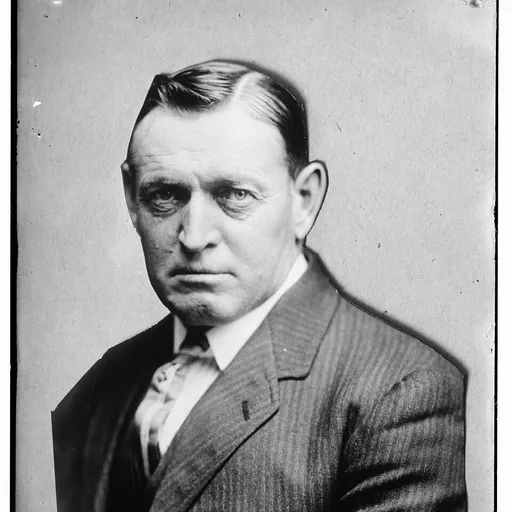
About Stephen Farrell
Lived 1863 – 1933 (aged 69). Stephen Farrell was an American athletics competitor.
Stephen J. Farrell (December 26, 1863 – October 17, 1933) was an American professional track athlete, circus performer and track coach.
Farrell was a professional foot-racer in the 1880s and 1890s, beginning as a competitor in the hook, hose and ladder teams of New England. He was the first American to win England's Sheffield Cup on two occasions and competed in races from 100 yards to one mile. He became known as "the greatest professional footracer this country has ever known." attracting as much attention as football would in the 20th Century. Farrell gained fame as one of the world's foremost professional runners in the 1880s and 1890s. It was said that Farrell "could run any race from the hundred to the mile." Each town's fire team was made up of 16 men, and Farrell was the captain of three hose teams in Massachusetts. After winning his second Sheffield Handicap, a Massachusetts newspaper reported: "Steve Farrell is perhaps the best known runner in the world, having swept the card of sprinters in both hemispheres."
In August 1891, 20,000 spectators watched Farrell compete in the Clan-Na-Gael athletic games in Philadelphia. The Philadelphia Inquirer reported that Farrell won the half-mile race (which was "virtually a walk-over for Steve Farrell, who was never pushed for the race and won with consummate ease"), the 120-yards hurdle (with Farrell winning "in hollow style" after nearly falling over the first hurdle), and the standing hop, step and jump (with Farrell "winning comfortably with 33 feet, 10-1/2 inches"). It is said that Farrell "earned more money from professional foot racing than any other man who made a livelihood from this sort of endeavor." One of the losing runner's backers was "with difficulty restrained" from shooting Farrell. A newspaper reported: "The race was regarded as a farce and for a time there was almost a riot. Betting was two to one in favor of Farrell." Farrell was thrown from his horse and "for once made excellent use of his excellent pair of legs" in running from the scene.
In December 1909, Farrell was hired by Ohio State University as coach of the track team and trainer of the football team. In December 1911, Farrell became involved in a struggle for power between the faculty and Student Athletic Board at Ohio State. Farrell bid farewell to the football team after a Thanksgiving game, noting that he did not believe he would be retained. According to a contemporary press account, "the entire squad thereupon, in tears, pledged themselves not to again compete in athletics.". They went on to chronicle his record and describe their admiration for him in the student newspaper, saying, "No one man has ever done more for Ohio State athletics than "Steve" Farrell Since his coming to Ohio State two years ago, a cleaner, more sportsman-like spirit has been instilled into every athlete coming under the trainers' influence."
University of Michigan In September 1912, Farrell was hired as the athletic trainer at the University of Michigan and noted at the time that the Ann Arbor institution "is the only western college that is thought much of down east." He served as the school's track coach until his retirement in 1930, and he was also the trainer to Fielding H. Yost's football teams from 1912 to 1919.
In 1915, a series of newspaper articles touted Farrell as an innovator in track coaching, noting his innovations in the following areas: In February 1915, The New York Times reported on Farrell's novel plan to instill "enthusiasm and vim" in his athletes by having them train to the accompaniment of music played by the Varsity band. Farrell noted that his athletes had been taking more interest in dancing competitions than athletic training. Farrell planned to have the musicians "render tunes a trifle faster than the natural stride" of Michigan's best performer in each event. "It is expected that the inspiration of the music and the natural efforts of the dancers to get in time should make the Michigan men exert themselves more willingly than they are at present doing." In January 1915, Farrell introduced rope skipping as a training method for his long distance runners. Farrell noted, "It is a great form of exercise to develop the body, especially making men long winded and strong in the legs. It also has a tendency in making them quick and alert on their toes." Farrell instituted "the espionage system of discovering budding athletes" by stationing "a force of spies" in the college gymnasium watching for men of sufficient prowess to compete on the track team. The "new detective method of locating possible athletes" was begun after a freshman student was seen completing a high jump of six feet — six inches higher than any member of the track team.
When Michigan rejoined the Big Ten Conference in 1918, Farrell's Michigan track teams promptly won the indoor and outdoor track championships in both 1918 and 1919. His teams had a 50–16–1 record in dual meets, and his athletes won 76 Big Ten individual event titles and 11 NCAA individual event titles. Michigan also won its only NCAA team track championship in 1923 under Farrell. He won many meets by focusing on team power and placing athletes where they could score points.
War service When the United States entered World War I, Farrell volunteered at age 53 and passed the Air Service examination. He served for six months at Ellington Field in Houston, Texas, and Kelly Field in San Antonio.
Don’t just read it —
keep it.
Full-length biographies made to live with: read them, listen on the way to work, watch them tonight.
- E-book
- Audio
- Video
Instant download · yours to keep · every purchase keeps this site free
Important facts
Related people
Same field, nearest in time


Contemporaries
People whose lives overlapped Stephen Farrell's




Frequently asked questions
Who was Stephen Farrell?
track athlete, circus performer and track coach (1863–1933)
When was Stephen Farrell born?
Stephen Farrell was born on 26 December 1863 in Rockville.
When did Stephen Farrell die?
Stephen Farrell died on 17 October 1933 in Ann Arbor.
What was Stephen Farrell's occupation?
Stephen Farrell was an athletics competitor.
What nationality was Stephen Farrell?
Stephen Farrell was American.
Sources & further reading
· DBpedia: Stephen Farrell (track and field)
Cite this page
APA: Biography.guide. (2026). Stephen Farrell. https://biography.guide/stephen-farrell-athletics-competitor/
MLA: "Stephen Farrell." Biography.guide, https://biography.guide/stephen-farrell-athletics-competitor/.
Chicago: "Stephen Farrell." Biography.guide. https://biography.guide/stephen-farrell-athletics-competitor/.
Data last updated: 2026-09-23 · Spot an error? Report a correction.
Portrait: Wikimedia Commons · author & licence
Page generated 2026-09-27 05:06 UTC