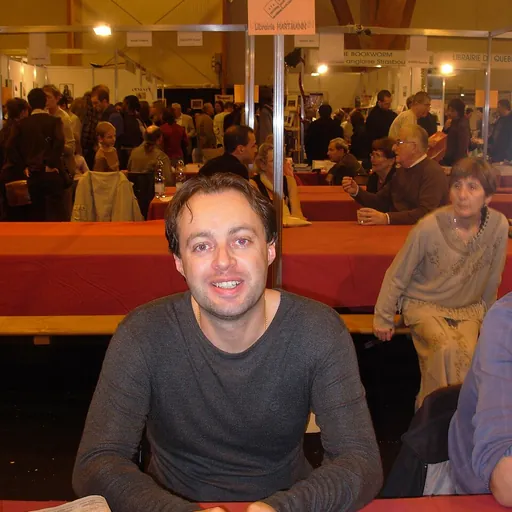
About Stéphane Breitwieser
Born 1971. Stéphane Breitwieser is a French art thief, writer, art collector and author.
Stéphane Breitwieser (born 1 October 1971) is a French art thief and author, notorious for his art thefts between 1995 and 2001. He admitted to stealing 239 artworks and other exhibits from 172 museums while travelling around Europe and working as a waiter, an average of one theft every 15 days. The Guardian called him "arguably the world's most consistent art thief". He has also been called "one of the most prolific and successful art thieves who have ever lived", and "one of the greatest art thieves of all time". His thefts resulted in the destruction of many works of art, destroyed by his family to conceal evidence of his crimes.
He differs from most other art thieves in that most of his thefts initially did not involve profit motive. He was a self-described art connoisseur who stole in order to build a personal collection of stolen works, particularly of 16th and 17th century masters.
Thefts According to journalist Michael Finkel's 2023 book The Art Thief, Breitwieser's first theft was in early 1994 in Thann, a medieval town in northeastern France. Breitwieser stole an 18th-century flintlock pistol from the Museum of the Friends of Thann. The second theft, as reported in The Art Thief, took place in February 1995. At that time, Breitwieser stole a medieval crossbow from a museum in the Alsatian mountains.
His third theft was in March 1995 during a visit to the medieval castle at Gruyères, Switzerland, with his then-girlfriend Anne-Catherine Kleinklaus. He became entranced with a small painting of a woman by the 18th-century German painter Christian Wilhelm Ernst Dietrich, later saying: "I was fascinated by her beauty, by the qualities of the woman in the portrait and by her eyes. I thought it was an imitation of Rembrandt." With his girlfriend keeping watch, Breitwieser worked out the nails holding the painting in its frame and slipped it under his jacket. He would go on to use similar methods for thefts at other museums numbering at least 170 in the ensuing years. He would typically visit small collections and regional museums, where security was lax, and Kleinklaus would serve as his lookout as he cut the paintings from their frames. He cut it from its frame at a Sotheby's auction where it was to be sold.
Breitwieser did not attempt to sell any of his large collection of art for profit at first; instead he enjoyed thinking about how he was "the wealthiest man in Europe." It was all kept in his bedroom in his mother's house in Mulhouse, France. His room was kept in semi-darkness so the sunlight would not fade the paintings. She threw other stolen artifacts, such as vases, jewelry, pottery, and statuettes, into the nearby Rhône–Rhine Canal, where a few later washed up on the shore; most of the 107 pieces were recovered through dredging and diving work.
She stated that she destroyed the paintings out of anger at her son, but police believe she did it to destroy incriminating evidence against him and herself. She apparently had no knowledge of the large monetary value of the works.
It took Swiss authorities 19 days to acquire the international search warrant required to search Breitwieser's mother's house. In 2006 Breitwieser published a romanticized autobiographical book about his exploits, titled Confessions d'un Voleur d'art (Confessions of an Art Thief), in which he claimed to have stolen some 230 artifacts over about seven years.
In April 2011, the police discovered 30 more stolen works during a house search. This resulted in another three-year prison sentence for Breitwieser in 2013.
Breitwieser was placed under surveillance in 2016 after he tried to sell a paperweight on eBay that had been stolen from a museum in St. Louis. He was arrested again in February 2019. At his home the police found Roman coins from another museum, as well as pieces from Alsatian and German galleries. In his mother's home, €163,000 in cash was found hidden in buckets.
Don’t just read it —
keep it.
Full-length biographies made to live with: read them, listen on the way to work, watch them tonight.
- E-book
- Audio
- Video
Instant download · yours to keep · every purchase keeps this site free
Important facts
People in Stéphane Breitwieser's life
Named in this biography and alive at the same time


Related people
Same field, nearest in time





Contemporaries
People whose lives overlapped Stéphane Breitwieser's



Frequently asked questions
Who is Stéphane Breitwieser?
French art thief
When was Stéphane Breitwieser born?
Stéphane Breitwieser was born on 1 October 1971 in Mulhouse.
What is Stéphane Breitwieser's occupation?
Stéphane Breitwieser is an art thief, writer, art collector and author.
What nationality is Stéphane Breitwieser?
Stéphane Breitwieser is French.
Sources & further reading
· Wikipedia: Stéphane Breitwieser
· DBpedia: Stéphane Breitwieser
Cite this page
APA: Biography.guide. (2026). Stéphane Breitwieser. https://biography.guide/stephane-breitwieser/
MLA: "Stéphane Breitwieser." Biography.guide, https://biography.guide/stephane-breitwieser/.
Chicago: "Stéphane Breitwieser." Biography.guide. https://biography.guide/stephane-breitwieser/.
Data last updated: 2026-09-21 · Spot an error? Report a correction.
Portrait: Wikimedia Commons · author & licence
Page generated 2026-09-27 04:58 UTC