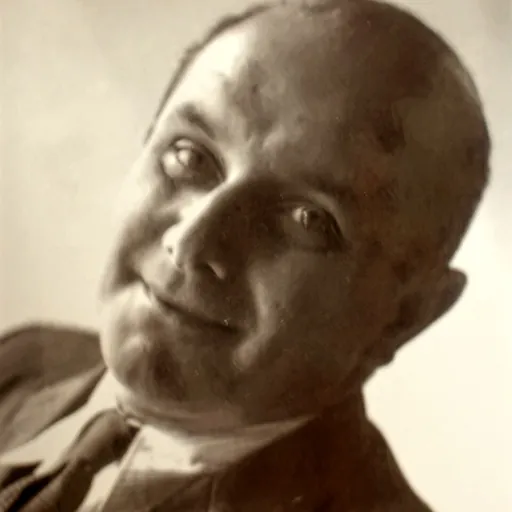
About Stanisław Jerzy Lec
Lived 1909 – 1966 (aged 57). Stanisław Jerzy Lec was an Austrian and Polish writer, poet and aphorist.
Stanisław Jerzy Lec (; 6 March 1909 – 7 May 1966), born Baron Stanisław Jerzy de Tusch-Letz, was a Polish aphorist and poet. Often mentioned among the greatest writers of post-war Poland, he was one of the most influential aphorists of the 20th century, known for lyric poetry and ironic philosophical-moral aphorisms, often with a political subtext.
Biography
Son of the Baron Benno de Tusch-Letz and Adéle Safrin, he was born on 6 March 1909 in Lemberg, Austro-Hungarian Empire (now Lviv) to a Jewish nobilitated family. After the war, mother and son returned to their hometown, now called Lwów in the Second Polish Republic. Lec attended the Lemberg Evangelical School. In 1927 he matriculated and began studies at Lwów's Jan Kazimierz University in Polish language and law. He graduated in 1933.
His literary debut was in 1929. While in the Soviet Union, Lec joined in the literary life under the auspices of Ukrainian SSR authorities. He contributed to the magazine New Horizons. His poems, satires, articles, and translations from Russian were published in Krasnoe Znamya magazine. In 1940 he joined the Union of Soviet Writers of Ukraine and became a member of the editorial board of The Literary Almanac in Lwów. He wrote the first poem about Stalin written in the Polish language ("Stalin", Czerwony Sztandar, 5 December 1939). A number of his works appeared in the Czerwony Sztandar (Red Banner) newspaper. Lec's collaboration with the Soviet authorities remains controversial to this day, though he has been defended by Adam Michnik who wrote in his 2007 book that Lec has been unfairly branded by critical opinion as a "Soviet collaborator" on the basis of his "weakest, least successful, or most frankly conformist pieces".
After Nazi Germany's attack on the Soviet Union he was imprisoned in a German work camp in Tarnopol (now Ternopil), This became the subject of one of his most famous poems "He who had dug his own grave" (from the cycle "To Abel and Cain"): He who had dug his own grave looks attentively at the gravedigger's work, but not pedantically: for this one digs a grave not for himself. After his escape he participated in partisan warfare within the communist formations of Polish resistance (the Gwardia Ludowa and the Armia Ludowa), He also edited the communist resistance underground newsletter Żołnierz w Boju (Soldier in Combat) and the communist magazine Wolny Lud (Free Nation). with his wife, son and daughter. Lec couldn't adapt to the life in Israel and returned to Poland with his son after two years there. and Spanish.
Family Lec was married twice, first with Elżbieta Rusiewicz-Zuckerman, with whom he had a son Jan (1949) and a daughter Małgorzata (1941), and second with Krystyna Świętońska, with whom he had a son Tomasz (1955).
Influence Roman Turovsky composed a tombeau for Lec in 2018.
Radu Jude's movie "Do Not Expect Too Much from the End of the World" is titled after one of Lec's aphorisms.
Main works Barwy, poems (1933) Spacer cynika, satire and epigrams (1946) Notatnik polowy, poems (1946) Życie jest fraszką, satire and epigrams (1948) Nowe wiersze (1950) Rękopis jerozolimski (1956) Unkempt Thoughts (Myśli nieuczesane) (1957) Z tysiąca i jednej fraszki (1959) Kpię i pytam o drogę (1959) Do Abla i Kaina (1961) List gończy (1963) More Unkempt Thoughts (Myśli nieuczesane nowe) (1964) Poema gotowe do skoku (1964) Fraszkobranie (1966)
Don’t just read it —
keep it.
Full-length biographies made to live with: read them, listen on the way to work, watch them tonight.
- E-book
- Audio
- Video
Instant download · yours to keep · every purchase keeps this site free
Important facts
People in Stanisław Jerzy Lec's life
Named in this biography and alive at the same time

Related people
Same field, nearest in time



Contemporaries
People whose lives overlapped Stanisław Jerzy Lec's



Frequently asked questions
Who was Stanisław Jerzy Lec?
Polish writer (1909–1966)
When was Stanisław Jerzy Lec born?
Stanisław Jerzy Lec was born on 6 March 1909 in Lviv.
When did Stanisław Jerzy Lec die?
Stanisław Jerzy Lec died on 7 May 1966 in Warsaw.
What was Stanisław Jerzy Lec's occupation?
Stanisław Jerzy Lec was a writer, poet and aphorist.
What nationality was Stanisław Jerzy Lec?
Stanisław Jerzy Lec was Austrian and Polish.
Sources & further reading
· Wikipedia: Stanisław Jerzy Lec
· DBpedia: Stanisław Jerzy Lec
Cite this page
APA: Biography.guide. (2026). Stanisław Jerzy Lec. https://biography.guide/stanislaw-jerzy-lec/
MLA: "Stanisław Jerzy Lec." Biography.guide, https://biography.guide/stanislaw-jerzy-lec/.
Chicago: "Stanisław Jerzy Lec." Biography.guide. https://biography.guide/stanislaw-jerzy-lec/.
Data last updated: 2026-09-22 · Spot an error? Report a correction.
Portrait: Wikimedia Commons · author & licence
Page generated 2026-09-27 05:03 UTC