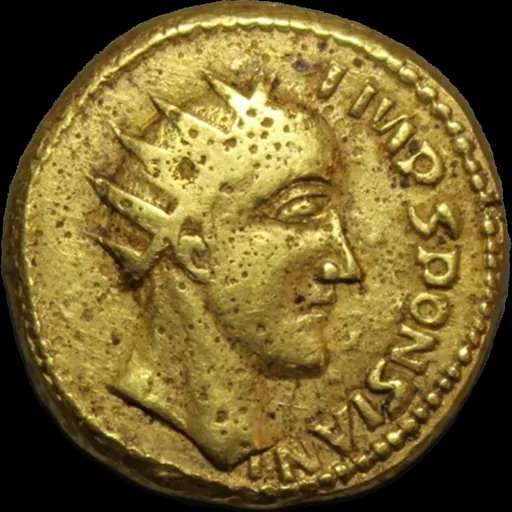
Sponsianus
Possible ancient Roman regional ruler/imperial usurper (probably in Dacia, circa 240s-260s) only known from a few Roman coins of disputed authenticity the first of which were found in Transylvania circa 1713
About Sponsianus
Born 200. Sponsianus was a Roman ruler.
Sponsianus, also known in English as Sponsian, may have been a Roman usurper during the third century. His existence is implied by a series of coins bearing his name, ostensibly part of a hoard excavated in the eighteenth century.
No corresponding figure named Sponsianus is mentioned in any ancient sources, and the coins are widely believed to be the work of modern forgers. However, a study of wear marks on the coins published in November 2022 concluded that the coins were authentic, supporting Sponsian's existence as a historical figure. The study's methodology and conclusions have been criticized by a number of scholars.
Scholars who accept the historicity of Sponsianus date his activity to the Crisis of the Third Century, often locating him in the particularly unstable province of Dacia. More precise dating is a matter of controversy: some scholars have conjectured that he may have proclaimed himself emperor in the 260s, after Dacia was cut off from the rest of the Empire, or in the early 270s after it was formally abandoned by Aurelian. Others contend he may have been active earlier, during the reign of Philip the Arab or his son, Philip II.
Discussion
Physical description and provenance The sole evidence for the existence of Sponsianus is his name on a few double-aurei reportedly uncovered in a coin-hoard in Transylvania in 1713, and subsequently dispersed among several collections. One was kept in the Hunterian Museum at Glasgow University, alongside three coins depicting other figures also claimed to have been from the hoard. Another entered the bequest of Baron Samuel von Brukenthal, a Habsburg governor of Transylvania.
Traditional numismatic analysis The traditional consensus among numismatists has been to regard the coins as modern forgeries. As early as 1828, Eckhel noted the strangeness of the coins and concluded against the historicity of Sponsianus. In 1868, the French numismatist Henri Cohen dismissed them as "very poor quality modern forgeries," and 1923 analysis, concluding that the coins were modern forgeries, is considered definitive by many numismatists. Other scholars concur with the RIC, and classify the coins as third-century imitations of Roman coinage, while still others contend that the coins can be ascribed to a historical usurper Sponsianus. In general, ancient historians have been more willing to accept the historicity of Sponsianus and the authenticity of the coins. The study attracted significant scholarly and media attention, and led the Brukenthal Museum in Sibiu to reclassify another coin bearing Sponsianus' image as genuine. Richard Abdy, the curator of the collection of Roman coins at the British Museum, condemned the study, stating "they've gone full fantasy." In the Journal Antigone, Alfred Deahl argued that the coins are forgeries, drawing attention to the unusual features of the coins as well as the oddness of the other coins purportedly found in the same hoard. NoteTag|, the numismatist who originally received many of the coins purportedly from the Transylvanian hoard, classified a piece bearing the image of Gordian III as a forgery immediately upon receiving the collection in March 1713. Alice Sharpless from the American Numismatic Society summarized criticism of the Pearson study by writing "the evidence of wear and of surface deposits cannot be shown conclusively not to have occurred in the modern period... Unless further study can provide more certain answers, it seems that these coins should continue to be regarded as modern forgeries." Petac notes that the legend irregularly excludes his praenomen and cognomen, or whose son or grandson he is.NoteTag|Son: filius, ; grandson: nepos. Another Romanian academic, Florian-Matei Popescu, highlighted the lack of written attestations of Sponsianus or his name—though the name Sponsianus is attested in the Roman world in inscriptions, these are very rare. Popescu argues that if the coins are real, which he deems unlikely, they date to the reign of Philip the Arab, who opened a mint in Dacia making low-value bronzes to pay the army. Pearson notes only one instance, from a funerary inscription naming an obscure person called Nicodemus Sponsianus, dating from the early first century. This inscription was not published until 1726, several years after the supposed discovery of Sponsian's coins, and Pearson regards this as an argument for their authenticity: a forger would not have known of the name. Two other instances appear in the Corpus Inscriptionum Latinarum, a catalogue of known Latin inscriptions, all dating from the same period, while a further two inscriptions give the abbreviated form Sposianus; all five inscriptions are from Rome. One of the latter was published by Jan Gruter well before the first known appearance of the coins, and other examples are known besides these, so a forger might still have been aware of or guessed at the existence of such a name.
Theories Scholars who accept the historicity of Sponsianus have proposed several possibilities for when and where Sponsianus would have been active. One explanation, based upon the other coins found with the aurei, would date Sponsian's activity to the 240s, during the rule of Gordian III (238–244) or Philip the Arab (244–249). Based upon the location of his aurei, some scholars posit that he may have staged a revolt in Pannonia. Ilkka Syvänne places the revolt early in Philip's reign, and identifies Sponsianus with the obscure Severus Hostilianus mentioned in later Byzantine histories (though he notes the evidence is circumstantial).
Another explanation is that he was a military commander who crowned himself as emperor when Dacia was cut off from the rest of the empire around 260. With an ongoing pandemic and civil war, and the empire being fragmented at the time, Sponsianus may have assumed supreme command to protect the military and civilian population of Dacia until order was restored. The Romans eventually evacuated Dacia between 271 and 275. He would have had access to a military force consisting of two legions there and their associated auxiliary personnel, totalling tens of thousands of soldiers. No other evidence has been found of Sponsianus' rule, and if he did exist, this would seem to indicate that Sponsianus was either uninterested or unsuccessful in expanding his territory.
Don’t just read it —
keep it.
Full-length biographies made to live with: read them, listen on the way to work, watch them tonight.
- E-book
- Audio
- Video
Instant download · yours to keep · every purchase keeps this site free
Important facts
Related people
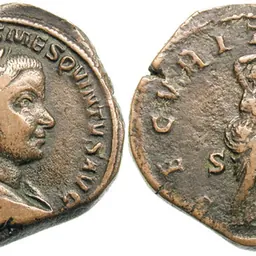
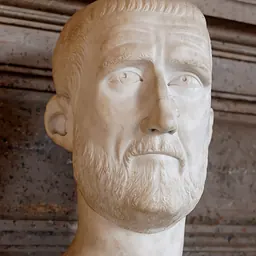
Same field, nearest in time




Frequently asked questions
Who was Sponsianus?
possible ancient Roman regional ruler/imperial usurper (probably in Dacia, circa 240s-260s) only known from a few Roman coins of disputed authenticity the first of which were found in Transylvania circa 1713
When was Sponsianus born?
Sponsianus was born in 200.
What was Sponsianus's occupation?
Sponsianus was a ruler.
What nationality was Sponsianus?
Sponsianus was Roman.
Sources & further reading
Cite this page
APA: Biography.guide. (2026). Sponsianus. https://biography.guide/sponsianus/
MLA: "Sponsianus." Biography.guide, https://biography.guide/sponsianus/.
Chicago: "Sponsianus." Biography.guide. https://biography.guide/sponsianus/.
Data last updated: 2026-09-22 · Spot an error? Report a correction.
Portrait: Wikimedia Commons · author & licence
Page generated 2026-09-27 05:04 UTC