
About Spanish Forger
Spanish Forger was an illuminator, art forger, painter and illustrator.
Boating party setting forth from a castle, 1890-1910, miniature attributed to the 'Spanish Forger'
The Spanish Forger is the name given to an unidentified individual who, in the late 19th to early 20th century, created a large number of forgeries of medieval miniatures.
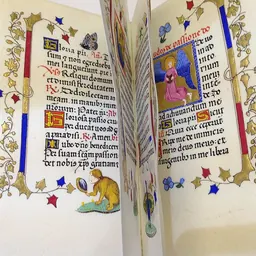
Technique and materials The Spanish Forger's works were painted on vellum or parchment leaves of genuine medieval books, using either blank margins or scraping off the original writing. He also "completed" unfinished miniatures or added missing miniatures in medieval choir books. His works fooled many experts and collectors at the time and appear today in the collections of many museums and libraries. More than 200 forgeries have been identified.
Nationality As recently as 1930, the Forger was believed to be of Spanish origin. This is because one of his first identified forgeries was attributed as a genuine work by Jorge Inglés, a Spanish artist who was active during the 15th century. However, when one considers the provenance of the Forger’s pieces along with many of the medieval collectible miniatures of the period, Paris was the center of purchasing, selling, and forging.
Identification The work of the Spanish Forger was first identified by Belle da Costa Greene who worked at the Pierpont Morgan Library. She was also the one who dubbed the artist the 'Spanish Forger'.
His works were very deceptive when created, but over time it has been recognized that the faces of individuals in his pictures have "sugary expressions" inconsistent with genuine medieval illuminations. Some of his miniatures have also been identified as forgeries because they are of secular scenes that would not have appeared in genuine medieval religious texts. Additionally, many of the individuals in the Spanish Forger’s miniatures have a tilt to their heads that would not be present in authentic medieval works. In the "Knights of the Crusade" miniature, the bearded knight at the gate and the maiden in the bottom embellishment exhibit the classic head tilt. The facial expressions on most of the subjects in his miniatures are sweet and cloying, not pious and pensive as with true works. In legitimate medieval works, gold leaf was added first so that the paints would not be obscured by it. However, the Spanish Forger used gold leaf as a final touch, obscuring his paints and giving a lustrous appearance to his forgeries.
Up to a certain point, most of the Spanish Forger’s miniatures had been identified by their unique stylistic characteristics. In 2009, Lucia Burgio, Robin Clark, and Richard Hark performed spectroscopic investigation, comprehensive analysis of pigments by Raman spectroscopy and X-ray fluorescence, upon five of the Spanish Forger’s miniatures in order to determine with scientific certainty that the forgeries were exactly that. Use of the pigments ultramarine blue (first synthesized after 1828) and Scheele’s green (synthesized after 1775) were discovered, providing solid evidence that the Forger’s imitations were fabricated in post-medieval period. His works are now themselves collected as forgeries, selling for several thousand dollars each. He created more than 194 imitations that have been identified, which were purchased by multiple collectors of medieval art around the end of the 19th century and the beginning of the 20th century. Another of the artist's paintings appeared on an episode of the Antiques Roadshow in 2014, being valued at around $4,000.
Don’t just read it —
keep it.
Full-length biographies made to live with: read them, listen on the way to work, watch them tonight.
- E-book
- Audio
- Video
Instant download · yours to keep · every purchase keeps this site free
Important facts
Related people
Same field, nearest in time


Frequently asked questions
Who was Spanish Forger?
illuminator and art forger
What was Spanish Forger's occupation?
Spanish Forger was an illuminator, art forger, painter and illustrator.
Sources & further reading
Cite this page
APA: Biography.guide. (2026). Spanish Forger. https://biography.guide/spanish-forger/
MLA: "Spanish Forger." Biography.guide, https://biography.guide/spanish-forger/.
Chicago: "Spanish Forger." Biography.guide. https://biography.guide/spanish-forger/.
Data last updated: 2026-09-20 · Spot an error? Report a correction.
Page generated 2026-09-27 04:58 UTC