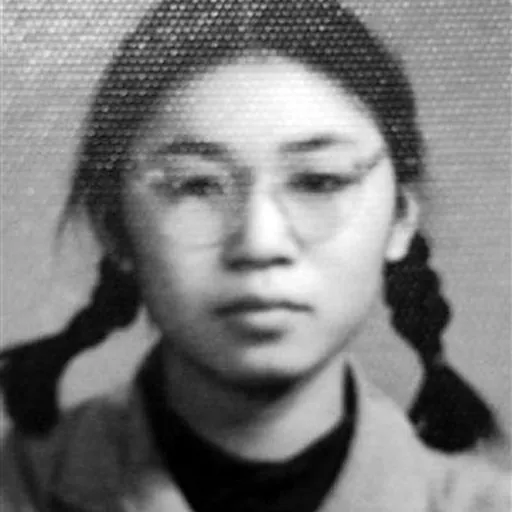
Song Binbin
Chinese revolutionary
About Song Binbin
Lived 1949 – 2024 (aged 74–75). Song Binbin was a Chinese and American, known for Bian Zhongyun and Red Guard.
Song Binbin (; 1947–September 16, 2024),
Early life Song was born in 1947, the daughter of Song Renqiong, one of China's founding leaders known as the Eight Immortals. In 1960, she started studying at the Experimental High School Attached to Beijing Normal University. In 1966, at her girls' school in Beijing, she was a senior leader among the leftist Red Guards, who worked to overthrow China's institutional frameworks in demonstration of their devotion to Mao.
Cultural Revolution
Song ties a red armband for Chairman Mao Zedong at the Tiananmen Gate, 1966. Song joined the Chinese Communist Party (CCP) in April 1966 as a reserve member. She led a rebellion at Experimental High School, which was attached to Beijing Normal University, in Beijing.
Andreas Lorenz of Der Spiegel writes that Beijing Teachers University was Song's school at the time when the Cultural Revolution claimed its first victim, reporting that she was presumed present when the female students of the school beat to death a 50-year old-teacher, Bian Zhongyun, with wooden sticks spiked with nails. Song would later claim that the CCP's paper, the People's Daily, had forced the nickname "Yaowu" on her. She claimed that she "was always opposed to violence" and that she had had no involvement in her teacher's murder. occurred in August 1966, and also seriously injured the vice-principal, Hu Zhitao. That night, Song and others were said to have reported the cause of Bian's death to Wu De, the second secretary of the CCP's Beijing Municipal Committee, at the Beijing Hotel.
Bian's slaying led to further killings by the Red Guards, and eventually over 1 million of them gathered in Tiananmen Square, where Song famously pinned a red band on Mao Zedong's arm. Mao then commented that her name "Binbin"—meaning (as variously reported) "properly raised" or "polite" or "elegant"—did not suit her well and suggested that she change it to "Yaowu", which means—again, as variously reported—"be violent" or "needs to be militant". The scene was captured in a famous photograph. Soon after, the Red August massacres followed. On August 20, 1966, the Guangming Daily published an article entitled "I Put a Red Armband on Chairman Mao", with Song's signature under her pen name "Song Yaowu". The article was reprinted by the People's Daily the next day.
At the end of August, Wang Renzhong, a Chinese politician, met Liu Jin and Song at the Diaoyutai Guesthouse and mobilised them to go to Wuhan to protect the Hubei Provincial Committee of the CCP. Before Liu went there, Song and her classmates went to Wuhan in early September. Soon after, they wrote an article with the keynote of protecting the Hubei Provincial Party Committee of the CCP and handed it to the Provincial Party Committee. Immediately, the local newspaper published an open letter signed under the pen name "Song Yaowu."
After becoming naturalised as a US citizen, Song worked for the Massachusetts Department of Environmental Protection as an environmental analysis officer from 1989 to 2003. In 2003, she moved back to China, where she served as chairwoman of the British-owned Beijing Cobia System Engineering Co., Ltd. and Beijing Cobia Innovation Technology Development Co., Ltd.
Bian Zhongyun death controversy
In 1995 Wang Youqin, a 1968 alumna of the Normal University High School for Girls, published a text in Hong Kong titled "1966: Students play the teacher's revolution", for the first time since August 5, 1966, in which Wang wrote that Song and other Guards played a role in the death of Bian and were linked to form a causal relationship.
In 2003, Carma Hinton, a graduate of Beijing 101 Middle School, directed the Cultural Revolution documentary Morning Sun, which was released in the United States but not officially in China. In the documentary, Song was interviewed and for the first time publicly stated that she had never participated in violent actions during the Cultural Revolution such as beating people, ransacking homes, or destroying the Four Olds. She claimed that the Guangming Daily had signed her article without seeking her opinion in advance and denied that she had written the article or authorised the reporter to ghostwrite.
In 2004, Wang Youqin published another article titled "The Death of Bian Zhongyun", in which she pointed out that Song was responsible for the Red Guard violence that led to Bian's death. The evidence was a list of seven people who had pledged to the hospital to rescue Bian at the Beijing Posts and Telecommunications University Hospital in Changping District , saying: "Six of the seven are Red Guards students. The first name on the list is Song Binbin, a senior in the school and the head of the Red Guards". Song responded to the article's claims by saying that the first name on the list was that of Li Songwen, a teacher, whereas her own name was ranked last, suggesting that she could not have played a major role in Bian's death. The apology was met with mixed reactions in China. Some people welcomed her words. Others said these words came too late and were inadequate, or that the CCP should apologise for the incidents that occurred during those times. Major public debate on the Internet in China ensued.
Cui Weiping, a Beijing Film Academy professor and social critic, said in a telephone interview:
Considering her identity, this is not enough. She is an important figure in the Red Guards, and the demands on her should be higher than ordinary people. She said she had witnessed a murder. It's meaningless to say you witnessed a murder and then say you don't know who the killers were.
Wang Youqin commented in an interview that although Song and various other Red Guards had been actively denying persecution and involvement in the Cultural Revolution and mass killings during that time, she believed Song's responsibility for all the violence at the Women's Affiliated High School should be obvious, due to her position as one of the school's deputy directors and organiser of the meetings by its revolutionary committee.
Death Song died of cancer in New York City on September 16, 2024, at the age of 77.
Don’t just read it —
keep it.
Full-length biographies made to live with: read them, listen on the way to work, watch them tonight.
- E-book
- Audio
- Video
Instant download · yours to keep · every purchase keeps this site free
Important facts
Family & relationships
People in Song Binbin's life
Named in this biography and alive at the same time



Contemporaries
People whose lives overlapped Song Binbin's


Frequently asked questions
Who was Song Binbin?
Chinese revolutionary (1947-2024)
When was Song Binbin born?
Song Binbin was born in 1949 in Beijing.
When did Song Binbin die?
Song Binbin died on 16 September 2024 in New York City.
What was Song Binbin known for?
Song Binbin was known for Bian Zhongyun and Red Guard.
What nationality was Song Binbin?
Song Binbin was Chinese and American.
Sources & further reading
Cite this page
APA: Biography.guide. (2026). Song Binbin. https://biography.guide/song-binbin/
MLA: "Song Binbin." Biography.guide, https://biography.guide/song-binbin/.
Chicago: "Song Binbin." Biography.guide. https://biography.guide/song-binbin/.
Data last updated: 2026-09-23 · Spot an error? Report a correction.
Portrait: Wikimedia Commons · author & licence
Page generated 2026-09-27 05:07 UTC