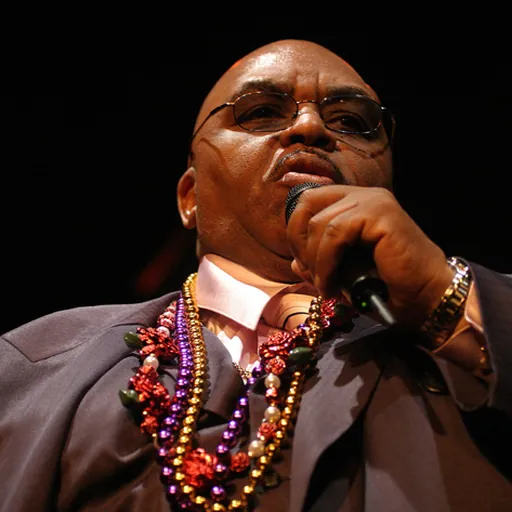
About Solomon Burke
Lived 1940 – 2010 (aged 70). Solomon Burke was an American singer, pastor, guitarist, songwriter, composer and recording artist.
Early life and career Burke was born James Solomon McDonald on March 21, 1940 (sometimes listed as 1936 ) in the upper floor of his grandmother Eleanor Moore's home, a row house in West Philadelphia. On his headstone, his birth year is 1940.
Burke was the child of Josephine Moore and an absentee father. His mother Josephine was a nurse, schoolteacher, concert performer and pastor. Burke was consecrated a bishop at birth by his grandmother in the Solomon's Temple, a congregation of the United House of Prayer for All People, which she founded at her home in Black Bottom, West Philadelphia.
Burke credited his grandmother as his main spiritual and musical influence. He learned how to sing all forms of music from his grandmother's coaching him to listen to music on the radio. and was soon nicknamed the "Boy Wonder Preacher" for his charismatic preaching in the pulpit. Burke became a pastor of the congregation at the age of 12, appeared on the radio station WDAS, and later hosted a gospel show on WHAT-AM, mixing songs and sermons in broadcasts from Solomon's Temple. On weekends he traveled with a truck and tent, to Maryland, Virginia, and the Carolinas to carry on the spiritual crusade of his church. "the first sign of a royal persona was evident in the cape that he wore only on Sundays, made from his "blankie"
Burke had six younger siblings – a sister, Laurena Burke-Corbin (born June 23, 1946), Mario "Chuck" (born September 13, 1953), From an early age Solomon Burke worked to supplement his family's income. He recalled: "I used to deliver grocery orders in a little wagon I made out of fish boxes. When I was seven, I sold newspapers out of my own newsstand on the corner of 40th and Lancaster. I had the first 99-cent car wash, which was located at 40th and Wallace outside Al's Barber Shop. We had it there because he was the only one who would let us use his water. We could wash your car in 20 minutes. I had four or five guys, gave 'em each a nickel for each car." He first became a father at 14.
During high school, Burke formed and fronted the quartet, the Gospel Cavaliers. The Cavaliers began performing in churches. It was around this time that Burke met Kae "Loudmouth" Williams, a famed Philadelphia deejay with help from Williams' wife, Viola, who saw Burke and the Cavaliers perform at church. Before entering a gospel talent contest in which a record deal was first prize, the group split up. Before pursuing the deal, Burke signed Kae Williams as his manager. After he signed with Apollo, the label's founder Bess Berman and its handlers were reportedly trying to make Burke "the next Harry Belafonte". releasing his first single, "Christmas Presents", on Christmas Eve of 1955.
He recorded with musicians including King Curtis and Lester Young. His other Apollo recordings during this early period included "I'm in Love", "I'm All Alone" and "No Man Walks Alone", Due to the song's title borrowing from Joe Louis' quote, "he can run, but he can't hide", Louis was credited as co-writer. Louis helped promote the song by having Burke appear on the Steve Allen Show in early 1957. Burke was abruptly dropped from Apollo following a violent argument with manager Kae Williams over performance royalties; and the label issued a self-titled album in 1962.
Following his initial Apollo departure, Burke struggled to record or get club dates, and an argument with his mother left him homeless. He later moved into a home owned by Ohella Thompson, after Thompson accidentally hit him with her car outside a club.
During this time, Burke studied the Islamic faith and married, but the marriage was annulled. Burke later had his own mortuary business in Los Angeles.
Burke was briefly signed to Herb Abramson's Triumph Records. However, Burke could not record for the label because his contract with Apollo had not yet been dissolved.
In 1959, Philadelphia businessman Marvin Leonard "Babe" Chivian (1925-1972), a "body-and-fender man" offered Burke a red Lincoln Continental convertible if he would agree to a management contract with him. Chivian arranged for Burke to be signed to Singular Records, a Philadelphia-based label that was owned by WPEN disc jockey Edwin L. "Larry" Brown and vocal coach Arthur "Artie" Singer, who had a distribution deal with Chess Records. Burke released just two singles for Singular, reportedly signing a "handshake deal" with Wexler and Ahmet Ertegun.
At the time of Burke's signing, two of Atlantic Records' major stars, Bobby Darin and Ray Charles, had left the label for better deals with Capitol and ABC respectively. Burke reportedly helped keep Atlantic Records solvent from 1961 to 1965 with his steady run of hit records.
Burke recorded thirty-two singles with Atlantic, most of which hit both the pop and R&B charts. Burke's second single for the label was the country single, "Just Out of Reach (Of My Two Open Arms)", which became his first charted single, reaching No. 24 on the Billboard Hot 100 and peaking at No. 7 on the R&B charts. The song also became Burke's first million-seller. His next hit came with "Cry to Me", which reached No. 5 on the R&B chart in 1962 and was described as one of the first songs to mix country, R&B and gospel. After the release of "Cry to Me", Burke was one of the first artists to be referred to as a "soul artist". Other hits included Wilson Pickett's "If You Need Me"; "You're Good for Me"; his co-written classic, "Everybody Needs Somebody to Love"; his only number-one single, "Got to Get You Off My Mind"; and "Tonight's the Night". Burke became the first R&B artist to cover a Bob Dylan song with his cover of "Maggie's Farm", which became the B-side of "Tonight's the Night". In 1965, Atlantic released his fifth album, The Best of Solomon Burke, which peaked at No. 22 on the US charts. Burke is credited with coining the term "soul music", which he confirmed in a 1996 interview.
Despite his initial reluctance, shared with several former gospel singers including Aretha Franklin and Wilson Pickett, Burke was "molded into a more secular direction when he signed with Atlantic in the '60s", and became one of "the "backsliders", artists who "preferred a secular acclaim to the gospel obscurity".
He decided eventually that "secular music was not the antithesis of the church but, rather, 'a new avenue, a new dimension to spread the gospel.'" Despite this, "leaving gospel for secular music, as well as integrating secular music into gospel performances, was controversial."
Noted blues scholar Paul Oliver maintains that when Sam Cooke and Burke "turned from gospel singing to the blues", unlike others who had done so previously, "they took the gospel technique with them"; "even the words often secularized gospel songs", and this was coupled with a "screaming delivery, the exploitation of emotional involvement, [and] the frenetic displays of dancing singers." Music critic Mark Deming described Burke as having: "one of the finest voices in popular music, that possessed a churchly authority that was the ideal match for his material which balanced the pleasures of the flesh with the price of the transgression."
"Burke sounded like a Baptist preacher in a country church, and for [Jerry] Wexler he was the first and possibly the greatest of all '60s soul men." Wexler, who considered Burke to be "the greatest male soul singer of all time", pronounced him a "vocalist of rare prowess and remarkable range. His voice is an instrument of exquisite sensitivity." Wexler also described the young Burke's vocal style as "churchy without being coarse." In 2003 Wexler assessed Burke: "I rate him at the very top. Since all singing is a trade-off between music and drama, he's the master at both. His theatricality. He's a great actor." Despite his admiration for Burke, Wexler also described Burke as "a piece of work: wily, highly intelligent, a salesman of epic proportions, sly, sure-footed, a never-say-die entrepreneur",
According to Gerri Hirshey: "Title agreed upon, Solomon added the trappings: a crown, a scepter, a cape, robe, dancing girls, and colored lights." Burke's crown was an exact replica of "the crown jewels of London" and the cape was trimmed with real ermine. Burke, whose shows were tours de force of riveting soul and unashamed hokum", "ticked every box from low comedy through country pleading to the kind of magisterial rock'n'roll that brought the house down", and he "became known as much for his showmanship as he did his voice. He would often take the stage in a flowing, 15-foot-long cape and bejeweled crown, his stage theatrics predating those of such legendary showman as James Brown. According to David Hepworth, Burke "once employed a midget who was secreted under his cape. When it was thrown off the cape would disappear stage left as of its own volition." According to Burke, "He paid me $7,500 to stand onstage and hand him my robe and crown. It was a great gig: I got paid and I didn't have to sing a note." Burke accepted Brown's money, but retained his title and regal paraphernalia. Consequently, over the years Burke "evolved a fervently demonstrative stage act", According to Weldon McDougal, Burke "turned theatres like the Apollo and the Uptown into churches, he had folk running down the aisles to be saved by his music." The album included the songs "Get Out of My Life Woman" and a cover of "I Wish I Knew How It Would Feel to Be Free", his first recording that provided social commentary. It was later dedicated to Martin Luther King Jr., and Atlantic gave up 5% of royalties on the single to King's family. It reached only No. 32 R&B and No. 68 pop. Burke later met his next manager Tamiko Jones at the Memphis studio. Burke and Jones recorded several duets on Jones' album, I'll Be Anything for You. Following a failed collaboration with other soul artists as the Soul Clan, Burke decided to leave the label. His reasons for leaving Atlantic were for not "being treated properly" and that Atlantic "just wasn't home anymore, wasn't family". In 1969 he had a small hit with his second release for Bell, a reworking of Creedence Clearwater Revival's "Proud Mary" b/w "What Am I Living For" (Bell 783). This was co-produced by Tamiko Jones, who was being rehabilitated after a bout of polio, and was at the time Burke's manager. The song became a brief hit reaching No. 15 R&B and No. 45 pop. Burke's record debut for MGM, "Lookin' Out My Back Door", another Creedence Clearwater Revival song, had disappointing sales. which produced the No. 14 R&B hit, "Midnight and You". He released the album Sidewalks, Fences and Walls on Infinity Records in 1979 (reissued as Let Your Love Flow in 1993 by Shanachie Records).
Between 1979 and 1984, Burke recorded four gospel albums for Savoy Records, starting with the album, Lord I Need a Miracle Right Now. He was nominated for his first Grammy in the Best Male Gospel Soul category for his rendition of "Precious Lord, Take My Hand", but complained later that he did not receive royalties from his Savoy work. He then recorded for smaller labels such as Rounder, MCI/Isis, Bizarre/Straight, Black Top, Pointblank and GTR Records. Burke was inducted into the Rock and Roll Hall of Fame on March 19, 2001, in New York City by Mary J. Blige, after eight previous nominations since 1986.
Final recordings
In 2002, Burke signed with Fat Possum Records and released the album, Don't Give Up on Me. Many of the songs were previously unreleased tunes, some written for him by top writers including Tom Waits, with whom he had a discussion over whether to sing about a mint julep, which was against Solomon's principles at the time. Burke agreed to sing the line. The album became critically acclaimed and later resulted in Burke's first Grammy Award win. In 2004 Burke appeared on the Italian singer Zucchero Fornaciari's Zu & Co., a duets album. He also performed at the Royal Albert Hall for the beginning of the Zu & Co. Tour, from which Zu & Co live at the Royal Albert Hall was recorded.
Burke later signed with Shout! Factory to release the album Make Do With What You Got, which became another critically acclaimed success. In 2006, Burke returned to his country roots with the album, Nashville. In 2008, he received another Grammy nomination for the album, Like a Fire. That year, Rolling Stone ranked Burke as No. 89 on its list of the "100 Greatest Singers of All Time". In 2010, Burke came out with the Willie Mitchell-produced Nothing's Impossible for E1 Entertainment. Later in 2010, he released his final album, Hold on Tight, a collaboration album with De Dijk, a Dutch band.
Entrepreneurship From an early age Burke was "always an enterprising personality". In addition to his recording career, Burke ran funeral homes, owned two drugstores and a popcorn business in Philadelphia,
Burke's entrepreneurial activities included cooking and selling barbecued chicken sandwiches backstage, as well as sandwiches, soft drinks, and fried chickens at increasingly inflated prices to other performers who were refused service at restaurants on the Chitlin' Circuit in the "Jim Crow" South. According to Sam Moore of the soul duo Sam & Dave, "He gave me one pork chop, one scoop of macaroni and cheese, and one spoonful of gravy. I said, 'Is that it?' And he'd say, "That's it, brother. I'm doing you a favor, so take it or leave it." Burke demanded and operated the concessions at the Apollo Theater when he performed there in 1966. This was very profitable for him but so enraged the owner Frank Schiffman that he was banned from performing at the Apollo for life. After playing at the reopening of The Cavern Club in Liverpool in July 1966, Burke said: "The Cavern was a great place to play. The groove was there, the people were there, and it was wonderful. I remember them selling hot Pepsis. What a mistake—you gotta put ice in those things. Think of how many more they could have sold with ice in them."
Bishopric and community work From the early 1970s, after having moved to Los Angeles, Burke concentrated on his episcopal duties, preaching from a crimson throne on the third Sunday of the month at the Prayer Assembly Church of God in Christ, his church at 226 North Market St., Inglewood, California. Within three decades his church grew to have about 170 missions and 40,000 members. By 2000, Burke's Solomon's Temple: The House of God for All People had over 300 ordained ministers whose job is to "feed the hungry, educate the uneducated and be God's workers in the vineyard", and 40,000 parishioners in close to 200 churches across the USA, Canada, and Jamaica. At the time of his death, there were about 180 churches that were established under the charter of his denomination, with Burke indicating: "We're non-sectarian, non-denominational. Ours is an open door."
Personal life Burke was married four times. In total he fathered 21 children (fourteen daughters and seven sons). He had seven step-children, 90 grandchildren and 19 great-grandchildren at the time of his death. though it resulted in the birth of one child, Valerie Doris Gresham (born 1957).
Burke's second wife was Delores Clark Burke, with whom he had seven children, including Eleanor Alma (born 1958), Dr. Melanie Burke-McCall (born March 1960), Solomon Vincent Jr. (born 1961), Carolyn J. Burke (born 1962), Prince Solomon (JFK) Burke, Gemini C. Burke (born 1964), and Lillian (born 1966).
Burke's third wife was Bernadine Burke. In 2012 Court documents BP Case 126258 (Solomon McDonald Burke) it proved that Burke had never divorced Arch Bishop Bernadine Turner Burke in 1970 before marrying Frances Szeto, Court records shows no divorce from Bernadine McDonald Burke or Delores Burke. Burke's fourth wife was Frances Szeto Burke McDonald (born 1951), Marriage License dated December 1977; Solomon Vincent Burke Jr. (born 1961). who had a couple of local hit singles in Philadelphia on Showtime Records in 1968, including a No. 11 hit on the UK Singles Chart with "Ain't Nothin' But a Houseparty" b/w "How Easy Your Heart Forgets Me" (Heritage HE-800), which peaked at No. 87 on the Billboard chart in 1968, Casablanca, A&M and Rawkus Records. She is a studio artist for groups Billy Preston, Peacock (Anna Gayle group), and Leslie Uggams, and toured with Chaka Khan, and wrote and produced Trouble Don't Last Play and LP with Family, & Friends, a 14-song original soundtrack, which was released in 2003, she opened for Jocelyn Brown, Jaheim, Norman Connors, and Angela Bofill, as well as for her father at the Kimmel Center for the Performing Arts in Philadelphia in 2006. In 1972 Burke-McCall was signed along with her siblings The Sons & Daughters of Solomon to MGM Records. who released his first studio album The Audiobiography in October 2008, and wrote movie soundtracks for Tyler Perry's Diary of a Mad Black Woman, Step Up, and 21. Her youngest son, Solomon, also has started recording.
Declining health For many years Burke struggled with his health, with his "weight estimated somewhere between 300 and 400 pounds" in 2006. New York Times writer Ben Sisario wrote of Burke: "Wide-shaped in his youth, he grew into Henry VIII-like corpulence, and in his later years had to be wheeled to his throne." In the later years of his life, "arthritis and weight ... limited his mobility"
In an interview in 2008, Burke said that "God put me in this wheelchair", and that God's message to him was: "'You are too fat!'" Burke denied having an eating disorder: ... I guess God let me develop into what I am now and allowed me to live. It's not an eating disorder. If I had an eating disorder, I wouldn't travel." The cause of death was not immediately clear; according to his family, Burke died of natural causes. At a 2012 probate court hearing of Burke's will, Burke's manager/companion of 16 years, Jane Margolis Vickers, stated that doctors at Reston Hospital suspected that Burke had a pulmonary embolism and had urged him not to travel. Burke decided to leave the hospital "against medical advice" and proceed to Dulles for his flight to Amsterdam. There was no autopsy after his death, but the general assumption is that Burke died as a result of a pulmonary embolism.
On October 21 a wake and meditation service was held at the Pierce Brothers Valley Oaks Griffin Mortuary at Westlake Village. Burke's funeral was at 10:00 am on October 22, 2010, at the City of Refuge in Gardena, California and was open to the public. It was simulcast on the internet and at a memorial service held at the Sharon Baptist Church in Philadelphia, the pastor of Our First Temple of Faith Mt. Deborah Pentecostal Church on Haverford Avenue in Philadelphia, and attended by Burke's extended East Coast family.
Burke is buried at Lot 4037, Space 1, in the Murmuring Trees section of the Forest Lawn Memorial Park in the Hollywood Hills, at 6300 Forest Lawn Drive, Los Angeles, California.
Neil Portnow, President/CEO of The Recording Academy, praised Burke soon after his death: "GRAMMY-winning soul singer Solomon Burke was revered as one of music's greatest vocalists and a pioneer of the genre. A deeply spiritual man, his love and passion for his craft kept him touring and performing to sold-out audiences right up to his final days. Few artists have had careers as long, rich and influential as his, and he leaves a larger-than-life legacy as powerful and soulful as he was. The music industry has lost one of its most distinctive voices."
Discography
Don’t just read it —
keep it.
Full-length biographies made to live with: read them, listen on the way to work, watch them tonight.
- E-book
- Audio
- Video
Instant download · yours to keep · every purchase keeps this site free
Important facts
People in Solomon Burke's life
Named in this biography and alive at the same time






Related people
Same field, nearest in time




Contemporaries
People whose lives overlapped Solomon Burke's



Frequently asked questions
Who was Solomon Burke?
American singer (1940–2010)
When was Solomon Burke born?
Solomon Burke was born on 21 March 1940 in Philadelphia.
When did Solomon Burke die?
Solomon Burke died on 10 October 2010 in Haarlemmermeer, Amsterdam Schiphol Airport.
What was Solomon Burke's occupation?
Solomon Burke was a singer, pastor, guitarist, songwriter, composer and recording artist.
What nationality was Solomon Burke?
Solomon Burke was American.
Sources & further reading
Cite this page
APA: Biography.guide. (2026). Solomon Burke. https://biography.guide/solomon-burke/
MLA: "Solomon Burke." Biography.guide, https://biography.guide/solomon-burke/.
Chicago: "Solomon Burke." Biography.guide. https://biography.guide/solomon-burke/.
Data last updated: 2026-09-21 · Spot an error? Report a correction.
Portrait: Wikimedia Commons · author & licence
Page generated 2026-09-27 05:01 UTC