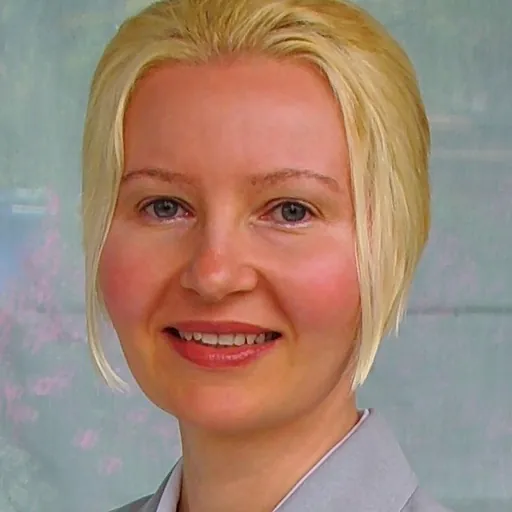
About Snježana Kordić
Born 1964. Snježana Kordić is a Yugoslav and Croatian linguist, pedagogue, science writer, sociolinguist, grammarian and slavist.
Biography
Education Snježana Kordić obtained a degree from Osijek University (1988) and an M.Sci in Linguistics from the Faculty of Philosophy at Zagreb University (1992). She earned her Ph.D. in Zagreb in 1993. In 2002, she obtained a habilitation in Slavic philology (qualification at professorship level) from the University of Münster.
Academic appointments Kordić taught and conducted research at various Croatian and German universities. From 1990 to 1991 she was an assistant at Osijek University, and from 1991 to 1995 she was an assistant at Zagreb University. She then moved to Germany and was a lecturer at the Bochum University from 1993 to 1998.
Works and reception Existential clauses (Kordić)Snježana Kordić's main focal points in research and teaching are grammar, syntax, discourse analysis, text linguistics, textual cohesion, pragmatics, lexicology, corpus linguistics, quantitative linguistics, critical linguistics, sociolinguistics and language policy. She has authored over 150 linguistic publications, including textbooks, a grammar book, and three monographs, which have been translated into English, German or Spanish. Each of her books on syntactic issues has gotten more positive reviews from around the world than any other linguistic book published in Croatia.
Monograph on relative clauses in Serbo-Croatian (1995) Her first monograph on relative clauses was well received. Many reviewers commented favourably on it.
Hans-Peter Stoffel underlined:
Monograph on Serbo-Croatian words on the border between lexicon and grammar (2002) Personal pronouns (Kordić)In her second monograph, which has also been reviewed with approval, Snježana Kordić examines Serbo-Croatian words that oscillate between having a full lexical status and a functional grammatical status, a factor that has complicated their lexicographic and grammatical description in dictionaries and grammars. These are mainly lexemes which have a high frequency usage and are used in many different ways. The monograph provides information on the syntax, semantics and pragmatics of the usage of selected pronouns, nouns, particle, conjunctions and verbs.
Peter Herrity emphasised that:
Frequency of relativizers (Kordić)Wayles Browne, an American expert on relative clauses, commented both of the books. He noted that Kordić's first book on relative clauses is: In the same review article, Browne pointed out that Kordić's second monographBlockquote shares the virtues of her work on relative clauses, being empirically well supported and making references to a variety of traditions in linguistics. One is impressed to see, on its pages, apposite quotations from independently developed German, Russian, Polish, Czech, and English-American scholarship converging on similar views. Canadian Slavonic Papers deals with sociolinguistic topics, including Croatia's language policy, the theory of pluricentric languages, and how identity, culture, nation, and history can be misused by politically motivated linguists. Kordić asserts that purism and prescriptivism have been the main features of Croatia's language policy since 1990. A ban on certain words perceived as "Serbian" and the idea that a word is more "Croatian" if fewer Croats understood it, resulted in the widespread impression that no one but a handful of linguists in Croatia knew the standard language.
With a plethora of quotations from German, French, Polish, and English linguistic literature, Kordić demonstrates that the language of Croats, Serbs, Bosniaks, and Montenegrins is a polycentric language, with four standard variants spoken in Croatia, Serbia, Montenegro and Bosnia and Herzegovina.
These variants do differ slightly, as is the case with other polycentric languages (English, German, French, Portuguese, and Spanish, among others ), but not to a degree which would justify considering them as different languages. This fact suggests by no means a re-establishment of a common state, since standard variants of all other polycentric languages are spoken in different countries, such as English in the US, UK, Australia, and Canada, and German in Austria, Germany, and Switzerland. The above examples demonstrate that pluricentricity of a language does not imply linguistic unification.
Kordić criticizes a romantic view of language and nation, which is widespread in Croatia. The romantic idea that nation and language must match has its roots in 19th century Germany, but was abandoned by the middle of the 20th century by the scientific community. She also argues against political interference in linguistics.
Regarding the name of the language, Kordić discusses only the name to be used in linguistics, leaving non-linguists to name the language any way they prefer.
The monograph generated significant media coverage. Kordić gave over sixty interviews discussing her book. Some prominent Croatian intellectuals have praised the book. The book also received negative criticism, in both Croatia and Serbia, where Serbian weekly journals stated that the book was "far more dangerous for Serbian linguistics than for Croatian [linguistics]" and that it was "destructive for the Serbs" because it "makes the language free from the Serbian tradition, it reduces the language to a symbolic-neutral communication tool, it encourages the indifference towards naming of the language and towards the number of different names given to the Serbian language". In Croatia, a group, Hitrec, tried to file a lawsuit against the then active minister of culture arguing that the state should not sponsor the book. However, the State's Attorney of Zagreb declined to prosecute. The attempt itself to file the lawsuit was criticised as a "witch hunt" in parts of the Croatian media. In 2017, Kordić's book became the inspiration for the Declaration on the Common Language which also attracted media attention.
In his review of the monograph on language and nationalism (Jezik i nacionalizam), Zoran Milutinović commented:
Reviewer Tomasz Kamusella wrote:
Reviewer Goran Miljan wrote:
Selected publications
Don’t just read it —
keep it.
Full-length biographies made to live with: read them, listen on the way to work, watch them tonight.
- E-book
- Audio
- Video
Instant download · yours to keep · every purchase keeps this site free
Important facts
People in Snježana Kordić's life
Named in this biography and alive at the same time





Related people
Same field, nearest in time


Contemporaries
People whose lives overlapped Snježana Kordić's



Frequently asked questions
Who is Snježana Kordić?
Croatian linguist
When was Snježana Kordić born?
Snježana Kordić was born on 29 October 1964 in Osijek.
What is Snježana Kordić's occupation?
Snježana Kordić is a linguist, pedagogue, science writer, sociolinguist, grammarian and slavist.
What nationality is Snježana Kordić?
Snježana Kordić is Yugoslav and Croatian.
Sources & further reading
Cite this page
APA: Biography.guide. (2026). Snježana Kordić. https://biography.guide/snjezana-kordic/
MLA: "Snježana Kordić." Biography.guide, https://biography.guide/snjezana-kordic/.
Chicago: "Snježana Kordić." Biography.guide. https://biography.guide/snjezana-kordic/.
Data last updated: 2026-09-23 · Spot an error? Report a correction.
Portrait: Wikimedia Commons · author & licence
Page generated 2026-09-27 05:06 UTC