
About Sir William Parsons, 1st Baronet of Bellamont
Lived 1570 – 1650 (aged 79–80). Sir William Parsons, 1st Baronet of Bellamont was a politician.
Sir William Parsons, 1st Baronet of Bellamont, PC (Ire) ( – 1650), was known as a "land-hunter" expropriating land from owners whose titles were deemed defective. He also served as Surveyor General of Ireland and was an undertaker in several plantations. He governed Ireland as joint Lord Justice of Ireland from February 1640 to April 1643 during the Irish rebellion of 1641 and the beginning of the Irish Confederate War.
Birth and origins
William was born in England about 1570, the eldest son of James Parsons and Catherine Fenton. His father was the second son of Thomas Parsons of Diseworth, Leicestershire. William's mother was a daughter of Henry Fenton and Cicely Beaumont, and a sister of Sir Geoffrey Fenton, the Principal Secretary of State in Ireland to Elizabeth I. Both his parents' families were English and Protestant.
William listed among his brothersHe was the eldest of three brothers: William ( – 1650) Lawrence (died 1628), became a judge and father of William Parsons, 1st Baronet of Birr Castle Fenton, was knighted
Early life Parsons settled in Ireland about 1590, in the last years of the reign of Queen Elizabeth I. He became a commissioner of plantations and obtained considerable territorial grants from the Crown. In 1602, Parsons became Surveyor General of Ireland; In 1610 he obtained a pension of £30 (English) per annum for life. In 1611, he was joined with his younger brother Laurence in the supervisorship of the crown lands, with a fee of £60 per annum for life. His proposal that a Court of Wards be established in Ireland was accepted and he became its first master.
MP 1613–1615 He sat in the Irish House of Commons of the Parliament of 1613–1615, the only Irish Parliament of James I, as one of the two members for Newcastle Borough, County Dublin. This was one of the 39 new boroughs the King created for this parliament in an effort to ensure a Protestant majority.
Marriage and children About 1615 William Parsons married his cousin Elizabeth, eldest daughter of John Lany, an Alderman of Dublin, and niece of his maternal uncle Sir Geoffrey Fenton. This marriage made him a cousin of Richard Boyle, 1st Earl of Cork, the dominant Anglo-Irish magnate of his time, to whom he was close.
William and Elizabeth had five sons: Richard (living 1639), MP for the borough of Wicklow, married Lettice Loftus, eldest daughter of Sir Adam Loftus of Rathfarnham, vice-treasurer of the Exchequer, and predeceased his father John, married Elizabeth, daughter of Sir Walsingham Cooke, of Tomduffe, County Wexford Francis (died 1668) of Garrydice, County Leitrim, married Sarah Faircloath, and left children James, died unmarried and William, died unmarried
—and seven daughters: Catherine, married Sir James Barry, created 1st Baron Barry of Santry Margaret, married Thomas Stockdale of Bilton Park, Yorkshire Elizabeth, married Sir William Ussher, of Grange Castle, County Wicklow, grandson of Sir William Ussher, clerk of the Privy Council of Ireland Jane, married Sir John Hoey, Knight of Dunganstown, County Wicklow Mary, married Arthur Hill of Hillsborough, County Down Anne, married Sir Paul Davys, Secretary of State (Ireland) Judith, married Thomas Whyte of Redhills, County Cavan
Later life Knight and Baronet Parsons personally presented surveys of escheated estates to King James I. On 7 June 1620 Parsons was knighted by Oliver St John.
He was created 1st Baronet Parsons on 10 November. Parsons built or perhaps rebuilt Bellamount Castle in 1622. The ruin of a tower remains and stands in Ballymount Park, SW-Dublin, alongside the M50 Motorway. This baronetcy must not be confused with the later baronetcy Parsons of Birr Castle created in 1677.
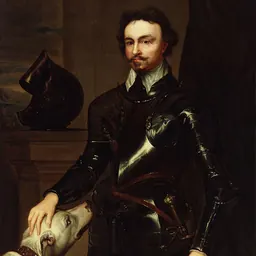
In 1623 Parsons was sworn a member of the Privy Council of Ireland. On 12 January 1632 Thomas Wentworth, 1st Viscount Wentworth (later Earl of Strafford) was appointed Lord Deputy of Ireland. During the years 1633–40, when Strafford was all-powerful in Ireland, Parsons prudently offered him no open opposition, but he came increasingly to dislike and distrust "that strange man ... a mischief to so many".
Parsons was notorious as a "land-hunter", who acquired lands previously held by Irish clans by dubious legal means. He has been particularly censured by historians for the seizure of the former O'Byrne lands in County Wicklow, although it has also been argued that his behaviour was no worse than that of his partner in the transaction, Lord Lieutenant Wentworth, who proceeded to swindle Parsons out of his share.
MP 1634–1635 and 1639–1649 According to Bagwell (1909) and Clavin (2009), Parson was one of the two MPs for County Armagh during the Parliament of 1634–1635, the first of Charles I, but the list of Irish MPs compiled in 1878 states that Sir Faithful Fortescue, knight, and Sir George Radcliffe, knight, sat for County Armagh in that parliament.
Parsons sat in the Irish House of Commons of the Parliament of 1639–1649, the second parliament of Charles I, as one of the two members for County Wicklow, at which occasion his residence is given as "Bellamont, Dublin". His son Richard sat for Wicklow.
Lord Justice In December 1640 Parsons was appointed Lord Justice jointly with Robert Dillon, the future 2nd Earl of Roscommon. However, Dillon was soon removed as he was considered to have been too close to Strafford. On 10 February 1641 Parsons was resworn with Sir John Borlase, Master-General of the Ordnance.
The King appointed Robert Sidney, 2nd Earl of Leicester Lord Lieutenant of Ireland in 1641 but Leicester never went to Ireland and left the administration of the country to the Lords Justices. Leicester would resign in 1643 to make place for Ormond.
Strafford was executed on 12 May 1641. His downfall ruined those members of the Irish administration who had been close to him, but Parsons, who had quarrelled with Strafford over the O'Byrne land deal, was clearly identified as one of his enemies, and Strafford's fall strengthened Parsons's position in the short term.
When the Irish Rebellion of 1641 broke out, Sir William had to cope with it virtually single-handedly, since his colleague Borlase was incompetent. His management of the crisis has been much criticised, in particular, his habit of dealing with the English Parliament directly without informing King Charles I. His enemies accused him of inflaming, or even provoking the Rebellion, as a pretext for a second and more thorough conquest of Ireland. Certainly he argued that the Rebellion must be crushed ruthlessly, and rejected all attempts at compromise.
Parsons continued in the government until April 1642, when Charles I replaced him with Sir Henry Tichborne. In 1643 Parsons was charged with treason, and committed to prison, together with Adam Loftus, 1st Viscount Loftus and others. He was quickly released, but complained bitterly of this "poor reward" for his "zealous and painful toil on behalf of the Crown". He continued to live in Dublin until 1648 when he retired to England.
Death, succession, and timeline Parsons died in January or February 1650 at Westminster, London, and was buried in St Margaret's, Westminster. As his eldest son Richard had predeceased him, he was succeeded by his grandson William as the 2nd Baronet Parsons. The 2nd Baronet married Catherine, the eldest daughter of Arthur Jones, 2nd Viscount Ranelagh and his wife Katherine Jones, Viscountess Ranelagh, née Boyle.
Don’t just read it —
keep it.
Full-length biographies made to live with: read them, listen on the way to work, watch them tonight.
- E-book
- Audio
- Video
Instant download · yours to keep · every purchase keeps this site free
Important facts
People in Sir William Parsons, 1st Baronet of Bellamont's life
Named in this biography and alive at the same time



Related people
Same field, nearest in time



Contemporaries
People whose lives overlapped Sir William Parsons, 1st Baronet of Bellamont's



Frequently asked questions
Who was Sir William Parsons, 1st Baronet of Bellamont?
Irish politician
When was Sir William Parsons, 1st Baronet of Bellamont born?
Sir William Parsons, 1st Baronet of Bellamont was born in 1570.
When did Sir William Parsons, 1st Baronet of Bellamont die?
Sir William Parsons, 1st Baronet of Bellamont died in 1650.
What was Sir William Parsons, 1st Baronet of Bellamont's occupation?
Sir William Parsons, 1st Baronet of Bellamont was a politician.
Sources & further reading
· Wikipedia: Sir William Parsons, 1st Baronet of Bellamont
· DBpedia: Sir William Parsons, 1st Baronet of Bellamont
Cite this page
APA: Biography.guide. (2026). Sir William Parsons, 1st Baronet of Bellamont. https://biography.guide/sir-william-parsons-1st-baronet-of-bellamont/
MLA: "Sir William Parsons, 1st Baronet of Bellamont." Biography.guide, https://biography.guide/sir-william-parsons-1st-baronet-of-bellamont/.
Chicago: "Sir William Parsons, 1st Baronet of Bellamont." Biography.guide. https://biography.guide/sir-william-parsons-1st-baronet-of-bellamont/.
Data last updated: 2026-09-20 · Spot an error? Report a correction.
Page generated 2026-09-27 05:32 UTC