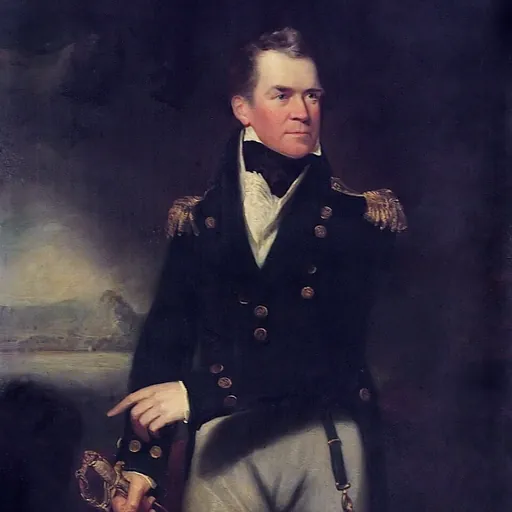
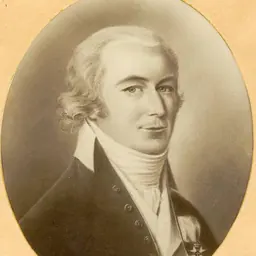
Sir George Collier, 1st Baronet
Royal Navy officer during the French Revolutionary Wars, Napoleonic Wars and the War of 1812.
About Sir George Collier, 1st Baronet
Lived 1774 – 1824 (aged 49–50). Sir George Collier, 1st Baronet was a British military personnel.
Sir George Ralph Collier, 1st Baronet, KCB (bapt. 4 June 1772 – 24 March 1824) was an officer of the Royal Navy during the French Revolutionary and Napoleonic Wars, and the War of 1812. He had an eventful early life, being shipwrecked early in his career and later captured by the French. Nevertheless, he saw enough service to attract the attention of powerful patrons that secured his rise through the ranks. An officer of considerable ability, he won a noteworthy victory against a stronger French opponent, before embarking on a period of distinguished service off the Spanish and Portuguese coasts, working closely with the British generals fighting the Peninsular War, and markedly contributing to their success. His good service led to a prime posting in command of a squadron despatched to hunt down and neutralise the American super frigates during the War of 1812. He came close to capturing the , but lost her in circumstances that were unclear and would later return to haunt him. The years of peace that followed the end of the Napoleonic Wars saw him rewarded with a baronetcy, and he continued to serve in the navy where he was tasked with the suppression of the slave trade. The publishing of William James's account of the War of 1812, which lambasted him for incompetence and cowardice in his failure to catch the Constitution, broke his personal peace. Having failed to clear his name, and increasingly depressed by the accusations, Collier killed himself.
Family and early life Collier was born in London in 1774, the second son of the chief clerk of the Victualling Board Ralph Collier, and his wife Henrietta Maria. He began his education at the Chelsea Maritime Academy, but by January 1784 his name appeared in the books of the 74-gun third rate as a captain's servant to the Triumphs commander, Captain Robert Faulknor. Collier had passed his lieutenant's examination in 1790, but only now did he receive his commission, when he was appointed lieutenant and commander of the Suffolk Tender on 31 July 1795. and by 1812 was back in the Bay of Biscay. Collier's raids were particularly useful in forcing the French forces in the north of the county to attempt to fortify and defend hundreds of small coastal creeks and villages, instead of supporting the forces in the south, allowing Wellington to defeat them.
It was while operating off the Iberian Peninsula that Collier devised a need for an improved type of ships' boat. He developed a design based on elements of both a whaleboat and a jolly boat, and had one built for him at Plymouth Dockyard. Collier's three ships gave chase and were overhauling the Constitution, when, having allowed the Cyane to escape, the Levant broke away and Collier followed her. but allowed Constitution to escape. He was invested as a Knight Commander of the Order of the Bath on 2 January 1815. Unfortunately, however, the squadron initially had only six ships with which to patrol over of coast. Collier served in this post from 1818 to 1821. His distinguished role in anti-slavery efforts led to his election as an honorary life member of the African Institution on 17 May 1820.
James's account and death Collier's life was disturbed by the publication of William James's Naval History in 1823. James paid particular attention to the escape of the Constitution, and lamented Collier's failure to bring her to action and capture her. His brother took the precaution of removing the razors from his home, but Collier appears to have smuggled one to his room, and used it to cut his own throat early in the morning on 24 March 1824. The inquest later determined that 'The deceased destroyed himself, being in a state of temporary mental derangement.' The baronetcy became extinct upon his death.
Don’t just read it —
keep it.
Full-length biographies made to live with: read them, listen on the way to work, watch them tonight.
- E-book
- Audio
- Video
Instant download · yours to keep · every purchase keeps this site free
Important facts
People in Sir George Collier, 1st Baronet's life
Named in this biography and alive at the same time


Related people
Same field, nearest in time


Contemporaries
People whose lives overlapped Sir George Collier, 1st Baronet's




Frequently asked questions
Who was Sir George Collier, 1st Baronet?
Royal Navy officer during the French Revolutionary Wars, Napoleonic Wars and the War of 1812. (1774-1824)
When was Sir George Collier, 1st Baronet born?
Sir George Collier, 1st Baronet was born in 1774 in London.
When did Sir George Collier, 1st Baronet die?
Sir George Collier, 1st Baronet died on 24 March 1824 in London.
What was Sir George Collier, 1st Baronet's occupation?
Sir George Collier, 1st Baronet was a military personnel.
What nationality was Sir George Collier, 1st Baronet?
Sir George Collier, 1st Baronet was British.
Sources & further reading
· Wikipedia: Sir George Collier, 1st Baronet
· DBpedia: Sir George Collier, 1st Baronet
Cite this page
APA: Biography.guide. (2026). Sir George Collier, 1st Baronet. https://biography.guide/sir-george-collier-1st-baronet/
MLA: "Sir George Collier, 1st Baronet." Biography.guide, https://biography.guide/sir-george-collier-1st-baronet/.
Chicago: "Sir George Collier, 1st Baronet." Biography.guide. https://biography.guide/sir-george-collier-1st-baronet/.
Data last updated: 2026-09-22 · Spot an error? Report a correction.
Portrait: Wikimedia Commons · author & licence
Page generated 2026-09-27 05:01 UTC