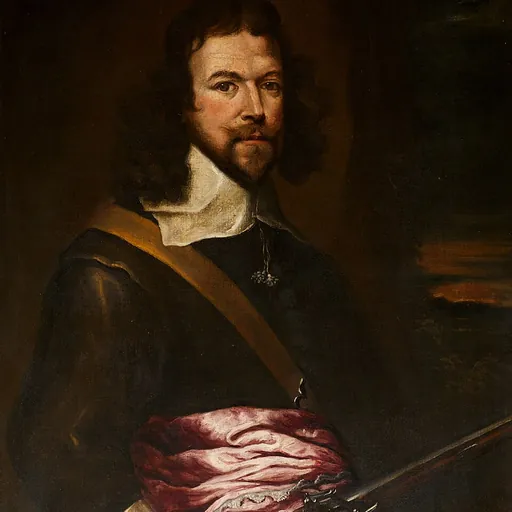
About Sir Edward Dering, 1st Baronet
Lived 1598 – 1644 (aged 45–46). Sir Edward Dering, 1st Baronet was an English politician and bibliophile.
Sir Edward Dering, 1st Baronet (1598–1644) of Surrenden Dering, Pluckley, Kent, was an English antiquary and politician.
Ancestry and childhood Dering was the eldest son of Sir Anthony Dering (d. 1636) of Surrenden Dering. His mother, Sir Anthony's second wife, was Frances, daughter of Chief Baron Robert Bell.
He was born in the Tower of London on 28 January 1598, his father being the deputy-lieutenant. He was educated at Magdalene College, Cambridge.
Early career After leaving the university he devoted himself to antiquarian studies and to the collection of manuscripts. On 22 January 1619 he was knighted at Newmarket, and in November of the same year married Elizabeth, daughter of Sir Nicholas Tufton. She died on 24 January 1622. According to an entry in his account book, he purchased two copies of William Shakespeare's First Folio on 5 December 1623: this is the earliest recorded retail purchase of this famous book.
Dering subsequently married Anne, daughter of Sir John Ashburnham. Lady Ashburnham, his new mother-in-law, being of the Beaumont family, was a connection of the king's favourite, Buckingham. Through her, Dering strove for court favour and was created a baronet on 1 February 1626 (1627 New Style). Buckingham's assassination in 1628 cut short Dering's ambitions at court. He lost his second wife in the same year that he lost his patron.
On 20 November in the year of his wife's death, Dering became one of the many suitors of a rich city widow, Mrs Bennett, and kept a curious journal of his efforts to win her, especially of the bribes which he administered to the lady's servants. Mrs Bennett, however, married Sir Heneage Finch on 16 April 1629, and shortly afterwards Dering married his third wife, Unton, daughter of Sir Ralph Gibbs, his 'ever dear Numps', as he calls her in the letters which he addressed to her. an office for which he paid the late holder of the post, and which brought him in much less than he expected. When he, at last, managed to be quit of it, he was able to devote himself more freely to the antiquarian pursuits at which he was most at home. Dering's real sentiments were disclosed when the bill was in committee, when he argued in defence of primitive episcopacy, that is to say, of a plan for ensuring that bishops should do nothing without the concurrence of their clergy. It was a plan which appealed strongly to students of antiquity; but it is no wonder that he was now treated by the more thoroughgoing opponents of episcopacy as a man who could no longer be trusted. The Dering Manuscript of Henry IV, Part 1, the earliest surviving manuscript of a play by William Shakespeare.
He concocted an ancient Saxon pedigree for himself, inserting details into various authentic documents and installing fake monuments in the church.
Personal life and descendants
Sir Edward was married three times:
On 25 November 1619 at St Dionis Backchurch, London (since demolished), to Elizabeth Tufton (1602/3-1622/3), eldest daughter of Nicholas Tufton, later 1st Earl of Thanet, by Lady Frances Cecil, daughter of Thomas Cecil, 1st Earl of Exeter. Their only child, Anthony, died September 1634, aged 14. During January 1625, to Anne Ashburnham (c. 1605–1628), third daughter of Sir John Ashburnham of Ashburnham, Sussex, by Elizabeth (later created Lady Cramond), daughter of Sir Thomas Beaumont of Stoughton Grange, Leicestershire. Anne was the mother of Sir Edward Dering, 2nd Baronet; she died aged 23 and was buried on 17 April 1628. On 16 July 1629, at St Dionis Backchurch, to Unton Gibbes (died 1676), daughter of Sir Ralph Gibbes, 1st Baronet of Honington, Warwickshire, by Gertrude, daughter of Sir Thomas Wroughton of Wiltshire. They had further issue.
He was buried at St Nicholas' Church, Pluckley.
Published works Dering's published works are: The Four Cardinal Virtues of a Carmelite Friar, 1641. Four Speeches made by Sir E. Dering, 1641 (the pamphlet thus headed contains only three speeches, the fourth being published separately). A most worthy Speech ... concerning the Liturgy, 1642. A Collection of Speeches made by Sir E. Dering on Matters of Religion, 1642. A Declaration by Sir E. Dering, 1644 A Discourse of proper Sacrifice, 1644
Don’t just read it —
keep it.
Full-length biographies made to live with: read them, listen on the way to work, watch them tonight.
- E-book
- Audio
- Video
Instant download · yours to keep · every purchase keeps this site free
Important facts
People in Sir Edward Dering, 1st Baronet's life
Named in this biography and alive at the same time




Related people
Same field, nearest in time
Contemporaries
People whose lives overlapped Sir Edward Dering, 1st Baronet's


Frequently asked questions
Who was Sir Edward Dering, 1st Baronet?
English politician (1598–1644)
When was Sir Edward Dering, 1st Baronet born?
Sir Edward Dering, 1st Baronet was born in 1598 in London.
When did Sir Edward Dering, 1st Baronet die?
Sir Edward Dering, 1st Baronet died in 1644.
What was Sir Edward Dering, 1st Baronet's occupation?
Sir Edward Dering, 1st Baronet was a politician and bibliophile.
What nationality was Sir Edward Dering, 1st Baronet?
Sir Edward Dering, 1st Baronet was English.
Sources & further reading
· Wikipedia: Sir Edward Dering, 1st Baronet
· DBpedia: Sir Edward Dering, 1st Baronet
Cite this page
APA: Biography.guide. (2026). Sir Edward Dering, 1st Baronet. https://biography.guide/sir-edward-dering-1st-baronet/
MLA: "Sir Edward Dering, 1st Baronet." Biography.guide, https://biography.guide/sir-edward-dering-1st-baronet/.
Chicago: "Sir Edward Dering, 1st Baronet." Biography.guide. https://biography.guide/sir-edward-dering-1st-baronet/.
Data last updated: 2026-09-22 · Spot an error? Report a correction.
Portrait: Wikimedia Commons · author & licence
Page generated 2026-09-27 05:03 UTC