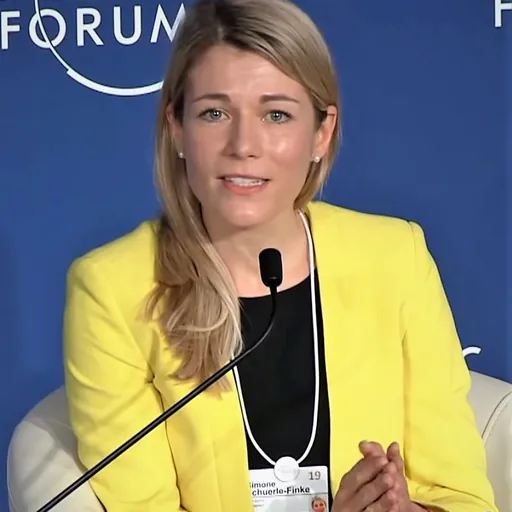
Simone Schürle-Finke
German biomedical engineer
About Simone Schürle-Finke
Born 1985. Simone Schürle-Finke is a German biomedical engineer.
Simone Schürle-Finke (born April 16, 1986 in Ulm, Germany) is a German biomedical engineer, professor, and Principal Investigator for the Responsive Biomedical Systems Laboratory in Switzerland. Schürle is a pioneer in nanorobotic and magnetic servoing technologies.
Education In 2003, Schürle pursued her post-secondary academic studies at the Karlsruhe Institute of Technology (KIT) in Karlsruhe, Germany. During her studies, Schürle travelled abroad to learn techniques and apply her expertise in engineering at two international institutes, funded by the Heinrich Hertz Fellowship and a German State scholarship. She then travelled to Kyoto University in Japan in where she worked in the Nano/Micro System Laboratory learning the fundamentals of building and applying carbon nanotube based sensors to biomedical application.
Career Schürle pursued postdoctoral studies at the Koch Institute at the Massachusetts Institute of Technology in Cambridge, Massachusetts. The goal of the institute is to walk the line between the laboratory and the clinic to move science into treatments and diagnostics as quickly as possible. Schürle is also an advocate for women in STEM and for improving the culture of academia. She advocates for science to be done in multidisciplinary teams, not in individual silos.
Research
Magnetic control methods and microstructure design In her graduate work, Schürle used her expertise from her undergraduate experience in Kyoto to fabricate innovative ways to mechanically characterize the properties of carbon nanotubes (CTN) and their interfaces with other substances. Since transmission electron microscopes (TEM) are often used to observe the characteristics of novel CNTs, Schürle and her colleagues designed a fabrication technique for TEM compatible devices with which to image CNT-metal contact strength. Their system has critical applications to translational medicine as controlled servoing is critical to designing and implementing magnetic drug carrier technology and targeting it to cancer cells. Since the first step in targeted tumor treatment is a precise diagnosis of the specific biology of the tumor and is microenvironment, Schürle began designing a system that allowed specific control and delivery of protease-activity nanosensors via alternating magnetic fields. They designed a microrobotic probe that mimicked bacteria, such that they could characterize the attack profiles of macrophages, phagocytic innate immune cells, as they hunt and engulf bacteria. Magnebotix develops a range of nanorobotic technologies for applications in biological systems such as crystal capture and dissection of the mechanobiology of various cells and tissues in vivo.
Schürle continues to develop innovative robotic tools, based on biological systems, designed for targeted drug delivery. In 2019, Schürle and her colleagues developed two new types of micropropellers that enhance the ease of nanoparticles transport through blood vessels and into tissues. The first structure is an artificial bacterial flagellum and the second is a swarm of living magnetotactic bacteria to create a fluif stream to propel the transport of nanoparticles. 2016 Branco Weiss Fellowship - Society and Science 2014 Early Postdoctoral Mobility Fellowship from the Swiss National Science Foundation Synthetic and living micropropellers for convection-enhanced nanoparticle transport. Simone Schuerle, Ava P. Soleimany, T. Yeh, G.M. Anand, M. Häberli, H.E. Fleming, Nima Mirkhani, Famin Qiu, Sabine Hauert, X. Wang, Bradley J. Nelson and Sangeeta N. Bhatia. Science Advances, vol. 5: no. 4, pp. eaav4803, Washington, DC: AAAS, 2019. Helical and Tubular Lipid Microstructures that are Electroless-Coated with CoNiReP for Wireless Magnetic Manipulation. Simone Schuerle, Salvador Pané, Eva Pellicer, Jordi Sort, Maria D. Baro and Bradley J. Nelson. Small, vol. 8: no. 10, pp. 1498–1502, Weinheim: Wiley-VCH, 2012.
Don’t just read it —
keep it.
Full-length biographies made to live with: read them, listen on the way to work, watch them tonight.
- E-book
- Audio
- Video
Instant download · yours to keep · every purchase keeps this site free
Important facts
People in Simone Schürle-Finke's life
Named in this biography and alive at the same time


Related people
Same field, nearest in time



Contemporaries
People whose lives overlapped Simone Schürle-Finke's



Frequently asked questions
Who is Simone Schürle-Finke?
German biomedical engineer
When was Simone Schürle-Finke born?
Simone Schürle-Finke was born on 16 April 1985 in Ulm.
What is Simone Schürle-Finke's occupation?
Simone Schürle-Finke is a biomedical engineer.
What nationality is Simone Schürle-Finke?
Simone Schürle-Finke is German.
Sources & further reading
· Wikipedia: Simone Schürle-Finke
· DBpedia: Simone Schürle-Finke
Cite this page
APA: Biography.guide. (2026). Simone Schürle-Finke. https://biography.guide/simone-schurle-finke/
MLA: "Simone Schürle-Finke." Biography.guide, https://biography.guide/simone-schurle-finke/.
Chicago: "Simone Schürle-Finke." Biography.guide. https://biography.guide/simone-schurle-finke/.
Data last updated: 2026-09-21 · Spot an error? Report a correction.
Portrait: Wikimedia Commons · author & licence
Page generated 2026-09-27 04:59 UTC