
About Simone Boccanegra
Lived 1301 – 1363 (aged 61–62). Simone Boccanegra was a politician.
Simone Boccanegra (; ; died 1363) was the first Doge of Genoa. He became doge in 1339, but was ousted from power six years later. He regained the position in 1356, retaining it until his death in 1363.
His story was popularized by Antonio García Gutiérrez's 1843 play Simón Bocanegra and Giuseppe Verdi's 1857 opera Simon Boccanegra.
Family background Simone Boccanegra belonged to the wealthy Genoese Boccanegra family of merchants, a family that had among its members Guglielmo Boccanegra, who in 1257 became a virtual dictator of the Republic of Genoa when an insurrection against the government of the old aristocracy made him gain the control of the republic. Guglielmo Boccanegra was also the commissioner, in 1260, of the building of Palazzo San Giorgio, the future seat of republican power in the republic.
Second dogeship and death
Boccanegra was forced to resign his office at a public meeting he had called on 23 December 1345. He was succeeded by Giovanni I di Murta, who died in early January 1350 and then by Giovanni II Valente, who ruled as chief magistrate. Following the defeat at the Battle of Alghero in August 1353 against the Catalans and Venetians, internal tensions in Genoa raised the spectre of renewed conflict between the Guelph and Ghibelline once more, leading to the Genoese deciding to place themselves under the rule of a foreign prince who could both protect and finance the city in its war against Venice. On 9 October 1353 Genoa submitted to Giovanni Visconti, Archbishop and Lord of Milan, while the Doge Giovanni II left the city.
Boccanegra's life during these years was spent in exile, a period of his life which is obscure. He appears to have spent most of his time in Tuscany, but he also visited Milan, where he apparently tried to ingratiate himself with the Visconti, who now ruled his native city. Regardless of these moves, when an anti-Visconti revolt broke out in Genoa on 14 November 1356, Boccanegra came to Genoa, appeared publicly at the San Siro church, and rallied the commoners to his side, thereby deciding the uprising's outcome. The pro-Visconti nobles gave up the fight, and Boccanegra was restored to the dogeship.
It was under his dogate that Genoa obtained the surrender of the ambassadors of the anti-seigneurial revolt in Corsica, of which Sambucucciu d'Alandu was a part, during the year 1358.
By 1362, Boccanegra's popularity with the commoners had begun to wane; in October and November of that year, conspiracies against him were uncovered. In January 1363, King Peter I of Cyprus came to Genoa for an official visit. The King confirmed Genoese privileges in his kingdom, and knighted Boccanegra's two-year-old son. Boccanegra died suddenly on 14 March 1363, after a banquet in honour of the King the previous evening, leading to rumours that he had been poisoned. The accounts of his death are in disagreement on the exact cause. According to the Genoese chronicler , while Boccanegra was too ill to react, a revolt overthrew the regime, his brothers were imprisoned and a new doge, Gabriele Adorno, was elected. Boccanegra was buried hastily, amid widespread odium, and without ceremony on the next day, 15 March. Other sources mention nothing of a poisoning, and Boccanegra's modern biographer Petti Balbi considers that he died a natural death; his burial at any rate seems to have been unremarkable, especially for a doge.
In culture
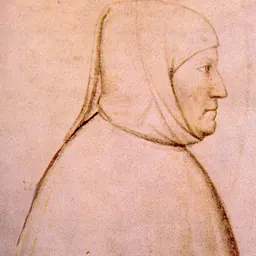
The humanist poet Petrarch wrote letters to the people of Genoa and to the doge of Venice appealing to them to end their fratricidal wars and find a common aim. These letters were among Verdi's inspirations for the revision of the opera in 1881.
Simone Boccanegra's tomb in the no longer extant church of San Francesco in Castelletto was decorated with a remarkable funeral sculpture, depicting him as if lying in state with extraordinary realism in his features. This sculpture is now in the Museum of Sant'Agostino.
Don’t just read it —
keep it.
Full-length biographies made to live with: read them, listen on the way to work, watch them tonight.
- E-book
- Audio
- Video
Instant download · yours to keep · every purchase keeps this site free
Important facts
People in Simone Boccanegra's life
Named in this biography and alive at the same time

Related people
Same field, nearest in time

Contemporaries
People whose lives overlapped Simone Boccanegra's


Frequently asked questions
Who was Simone Boccanegra?
Genoese doge (1301-1363)
When was Simone Boccanegra born?
Simone Boccanegra was born in 1301 in Genoa.
When did Simone Boccanegra die?
Simone Boccanegra died on 14 March 1363 in Genoa.
What was Simone Boccanegra's occupation?
Simone Boccanegra was a politician.
What nationality was Simone Boccanegra?
Simone Boccanegra's recorded nationality: Republic of Genoa.
Sources & further reading
· Wikipedia: Simone Boccanegra
Cite this page
APA: Biography.guide. (2026). Simone Boccanegra. https://biography.guide/simone-boccanegra/
MLA: "Simone Boccanegra." Biography.guide, https://biography.guide/simone-boccanegra/.
Chicago: "Simone Boccanegra." Biography.guide. https://biography.guide/simone-boccanegra/.
Data last updated: 2026-09-20 · Spot an error? Report a correction.
Page generated 2026-09-27 05:20 UTC