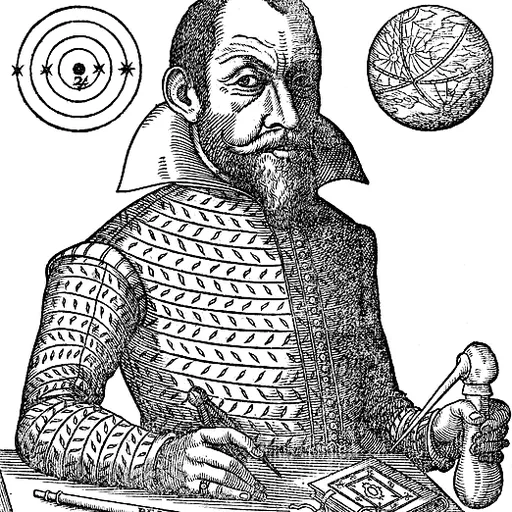
About Simon Marius
Lived 1573 – 1624 (aged 51). Simon Marius was a mathematician, astronomer, physician and opinion journalist, known for Andromeda Galaxy, Galilean moons and Jupiter.
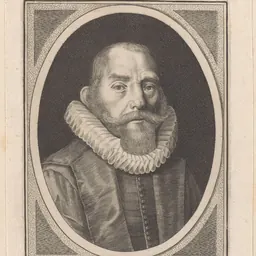
Simon Marius (Latinized form of Simon Mayr; 10 January 1573 – 5 January 1625) was a German astronomer. He was born in Gunzenhausen, near Nuremberg, but spent most of his life in the city of Ansbach. He is best known for being among the first observers of the four largest moons of Jupiter, and his publication of his discovery led to charges of plagiarism.
Early life Marius was the son of Reichart Mayr, a mayor of Gunzenhausen. On the recommendation of George Frederick, Margrave of Brandenburg-Ansbach, he was admitted to the Margrave's Academy in Heilsbronn in 1586, where he studied until 1601. During this time, he published observations about a comet as well as astronomical tables, which gave him a reputation as a good astronomer and mathematician, and the Margrave appointed him as his official mathematician. ) on the invention of the proportional compass and Marius took his student's side in the argument. and in 1609 he published the first German translations of Euclid's Elements. That year, he also built his own telescope and made observations of the Galilean moons, around the same time that Galileo did himself; the priority of discovery became a major dispute between the two. In The Assayer in 1623, he accused Marius of plagiarism. Marius had discovered the moons independently but had not noted it until 29 December 1609. Marius used the Julian calendar, and that date is equivalent to 8 January 1610, in the Gregorian one used by Galileo, one day after Galileo's letter in which he first described the moons.
Regardless of priority, the mythological names by which these satellites are known today (Io, Europa, Ganymede and Callisto) are those given them by Marius:
Discoveries Simon Marius also observed the Andromeda "nebula", which had also been known to Persian Muslim astronomers of the Middle Ages.
Discussion of Marius's work is scarce, but what exists tends to note his skill as an observer, including: That in 1612 he measured the diameter of the Andromeda nebula and discerned it as having a dull, pale light which increased in brightness toward its center, like "a candle shining through horn". That he detected spurious disks of stars created by his telescope. That, from his observations of the Galilean moons he derived better periods of revolution and other orbital elements for them than did Galileo. That he observed the location of Tycho Brahe's supernova of 1572 and found a star there which he estimated to be "somewhat dimmer than Jupiter's third moon".
Marius drew conclusions about the structure of the universe from his observations of the Jovian moons and the stellar disks. The stellar disks he observed were spurious (likely the Airy disk caused by diffraction, as stars are too distant for their physical disks to be detected telescopically), but Marius interpreted them to be physical disks, like the planetary disks visible through a telescope. He concluded that since he could see stellar disks, the stars could not be as distant as was required in the Copernican world system, and he said that the appearance of the stars as seen through a telescope actually argued against Copernicus. These findings are contrasting to those of Galileo, who utilized similar telescopic data alternatively to support the Copernican world system. This adherence by Galileo to the Copernican heliocentric theory arises due to its apparent mathematical grandeur and his prior commitment to the theory. Marius, however, showed no evident commitment to any theory but rather hypothesized based on telescopic observation. He also concluded from his observations of the Galilean moons that they must orbit Jupiter while Jupiter orbits the Sun. Therefore, Marius concluded that the geocentric Tychonic system, in which the planets circle the Sun while the Sun circles the Earth, must be the correct world system, or model of the universe.
Work Mundus Iovialis anno MDCIX Detectus Ope Perspicilli Belgici (Die Welt des Jupiter, 1609 mit dem flämischen Teleskop entdeckt; Lateinisches Faksimile und deutsche Übersetzung; Hrsg. und bearb. von Joachim Schlör. Naturwiss. begleitet und mit einem Nachw. vers. von Alois Wilder), 1614 Zinner, E., "Zur Ehrenrettung des Simon Marius", in: Vierteljahresschrift der Astronomischen Gesellschaft, 77. Jahrgang, 1. Heft, Leipzig 1942 Bosscha, J., "Simon Marius. Réhabilitation d´un astronome calomnié", in: Archives Nederlandaises des Sciences Exactes et Naturelles, Ser. II, T. XII, pp. 258–307, 490–528, La Haye, 1907
Don’t just read it —
keep it.
Full-length biographies made to live with: read them, listen on the way to work, watch them tonight.
- E-book
- Audio
- Video
Instant download · yours to keep · every purchase keeps this site free
Important facts
People in Simon Marius's life
Named in this biography and alive at the same time

Related people
Same field, nearest in time




Contemporaries
People whose lives overlapped Simon Marius's

Frequently asked questions
Who was Simon Marius?
German astronomer (1573–1624)
When was Simon Marius born?
Simon Marius was born on 10 January 1573 in Gunzenhausen.
When did Simon Marius die?
Simon Marius died on 26 December 1624 in Ansbach.
What was Simon Marius's occupation?
Simon Marius was a mathematician, astronomer, physician and opinion journalist.
What was Simon Marius known for?
Simon Marius was known for Andromeda Galaxy, Galilean moons and Jupiter.
What nationality was Simon Marius?
Simon Marius's recorded nationality: Principality of Ansbach.
Sources & further reading
Cite this page
APA: Biography.guide. (2026). Simon Marius. https://biography.guide/simon-marius/
MLA: "Simon Marius." Biography.guide, https://biography.guide/simon-marius/.
Chicago: "Simon Marius." Biography.guide. https://biography.guide/simon-marius/.
Data last updated: 2026-09-22 · Spot an error? Report a correction.
Portrait: Wikimedia Commons · author & licence
Page generated 2026-09-27 05:02 UTC