
Sigurd Eysteinsson
Viking warlord, Earl of Orkney
About Sigurd Eysteinsson
Lived 850 – 890 (aged 39–40).
Map of north-eastern Scotland showing Orkney, Shetland, Caithness and Moray. At his death, Sigurd Eysteinsson controlled the area north of the river Oykel. The probable site of his burial mound, Sigurd's Howe, is shown. alt=The Orkney and Shetland islands lie to the north and east of the north-east coast of mainland Scotland. Caithness is the northernmost part of the mainland, with Moray further south. Caithness and Moray are divided by a firth, called Moray Firth. Just north of this, towards Caithness, lies another firth, Dornoch Firth, into which flows the river Oykel. Sigurd's Howe lies on the north bank of Dornoch Firth.
Sigurd Eysteinsson, or Sigurd the Mighty (reigned 875–892 ), was the second Jarl of Orkney—a title bequeathed to Sigurd by his brother Rognvald Eysteinsson. A son of Eystein Glumra, Sigurd was a leader in the Viking conquest of what is now northern Scotland.
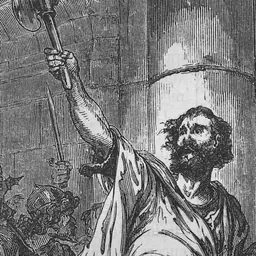
His death was said to have been caused by the severed head of Máel Brigte, whom Sigurd defeated in battle.
Heimskringla and Orkneyinga The two main sources for Sigurd's life are the Norse Heimskringla and Orkneyinga sagas. According to the sagas, after the Battle of Hafrsfjord unified the Norwegian kingdom in or after 872, the Orkney and Shetland islands became a refuge for exiled Vikings, who raided their former homeland. The king of Norway, Harald Fairhair, subdued the pirate Vikings with the aid of Rognvald Eysteinsson of Møre.
During the conquest, Rognvald's son, Ivar, was killed, and in compensation for his loss Harald gave Rognvald the islands along with the title of Jarl or Earl. With the consent of Harald, Rognvald transferred the title and lands to his brother Sigurd, who was one of Harald's forecastlemen. The Historia Norwegiæ, written around the same time as the sagas but from a different source, corroborates the conquest of the islands by Rognvald's family, but omits any details. His exploits in conquering the north of Scotland became legendary and earned him the epithet, "the Mighty",
Sigurd's death was apparently followed by a period of instability. He was succeeded by his son Guttorm, who died within a few months. Rognvald made his son Hallad Earl of Orkney, but Hallad could not contain the pirate Vikings, resigned his earldom and returned to Norway in disgrace. The sagas say that Rognvald's other sons were more interested in conquering places other than Scotland, and so the earldom was given to Rognvald's youngest son, Einarr, whose mother was a slave.
Don’t just read it —
keep it.
Full-length biographies made to live with: read them, listen on the way to work, watch them tonight.
- E-book
- Audio
- Video
Instant download · yours to keep · every purchase keeps this site free
Important facts
People in Sigurd Eysteinsson's life
Named in this biography and alive at the same time


Contemporaries
People whose lives overlapped Sigurd Eysteinsson's


Frequently asked questions
Who was Sigurd Eysteinsson?
Viking warlord, Earl of Orkney
When was Sigurd Eysteinsson born?
Sigurd Eysteinsson was born in 850 in Møre og Romsdal.
When did Sigurd Eysteinsson die?
Sigurd Eysteinsson died in 890 in Dornoch.
Sources & further reading
· Wikipedia: Sigurd Eysteinsson
Cite this page
APA: Biography.guide. (2026). Sigurd Eysteinsson. https://biography.guide/sigurd-eysteinsson/
MLA: "Sigurd Eysteinsson." Biography.guide, https://biography.guide/sigurd-eysteinsson/.
Chicago: "Sigurd Eysteinsson." Biography.guide. https://biography.guide/sigurd-eysteinsson/.
Data last updated: 2026-09-20 · Spot an error? Report a correction.
Page generated 2026-09-27 05:29 UTC